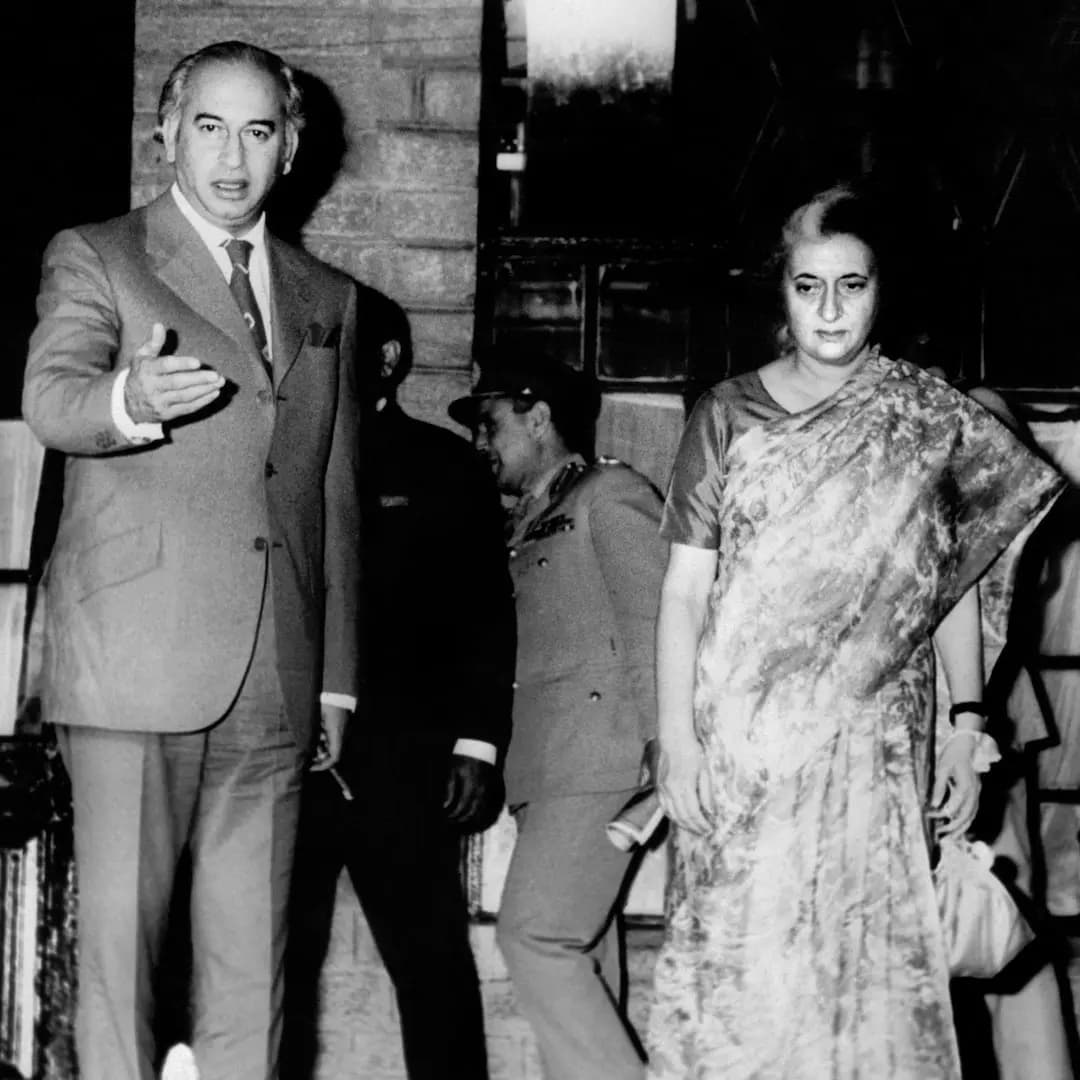
In the early hours of 3 July 1972, in the hill town of Shimla, Prime Minister Indira Gandhi and Pakistan's President Zulfikar Ali Bhutto signed a document meant to close the chapter of the 1971 war. Fifty-three years later, that document has been declared "dead" by Islamabad. What was designed to hold two nuclear-armed neighbours to peaceful, bilateral dialogue is, as of mid-2026, a treaty neither side is bound by in practice.
1. The Historic Framework: Who, What, and Where
The original agreement was signed by Prime Minister Indira Gandhi on behalf of India and President Zulfikar Ali Bhutto on behalf of Pakistan. The pact followed Pakistan's decisive defeat in the 1971 war and was intended to normalise relations, restore territory and diplomatic ties, and provide a strict mechanism for resolving future disputes bilaterally, reducing the scope for international intervention on Kashmir.
The negotiations and the signing took place in Shimla, Himachal Pradesh, at Barnes Court (now Raj Bhavan). The agreement's core geographic consequence, the Line of Control (LoC), runs through Jammu and Kashmir and remains the de facto boundary between Indian- and Pakistan-administered territory.
The Simla Agreement committed both countries to settle disputes, including Kashmir, through peaceful bilateral negotiation without third-party mediation. It converted the 1971 ceasefire line into the Line of Control, with both sides agreeing not to alter it unilaterally. It also accompanied the return of over 13,000 square kilometres of captured territory and the release of more than 90,000 Pakistani prisoners of war. Reached through direct, high-level negotiation following weeks of contentious talks over how Kashmir would be referenced, the agreement was signed on 2 July 1972, dated for the day talks concluded, though the signing itself took place after midnight on 3 July. It remained the reference framework for India-Pakistan relations for the following five decades.
2. The Breakdown: Where Things Stand Now
The contemporary breakdown began in April 2025, following a devastating terror attack on tourists in Pahalgam, Jammu and Kashmir, that killed at least 26 people. In response, India placed the Indus Waters Treaty in abeyance and imposed a set of strict diplomatic and economic measures against Pakistan. On 24 April 2025, Pakistan retaliated by announcing the immediate suspension of the Simla Agreement, alongside the closure of the Wagah border, a total halt to bilateral trade, the shutting of its airspace to Indian carriers, and the expulsion of Indian military diplomats.
Pakistani officials initially described the move as holding the agreement "in abeyance." However, by June 2025, Islamabad went further, officially declaring the treaty a "dead document." India has not recognised Pakistan's right to unilaterally suspend a bilateral treaty and continues to cite the Simla framework, including the core bilateralism principle on Kashmir, as its own position of record.
“Analysts on both sides note that with the treaty's bilateral machinery suspended, the Line of Control lacks its original restraining mechanism, since neither government is now formally committed to refraining from altering it unilaterally. This absence of a jointly recognised framework was cited as a major contributing factor in the four-day military confrontation between the two countries in May 2026, the most serious escalation along the LoC since the treaty's suspension began.”
3. Geopolitical Outlook
As of this reporting, no bilateral talks have been announced to restore or replace the Simla framework. Both governments firmly maintain their respective positions:
Pakistan: Holds that the agreement no longer binds it following India's actions on the Indus Waters Treaty.
India: Maintains that the 1972 framework, and its strict bilateral approach to Kashmir, remains its position regardless of Pakistan's declared suspension.
Notice: This report reflects publicly available statements and documented events as of July 2026. Readers are encouraged to follow official communications from the Ministry of External Affairs, Government of India, and Pakistan's Ministry of Foreign Affairs for further developments.
The COSMINNOX Policy & Diplomacy Report • Strategic Analysis Division • July 2026