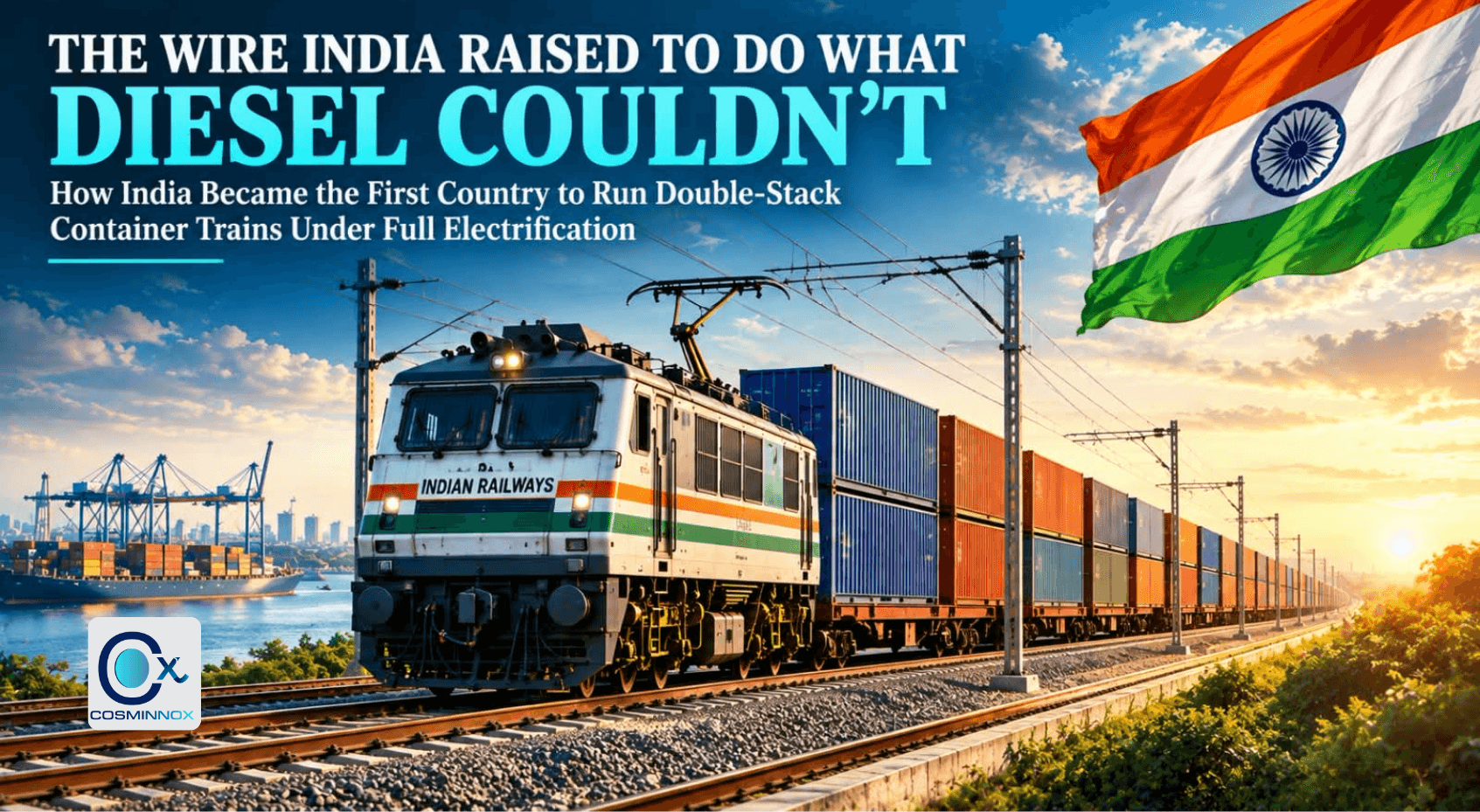
The US, China, Canada and Australia have run double-stack container trains for decades. All still haul them with diesel. India now runs them under live overhead wire — the first country to do so at scale on a fully electrified network. Is this a genuine engineering breakthrough the others couldn't manage, or an infrastructure choice the others simply didn't make? The evidence points to the second, more interesting answer: India didn't out-engineer the world so much as build the one thing the others' freight economics never justified — a dedicated, high-clearance electrified corridor from scratch.
01 THE PROBLEM, STATED PLAINLY
A double-stacked container rides roughly 20 feet off the rail — well above the clearance most electrified lines were ever built for. Standard overhead traction wire, including on most of Indian Railways' own conventional network, sits around 5.5 metres up. A loaded double-stack car needs more room than that to pass beneath it without fouling the wire. That single clearance conflict is why, worldwide, double-stack and electrification have historically been an either/or choice.
Country | Double-stack since | Traction | Why |
United States | 1984 | Diesel | Vast pre-existing freight network never built for electrification; diesel runs anywhere on the system |
China | — | Diesel (on double-stack routes) | Double-stack routes largely outside the electrified passenger/freight backbone |
Canada | — | Diesel | Shared freight network predates modern electrification planning |
Australia | — | Diesel | Older tunnels/bridges and freight-only lines built without electrification in mind |
India | 2020 (trial), 2026 (full corridor) | Electric | Purpose-built freight corridor designed for double-stack and electrification together |
Table 1. Snapshot comparison of double-stack traction across major rail nations.
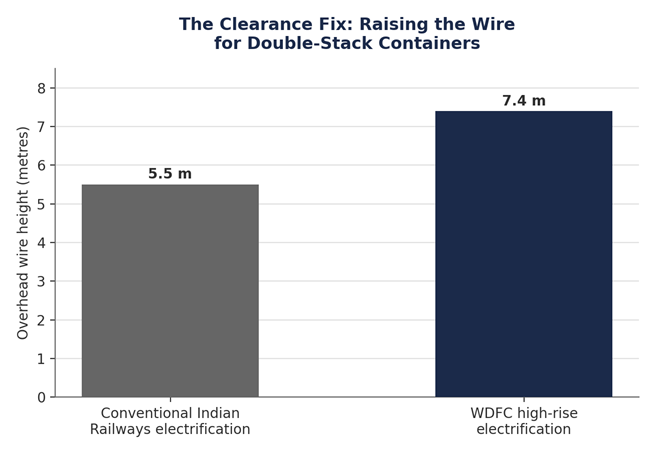
Figure 1. Overhead wire clearance: conventional Indian Railways electrification vs. the WDFC's high-rise electrification.
02 WHAT INDIA ACTUALLY BUILT
India's answer was the Western Dedicated Freight Corridor (WDFC) — a 1,506-km, double-line, freight-only electrified route from Jawaharlal Nehru Port near Mumbai to Dadri in Uttar Pradesh, built by the Dedicated Freight Corridor Corporation of India (DFCCIL), a Ministry of Railways public-sector undertaking. DFCCIL raised its overhead wire to roughly 7.4 metres — about two metres higher than conventional Indian Railways electrification — specifically to clear double-stacked wagons.
Source: DFCCIL press release, 29 May 2019
The first electric double-stack run under this high-rise wire took place on 10 June 2020, on the Palanpur–Botad section in Gujarat, which DFCCIL and the Ministry of Railways described at the time as a world first.
Source: Business Standard, 12 June 2020
The WDFC's final 102-km section, between JNPT and New Saphale, was commissioned in March 2026, completing the corridor end to end. In August 2026, Indian Railways ran its first full long-haul double-stack service on the completed line — a 422-km JNPT-to-Vadodara run carrying 360 TEUs across a 1.3-km train. WDFC trains are designed for speeds up to 100 km/h against 75 km/h on conventional Indian Railways track, with average freight speeds targeted to rise from roughly 26 km/h to 70 km/h.
Source: The Week, 23 August 2026; Maritime Gateway, 2026
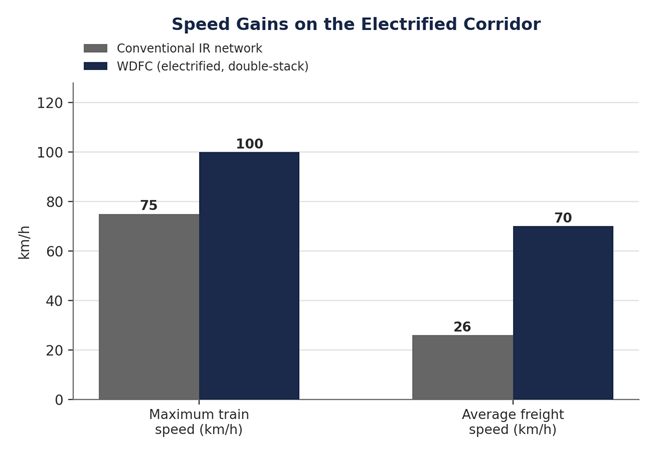
Figure 2. Speed gains: conventional Indian Railways track vs. the electrified, double-stack WDFC.
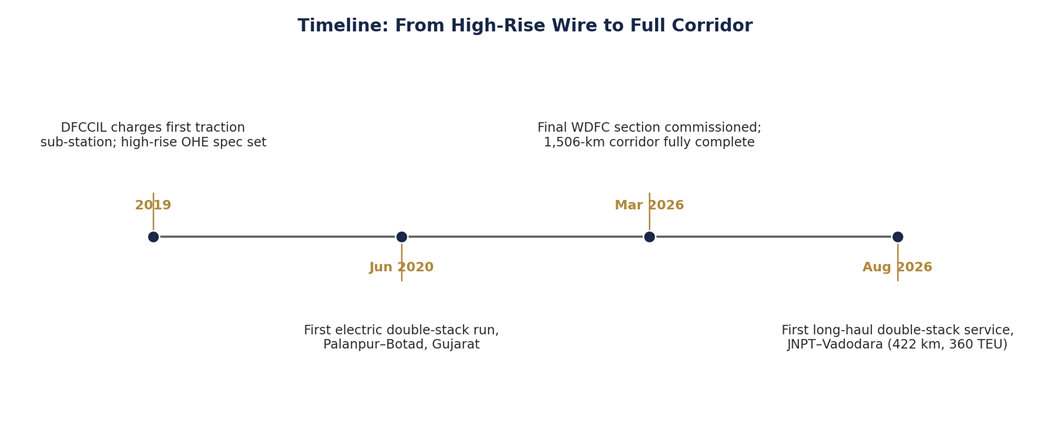
Figure 3. Timeline from the 2019 high-rise OHE spec to the August 2026 first long-haul double-stack service.
03 WHY EVERYONE ELSE STAYED ON DIESEL
The comparison isn't a story of others failing where India succeeded. In the United States, the US Congressional Research Service notes that freight railroads have stuck with diesel chiefly because most of the network was never built for electrification at all: diesel locomotives can run anywhere on the system, while electric traction would be stranded on whichever segments actually had wire, and retrofitting older bridges and tunnels for double-stack clearance under catenary carries its own separate cost.
Source: Congressional Research Service, IF12707, 21 Jan 2025
Reporting on China, Canada and Australia's double-stack operations points to a similar pattern — extensive diesel-hauled double-stack networks built over decades on track that predates, and was never re-engineered for, full electrification. India's advantage was starting later and narrower: the WDFC is a single, purpose-built freight corridor, not a retrofit of a century-old general-purpose network. That made it possible to design clearance and electrification together from the first survey stake, rather than reconciling them after the fact.
04 THE BOUNDED CLAIM
What the record supports is specific: India has become the first country to run double-stack container trains under conventional overhead electrification on a fully operational, at-scale freight corridor — a claim DFCCIL and the Ministry of Railways have made directly and that trade press has not disputed. What it does not support is the inference that the US, China, Canada or Australia lack the technical capability to do the same. Their diesel-haulage is better explained by the economics of retrofitting vast, shared, already-built freight networks than by any inability to raise a wire. India's edge is that it had a comparatively clean sheet — 1,506 km of new, freight-dedicated track — and chose to design it for double-stack and electrification together from day one.