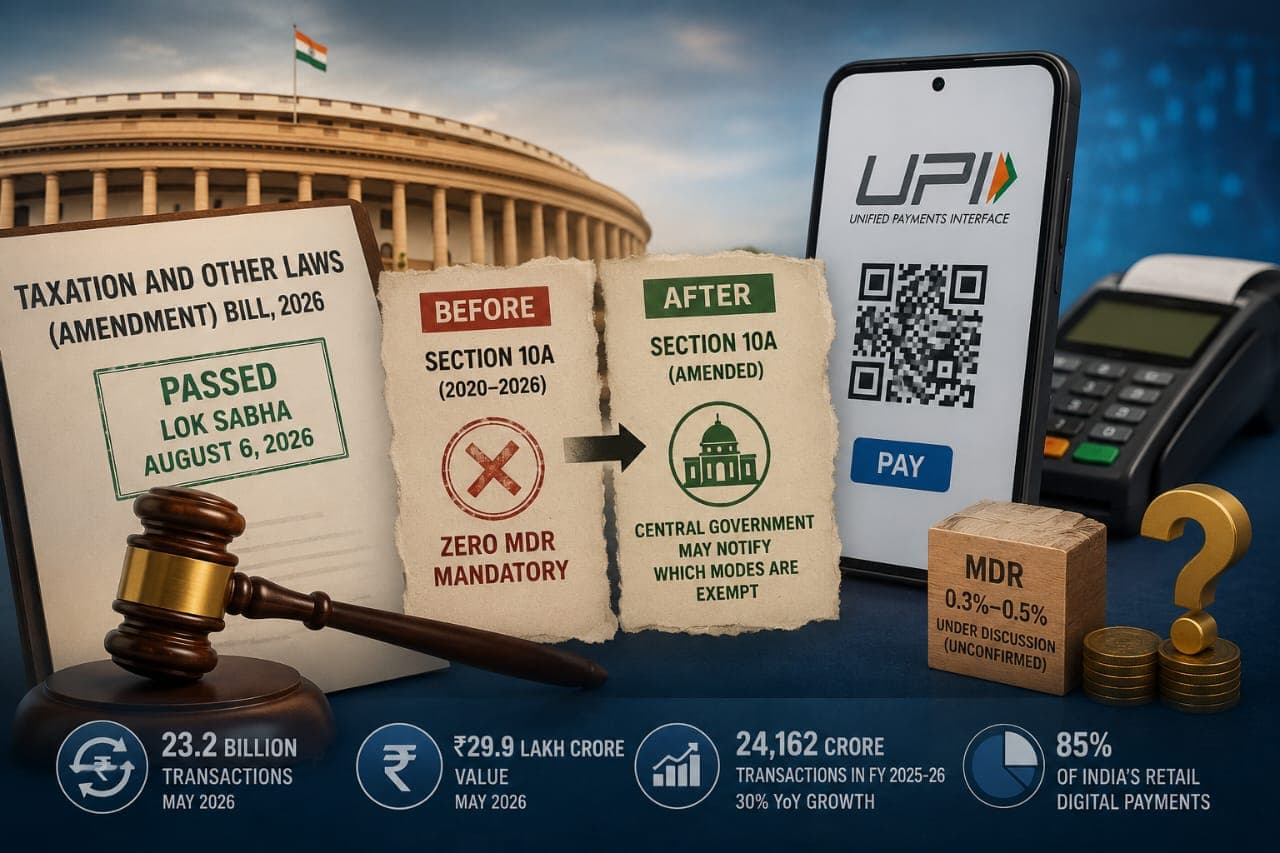
Did Parliament just impose a fee on UPI, or merely remove the law that made a fee illegal? The evidence supports the second, narrower reading. The Taxation and Other Laws (Amendment) Bill, 2026, passed by the Lok Sabha on August 6, 2026 by voice vote, does not fix any Merchant Discount Rate (MDR) or notify any charge. It deletes a six-year-old legal prohibition and hands the decision on if, when, and how much to charge to the Central Government and an NPCI-led committee that has not yet ruled
What Section 10A Actually Said — and What Replaces It
Since 2020, Section 10A of the Payment and Settlement Systems Act, 2007 barred banks and payment system providers from charging, directly or indirectly, on electronic payment modes prescribed under Section 269SU of the Income-tax Act — the provision under which UPI and RuPay debit cards were designated zero-MDR instruments. The amendment strips out that fixed reference and replaces it with a floating one: the Central Government may now notify, by executive order, which electronic payment modes stay exempt. Everything not notified is, by omission, no longer legally protected from charges. Finance Minister Nirmala Sitharaman introduced the Bill on August 4, 2026, and it cleared the Lok Sabha amid continuous Opposition sloganeering during the Monsoon Session, without substantive floor debate.
Who Decides Next, and When
The Bill itself sets no MDR figure and no effective date. Sitharaman stated on X that the NPCI-headed UPI and Services Steering Committee has yet to take a decision on MDR, and that this can only happen once the Bill clears both Houses. Reports have floated a range of 0.3–0.5% on UPI transactions above ₹2,000 as under discussion, but this figure has not been confirmed by the government and should be read as speculative pending an official notification.
The Commercial Stakes
UPI is not a marginal rail. NPCI data show the network processed 23.2 billion transactions worth ₹29.9 lakh crore in May 2026 alone, and FY 2025-26 volume reached 24,162 crore transactions, up 30% year-on-year, accounting for roughly 85% of India's retail digital payments. That scale, at zero MDR, has meant payment apps monetize UPI indirectly — through lending, insurance cross-sell, or ancillary fees — rather than the transaction itself. PhonePe and Google Pay held a combined 79% of UPI volume in May 2026, the first time that duopoly share dipped below 80% since app-level NPCI data began publishing. PhonePe, which paused its IPO process in March 2026 citing market volatility while targeting a $12–15 billion valuation, currently earns no direct payment revenue from UPI; any future MDR notification would be the first legal opening for such a revenue line since 2020.
Counter-Evidence: The Contested Claim
Two claims are in direct conflict and neither is resolved by the legislative text itself. The government's position, stated by Sitharaman, is that any MDR "applies only on the merchants and not on the end users/customers”. Congress leader Jairam Ramesh countered that the burden of MDR would ultimately fall on ordinary people, and called the government's sustainability argument "entirely wrong". Both are on-record political positions, not adjudicated facts; the Bill's text is silent on incidence, since it authorizes rather than sets any charge.
What the Evidence Establishes — and What It Doesn't
The amendment is confirmed: Section 10A no longer contains a blanket, statute-level ban on UPI charges. What remains unconfirmed is everything downstream — whether any mode will actually be notified for charging, at what rate, on which transaction sizes, and whether the incidence falls on merchants alone as the government asserts. Until the Steering Committee reports and a notification is issued, the accurate description is a change in legal authority, not a change in price.
Sources
Upstox: "Can govt now levy charges on UPI payments? What the proposed law means for merchants, customers," August 2026. https://upstox.com/news/business-news/latest-updates/can-govt-now-levy-charges-on-upi-payments-what-the-proposed-law-means-for-merchants-customers/article-198296/
TechTimes: "India Opens Door to UPI Merchant Fees as Parliament Amends Six-Year Zero-MDR Law," August 4, 2026. https://www.techtimes.com/articles/322958/20260804/india-opens-door-upi-merchant-fees-parliament-amends-six-year-zero-mdr-law.htm
Vajiram & Ravi: "Lok Sabha Passes Bill To Allow Charges On UPI," August 2026. https://vajiramandravi.com/current-affairs/lok-sabha-passes-bill-to-allow-charges-on-upi/
Sahi: "UPI Charges After Lok Sabha Bill," August 2026. (Tier 3 — reported MDR range of 0.3–0.5% is unconfirmed by government; flagged as speculative in text.) https://www.sahi.com/blogs/upi-mdr-new-bill-explained
CoinLaw: "UPI Statistics 2026: 23.2 Billion Monthly Transactions and 49% of Global Real-Time Volume," June 2026. https://coinlaw.io/upi-statistics/
Outlook Business: "PhonePe, Google Pay Combined UPI Market Share Drops Below 80% For First Time," June 2026. https://www.outlookbusiness.com/economy-and-policy/phonepe-google-pay-combined-upi-market-share-drops-below-80-for-first-time
Free Press Journal: "Lok Sabha To Take Up Taxation Amendment Bill 2026 Today: UPI MDR Return, FDI Incentives Proposed," August 2026. https://www.freepressjournal.in/business/lok-sabha-to-take-up-taxation-amendment-bill-2026-today-upi-mdr-return-fdi-incentives-proposed