THE QUESTION THIS PIECE ANSWERS Does the evidence support the Congress claim that the government's move to permit fees on UPI is a response to US trade pressure — or is the record confined to a funding-sustainability rationale from the government, with the “US pressure” charge remaining a political allegation rather than a documented cause? |
Legal vehicle | Taxation and Other Laws (Amendment) Bill, 2026 — amends S.10A, PSS Act 2007 |
Passed Lok Sabha | August 6, 2026 |
Proposed MDR | ≈ 0.25%–0.4% on business UPI transactions above ₹2,000 |
Exempt | Person-to-person transfers; small-merchant transactions |
Deciding body | NPCI-led UPI and Services Steering Committee (ruling pending) |
Estimated annual revenue | ₹5,000–10,000 crore by FY28 (Jefferies estimate) |
01 WHAT ACTUALLY CHANGED
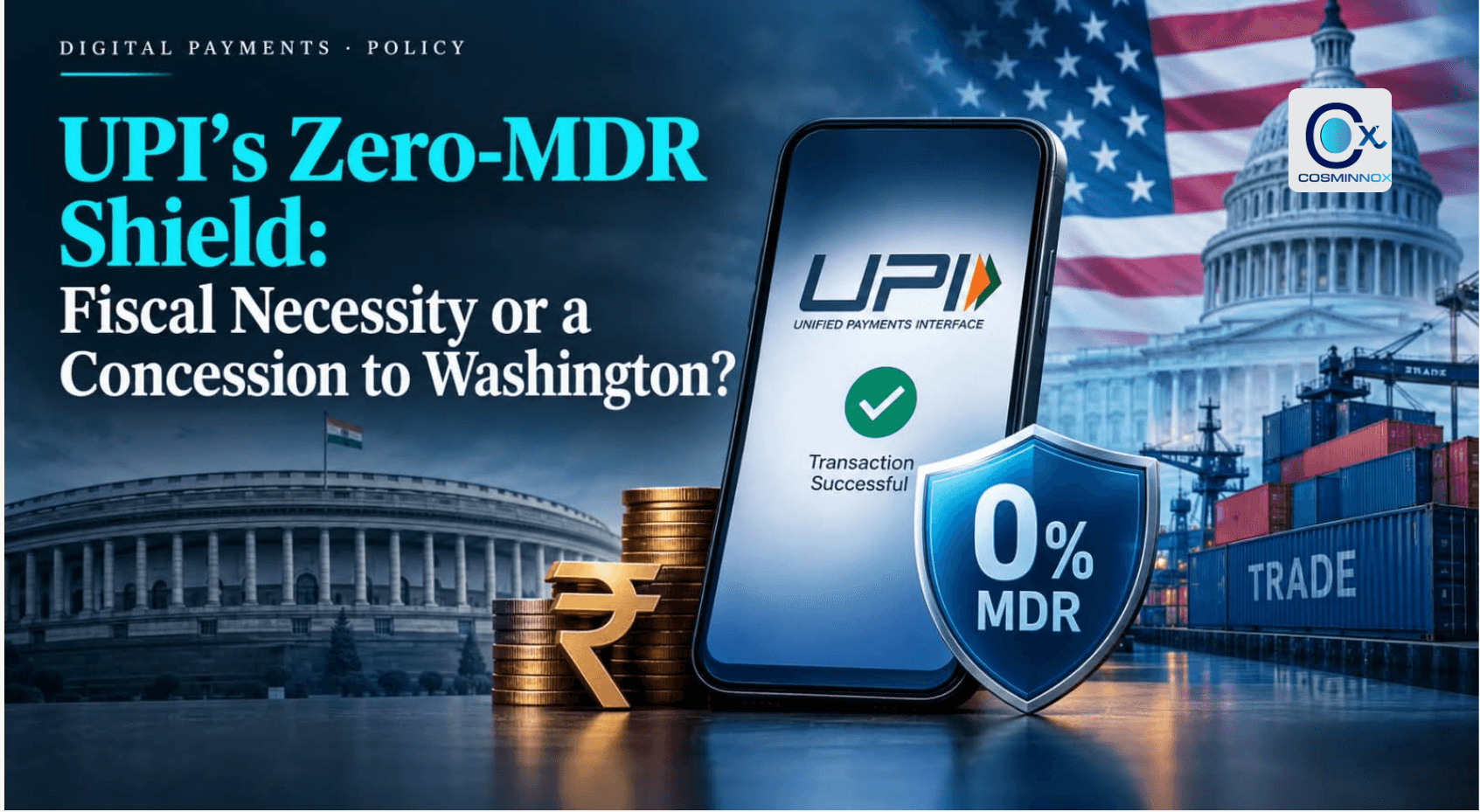
The legal basis is the Taxation and Other Laws (Amendment) Bill, 2026, passed by the Lok Sabha on August 6. It amends Section 10A of the Payment and Settlement Systems Act, 2007 — the provision that, since January 2020, has barred any charge on UPI transactions. The amendment replaces that blanket protection with a discretionary power: the government may now notify by gazette which electronic payment modes stay free, implicitly opening the door to charging others.
Source: The Wire, “Jairam Ramesh alleges US pressure in UPI fee Bill,” Aug 8, 2026
Under the framework reported so far, a Merchant Discount Rate of roughly 0.25%–0.4% is expected on business-directed UPI transactions above ₹2,000, with person-to-person transfers and small-merchant transactions exempt. The final rate, threshold and merchant eligibility have not been finalised; that decision now sits with the NPCI-led UPI and Services Steering Committee, which meets only after the Bill clears Parliament. Brokerage estimates from Jefferies put potential annual MDR revenue at ₹5,000–10,000 crore by FY28.
Sources: Inc42, “Payments Council Rules Out Consumer MDR,” Aug 2026; Deccan Herald, “NPCI-headed panel yet to decide on MDR charges: FM Sitharaman,” Aug 2026
02 THE GOVERNMENT'S STATED RATIONALE
Finance Minister Nirmala Sitharaman has argued the amendment is an enabling provision, not an automatic fee, framing it as necessary to fund infrastructure, fraud prevention and cybersecurity investment as UPI scales — noting UPI processed 2,366 crore transactions worth ₹29.9 lakh crore in July 2026 alone. This traces back to a March 2025 Payments Council of India letter citing UPI's roughly ₹10,000 crore annual maintenance cost against a government subsidy of about ₹1,500 crore.
Sources: Free Press Journal, “No UPI Charges For Users, But Nominal MDR May Apply,” Aug 2026; The Week, Aug 8, 2026
03 THE OPPOSITION'S CHARGE
Congress general secretary Jairam Ramesh has disputed the government's framing directly, calling Sitharaman's defence “five dubious claims” and arguing the amendment dismantles UPI's statutory zero-fee guarantee. He has pointed specifically to the US Trade Representative's 2026 National Trade Estimate Report, which criticised UPI and RuPay — alongside Brazil's Pix — for displacing Visa and Mastercard market share, arguing the Bill's timing raises questions about US pressure. Ramesh separately contends merchants will pass MDR costs to consumers despite the government's assurance otherwise.
Source: Deccan Herald, Aug 2026
04 COUNTER-EVIDENCE
Two things weigh against a confirmed causal link. First, RBI Governor Sanjay Malhotra has called it “premature” to say how any MDR cost will ultimately be distributed, and the NPCI steering committee has not yet ruled. Second, the domestic funding-gap rationale — the PCI's 2025 letter — predates the USTR report and reflects a longer-running industry ask, independent of any US trade complaint.
Source: Inc42, “Talks On MDR On UPI At A Premature Stage,” 2026
05 RESOLUTION
Two facts in this dispute are independently verifiable: the amendment does remove UPI's blanket statutory fee protection for the first time since 2020, and the USTR's 2026 National Trade Estimate Report did single out UPI and RuPay for displacing card networks shortly before the Bill's passage. What the record does not contain is a primary document — from the government, the USTR, or trade-negotiation correspondence — linking the two as cause and effect. The “US pressure” claim, as things stand, is Jairam Ramesh's political reading of the timing, contested by the Finance Ministry, and the final MDR framework itself remains undecided pending the NPCI steering committee's ruling. The evidence supports the coincidence in timing; it does not yet establish causation.
© The Cosminnox · IDC Innovation Development Council, India