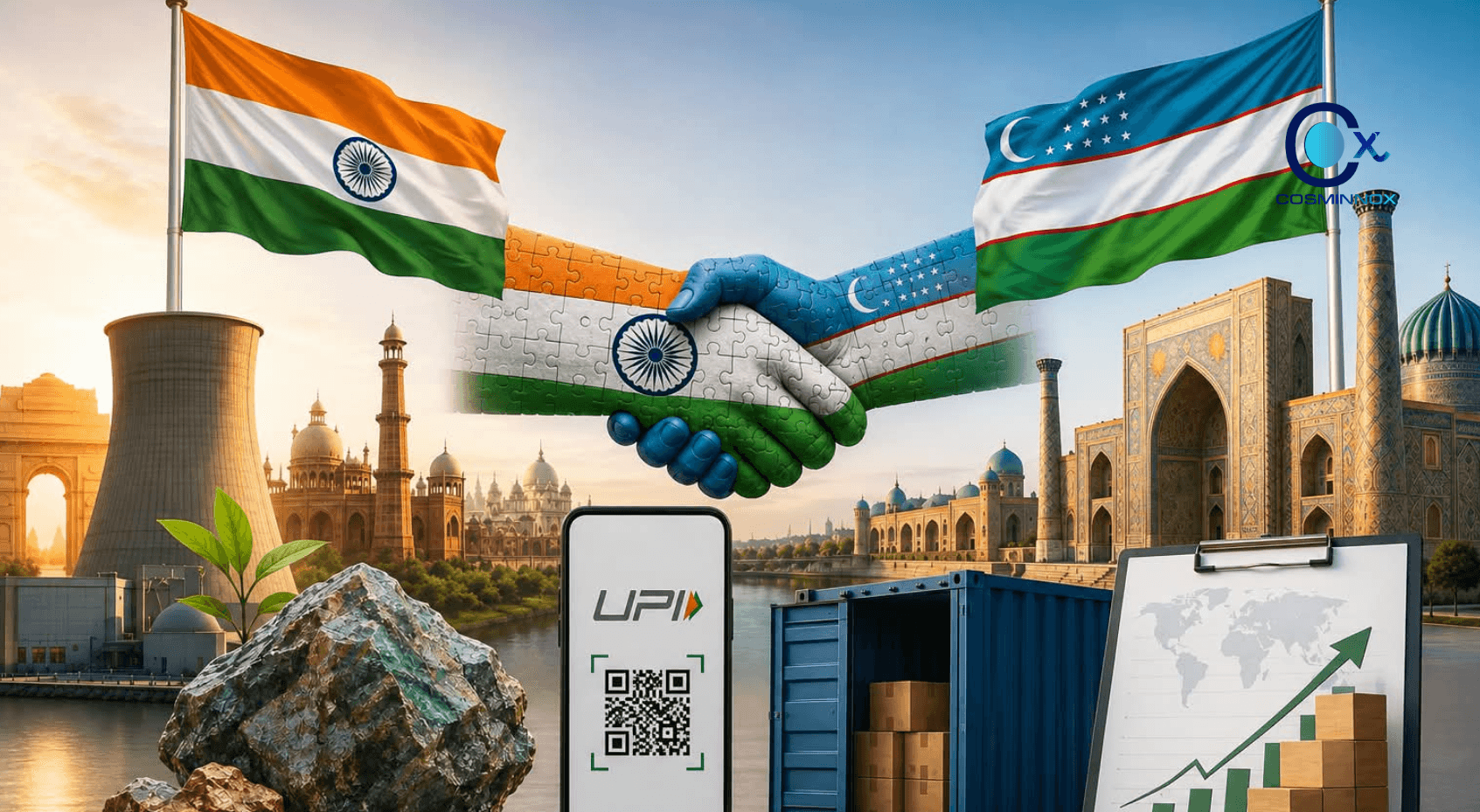
The record from Prime Minister Modi's August 29–30 state visit to Tashkent supports a more precise answer than the headline framing suggests. The $5 billion figure itself is the bilateral trade target the two countries set for 2030, up from roughly $1 billion in current annual trade [Business Standard, ANI, 30 August 2026] — not the value of a uranium, minerals, or UPI deal. The uranium supply arrangement, the mining MoU, and the UPI commercial pact are three separate, undated-in-value outcomes announced alongside that target, and each carries a different degree of completion.
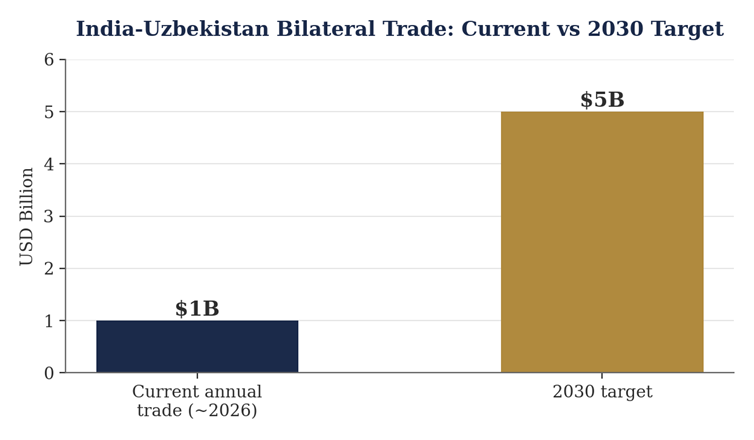
Figure 1: The $5 billion figure is a 2030 trade target, not a deal value. Source: Business Standard, ANI (30 Aug 2026).
OUTCOMES AT A GLANCE
Outcome | Status | What It Secures |
UPI–UZQR payments | Signed | Commercial agreement between NPCI International and Uzbekistan's National Interbank Processing Centre; rollout expected within ~1 year. |
Uranium supply | Not yet signed | Renewal of a contract expiring 2026; volumes/pricing undisclosed; MEA says signing expected “very shortly.” |
Critical minerals | MoU only | Geology/mining cooperation framework; no specific mineral offtake, asset, or investment figure disclosed. |
Diplomatic status | In effect | Ties elevated to Comprehensive Strategic Partnership; ministerial-level oversight mechanism created. |
THE ENERGY SECURITY CASE
India's nuclear expansion runs on imported fuel: domestic uranium production covers roughly 30% of the ~5,400 tonnes India's reactor fleet needs annually, with imports concentrated among Kazakhstan, Russia, Uzbekistan and Canada [Parliamentary Standing Committee report, cited in Millennium Post, August 2026]. India's existing long-term Uzbekistan supply contract runs only to 2026 [Millennium Post, August 2026] — meaning the new arrangement functions as a renewal against an expiring deal, not a first-time entry. It is also not yet signed: MEA Secretary (West) Sibi George said the two sides were “closing in to signing of an agreement very shortly” [ANI, 30 August 2026]. What is locked in now is a mining and geology MoU intended to support cooperation “including areas connected with uranium” [ANI, 30 August 2026] — an enabling framework, not a supply contract with volumes or pricing attached.
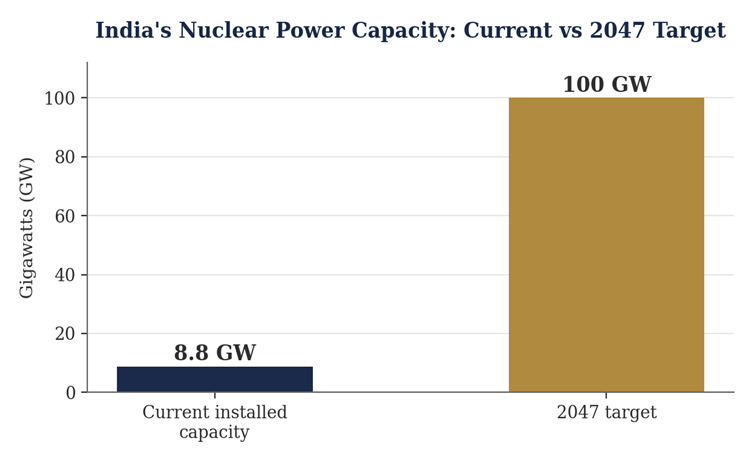
Figure 2: India's nuclear capacity target requires roughly a 12x expansion by 2047. Source: ForumIAS, Rare Earth Exchanges (August 2026).
The strategic logic for India nonetheless holds regardless of signing timeline: the government's target of 100 GW nuclear capacity by 2047 — roughly a twelvefold expansion from today's ~8.8 GW — requires securing fuel well beyond current contracted volumes, and analysts have flagged the concentration of supply among Central Asian and Russian sources as a geopolitical exposure in its own right [Discovery Alert, ForumIAS, August 2026]. A renewed, potentially expanded Uzbekistan channel addresses volume, not that concentration risk — Uzbekistan sits in the same broader risk basket as Kazakhstan and Russia rather than diversifying away from it.
THE CRITICAL MINERALS CASE
The mining and geological resources MoU is the operative document here, and it is explicitly a cooperation framework, not a supply contract. It is expected to “support greater collaboration in mining and critical minerals” [ANI, 30 August 2026], sitting alongside India's separately funded ₹163 billion (~$1.9 billion) National Critical Mineral Mission approved in 2025 to secure 24 minerals including lithium and cobalt through domestic mining and overseas acquisition [Bloomberg, January 2025]. No specific mineral volumes, assets, or investment figures tied to Uzbekistan were disclosed at Tashkent.
THE UPI CASE
This is the most concretely advanced of the outcomes. NPCI International Payments Ltd and Uzbekistan's National Interbank Processing Centre signed a commercial agreement enabling Indian UPI apps to scan Uzbekistan's national UZQR codes for merchant payments, with Indian officials expecting rollout within about a year [Euronews, ANI, 30 August 2026]. Unlike the uranium and minerals outcomes, this is a signed commercial agreement with an implementation timeline, extending UPI's existing interoperability push to a new market.
UPI's international footprint going into this agreement: as of the government's most recent official count, given in the Rajya Sabha in February 2026, UPI-based merchant payments were live in eight countries — the UAE, Singapore, Bhutan, Nepal, Sri Lanka, France, Mauritius and Qatar [PIB, Ministry of Electronics and IT Rajya Sabha reply, 6 February 2026]. Cambodia was added in June 2026 through an NPCI International partnership with ACLEDA Bank via Cambodia's national KHQR system, taking the count to nine per subsequent media reporting [Vajiram & Ravi, June 2026] — Uzbekistan would become the tenth if the arrangement goes live as planned.
THE DIPLOMATIC RELATIONS CASE
Separate from the three sectoral outcomes, the visit changed the structural architecture of the relationship itself. India and Uzbekistan elevated ties from a Strategic Partnership (established 2011) to a Comprehensive Strategic Partnership, and created a new Foreign Ministers-led mechanism for high-level coordination, while raising the existing Intergovernmental/Joint Commission from secretary-level to ministerial-level oversight [ANI, 30 August 2026]. MEA Secretary (West) Sibi George described this framework as the structural basis for taking “our bilateral cooperation forward” across sectors [ANI, 30 August 2026].
Two concrete diplomatic markers followed from this: Modi was conferred the 'Oliy Darajali Do'stlik' Order, Uzbekistan's highest state honour for a foreign leader [ANI, 30 August 2026], and India announced it will host the next India-Central Asia Summit [ANI, 30 August 2026] — positioning New Delhi, rather than a Central Asian capital, as convenor of the region's next multilateral engagement. Sub-national diplomacy also expanded, with a new Gujarat-Samarkand state partnership added to the existing Gujarat-Andijan link [ANI, 30 August 2026].
The diplomatic significance of ministerial-level upgrades and honorific awards is real but structurally different from the sectoral outcomes above: it raises the institutional ceiling for future cooperation and signals political priority, without itself constituting a resource, revenue, or market-access gain. Its value shows up in whether the elevated architecture translates into the pending uranium and minerals agreements closing faster than they otherwise would — a causal claim this record cannot yet verify, since the elevation and the pending agreements were announced simultaneously rather than sequentially.
WHAT THE RECORD DOES AND DOESN'T ESTABLISH
The visit produced one signed, dated payments agreement; a genuine diplomatic upgrade in institutional architecture; and two forward-looking frameworks — a mining MoU and a uranium arrangement still being finalized — bundled under a $5 billion figure that is actually an unrelated trade target. That is a real distinction worth holding onto rather than smoothing over for narrative effect.
THE RESOLUTION: India's tangible, near-term gain from this visit is the UPI–UZQR interoperability agreement (signed, timelined) plus a genuine diplomatic upgrade — Comprehensive Strategic Partnership status, ministerial-level oversight, and host rights for the next India-Central Asia Summit. The nuclear-fuel and critical-minerals gains are directionally positive but remain commitments-in-progress, not secured supply. The open variable: whether the elevated diplomatic architecture translates into the uranium agreement being signed with disclosed volumes and pricing in the coming weeks, and whether the mining MoU yields a specific offtake or investment deal within the year. Until then, “secured” overstates the resource side, even as the diplomatic upgrade is already banked.
Sources: ANI (30 Aug 2026), Business Standard (30 Aug 2026), Euronews (30 Aug 2026), Navhind Times (30 Aug 2026), Millennium Post (August 2026), ForumIAS (August 2026), Discovery Alert (August 2026), Bloomberg (January 2025). Figures current as of publish date (31 Aug 2026); the uranium agreement's terms should be checked against the final signed text once available.