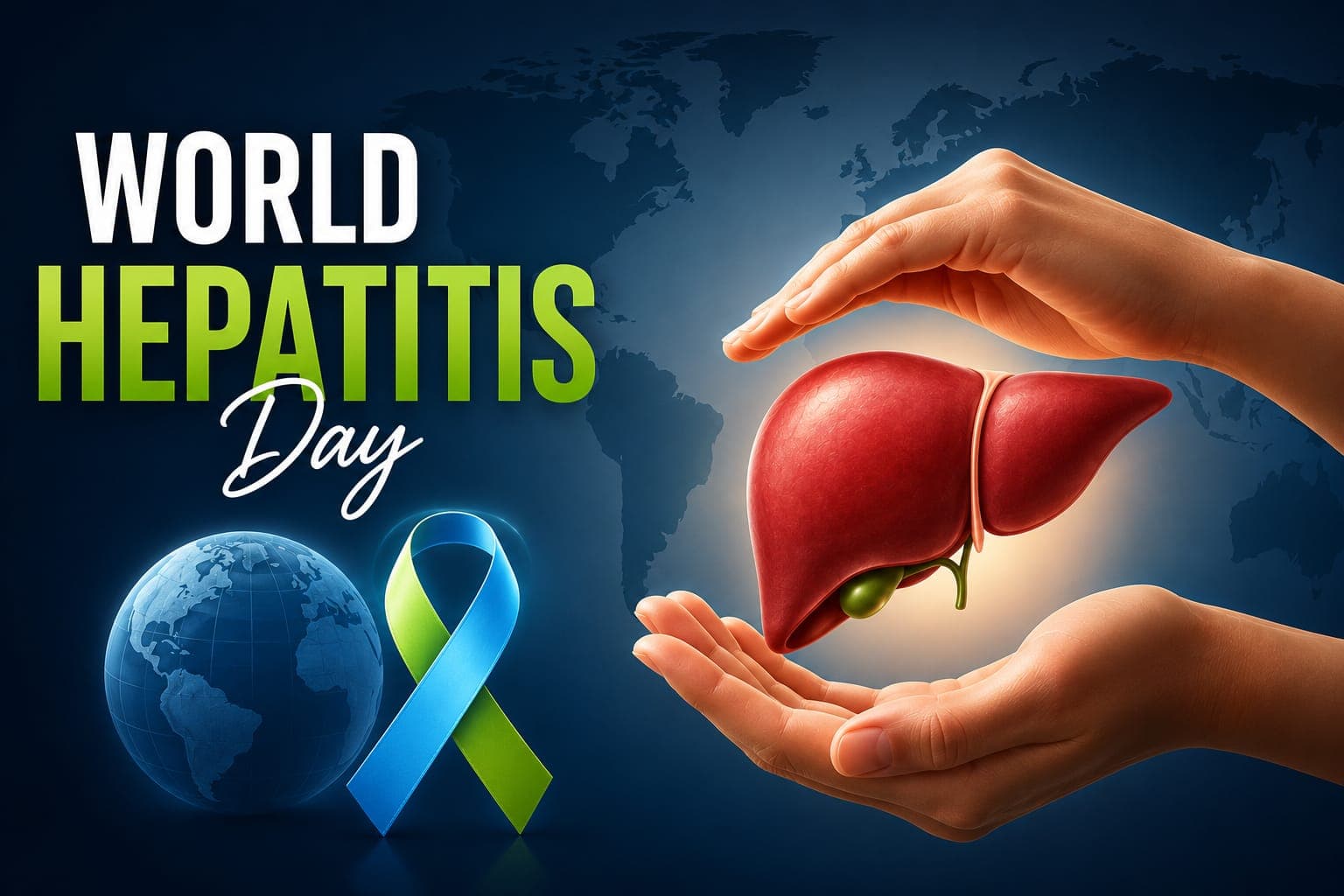
World Hepatitis Day is observed every year on July 28, marking the birthday of Dr. Baruch Blumberg, the scientist who discovered the hepatitis B virus and developed the first vaccine against it. The World Health Organization (WHO) coordinates the day globally, but for India the observance carries particular weight: the country is counted among the world’s highest hepatitis-burden nations. (Source: Boldsky; Medindia)
This Year’s Theme: “Let’s Break It Down”
The global theme for 2026 is “Hepatitis: Let’s Break It Down,” a call to remove the financial, social, and health-system barriers — including stigma and misinformation — that stop people from accessing testing, vaccination, and treatment. WHO says the tools needed to eliminate hepatitis already exist, including curative treatment for hepatitis C and effective long-term therapy for hepatitis B, but millions of people worldwide remain undiagnosed. (Source: WHO)
India’s Disease Burden
India is estimated to have around 29 million people living with chronic hepatitis B and 5.5 million with hepatitis C, according to figures cited in recent reporting on the country’s elimination efforts. India’s National Viral Hepatitis Control Programme (NVHCP), which uses somewhat broader estimates, puts the number at roughly 40 million people with hepatitis B and 6 to 12 million with hepatitis C. Prevalence of chronic hepatitis B infection in the general population is estimated at between 2 and 4 percent. (Source: Medindia; NVHCP; OC Academy)
Among the Worst-Hit Countries Globally
According to the WHO Global Hepatitis Report, India accounts for a substantial share of the world’s hepatitis-related deaths, contributing close to 69 percent of global hepatitis B deaths and 58 percent of global hepatitis C deaths, based on figures reported from the WHO data. India also has the second-largest hepatitis C burden of any country, behind only Pakistan. Globally, hepatitis B and C together are responsible for more than 95 percent of all hepatitis-related deaths. (Source: Omnicuris; OC Academy)
How the Virus Spreads in India
Most hepatitis B infections in the Indian population are acquired in early childhood, commonly through mother-to-child transmission during birth or through unsafe medical exposures such as needle sharing. Because the infection is frequently asymptomatic for years, many people are unaware they are carrying the virus until it progresses to cirrhosis or liver cancer. (Source: OC Academy)
India’s National Response: NVHCP
India rolled out the National Viral Hepatitis Control Programme in 2018 under the National Health Mission, offering free diagnostic testing and free medicines to eligible hepatitis B and C patients. Under the programme, more than 34 crore (340 million) people have been screened for hepatitis B and C nationally, and around 3 lakh (300,000) patients had been placed on treatment as of March 2024. A separate report citing 2026 WHO-linked data put screening numbers at 21 crore (210 million) people tested through free NVHCP testing. (Source: Medindia; Deccan Herald)
Gaps That Remain in India’s Care System
Public health research reviewing India’s hepatitis care points to barriers at multiple levels. At the community level, limited awareness, stigma, low perceived risk, and the symptomless course of early infection reduce demand for testing. At the health-system level, uneven diagnostic infrastructure, workforce shortages, and inconsistent implementation across states delay diagnosis and treatment. Even though antiviral therapy is provided free under NVHCP, out-of-pocket costs for travel, follow-up visits, and related investigations can cause patients to drop out of care before completing treatment. A separate hospital-based study of blood donors found that although free treatment was available, only about 28 percent of those found positive for hepatitis B, and under 9 percent of those positive for hepatitis C, actually went on to attend a treatment clinic. (Source: International Journal of Community Medicine and Public Health; PMC/NCBI)
The 2030 Elimination Target
India, along with WHO’s other member states, has committed to eliminating hepatitis C and significantly reducing the burden of hepatitis B by 2030, in line with United Nations Sustainable Development Goal target 3.3. Health experts and reviewers tracking India’s progress have recommended expanding nationwide screening, decentralizing testing to reach more districts, improving birth-dose vaccination coverage for newborns, and increasing private-sector involvement in diagnosis and treatment to help the country meet that target. (Source: Medindia; NVHCP)
World Health Organization (WHO): World Hepatitis Day 2026 – Campaign Materials.
Medindia: World Hepatitis Day 2026: Why Breaking Down Barriers Is Key to Eliminating Viral Hepatitis.
Deccan Herald: World Hepatitis Day 2026: India Among Top 10 Countries Contributing to Global Hepatitis B Burden.
National Viral Hepatitis Control Programme (NVHCP): Ministry of Health and Family Welfare, Government of India.
Omnicuris: Hepatitis Burden in India: WHO Report 2026 Analysis.
OC Academy: India’s Viral Hepatitis Burden: WHO Report 2026 Insights.
International Journal of Community Medicine and Public Health: Barriers Across the Hepatitis B and C Care Cascade in India.
PMC/NCBI: Linkage to Care of People With Chronic Hepatitis B Virus and Hepatitis C Virus Infection Among Blood Donors Under the National Viral Hepatitis Control Programme, India.