For decades, Bisleri has been almost synonymous with bottled water in India. Its familiar green label represents more than a commercial product; it represents an expectation of purity, reliability and safety.
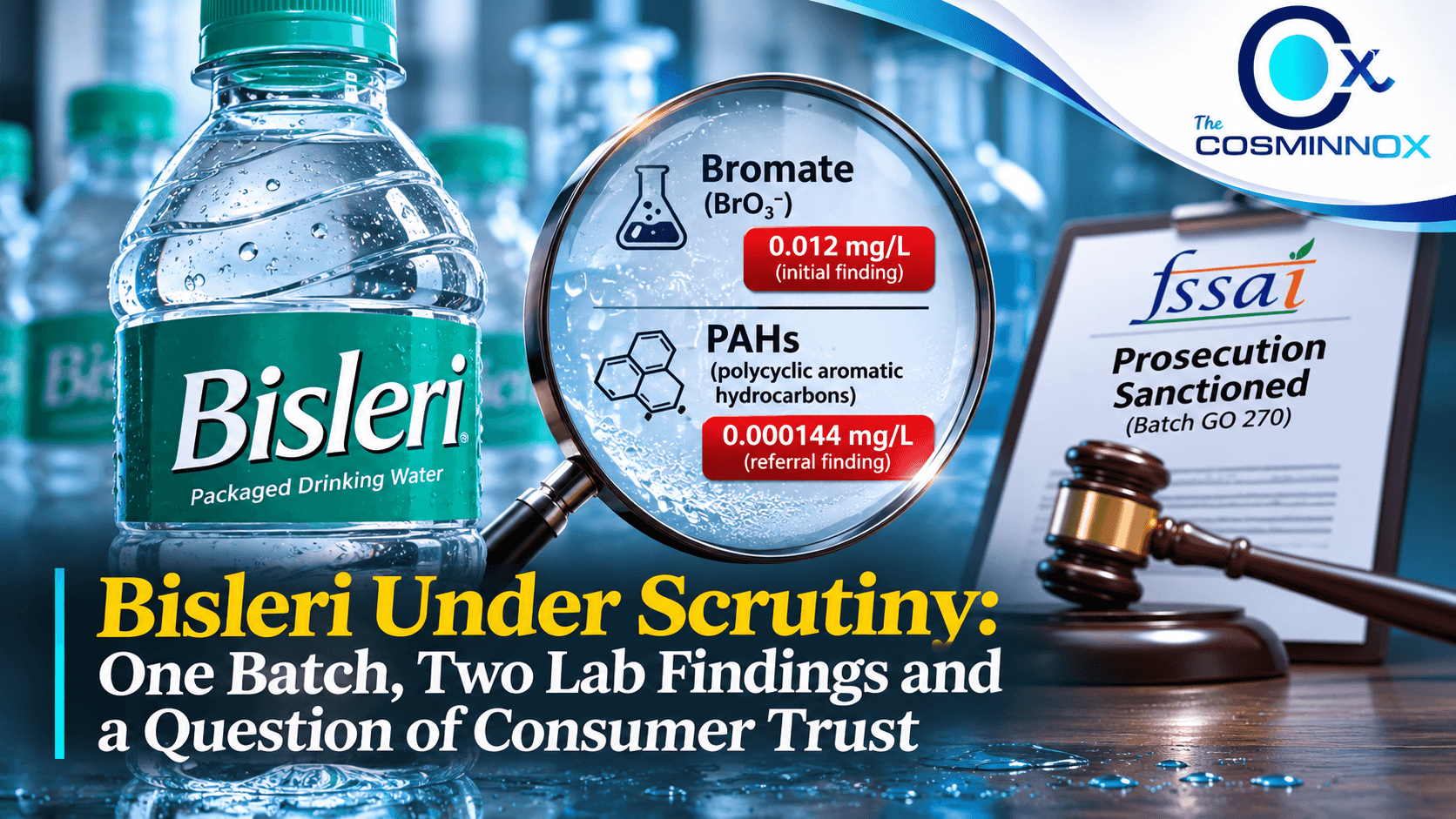
However, the Food Safety and Standards Authority of India's (FSSAI) decision to sanction prosecution following the testing of a sample from Bisleri's Goa manufacturing facility has placed that trust under scrutiny.
The controversy involves two differing laboratory findings, a disputed regulatory outcome and an increasingly competitive packaged drinking water market.
Understanding the episode requires separating established facts from corporate assurances, scientific uncertainties and market speculation.
1. How Bisleri became India's household water brand
Bisleri's origins can be traced to Italy, where its name was associated with a health beverage before becoming part of India's packaged drinking water industry.
The Chauhan family acquired the brand in 1969 and subsequently transformed it into one of India's most recognisable consumer brands.
Year | Development |
1965 | Bisleri bottled water introduced in India |
1969 | Acquired by the Chauhan family for a reported ₹4 lakh |
1980s | Transition from glass bottles to plastic packaging |
1993 | Bisleri retained by Ramesh Chauhan following the sale of several Parle beverage brands to Coca-Cola |
2022–23 | Acquisition discussions with Tata Consumer Products, subsequently discontinued |
2026 | Bisleri reports operating 143 manufacturing plants |
Sources: ThePrint, Business Standard, Deccan Herald and company statements reported in the media.
Bisleri's success demonstrates how a basic necessity can become a powerful branded commodity through distribution, accessibility and consumer confidence.
That confidence is also its most vulnerable commercial asset.
2. Packaged drinking water is not necessarily mineral water
One of the most common misconceptions among Indian consumers is that all bottled water is mineral water.
Under India's food safety framework, packaged drinking water and natural mineral water are distinct product categories.
Parameter | Packaged drinking water | Natural mineral water |
FSSAI regulation | 2.10.8 | 2.10.7 |
BIS standard | IS 14543 | IS 13428 |
Water source | Permitted water sources | Underground natural sources |
Treatment | Permitted purification and treatment processes | Restricted, permitted treatment |
Primary characteristic | Compliance with prescribed safety and quality standards | Naturally occurring mineral composition |
Brand example | Bisleri flagship packaged water | Himalayan, Vedica |
Sources: FSSAI and Bureau of Indian Standards.
The distinction matters because the applicable safety requirements depend on the product's legal classification rather than its popular description.
India's regulatory framework has also evolved. Following the removal of mandatory BIS certification requirements in 2024, FSSAI introduced a testing scheme for packaged drinking water and mineral water, effective from 1 January 2026.
The Bisleri sample at the centre of the controversy was collected before this scheme came into effect.
3. What exactly happened at Bisleri's Goa plant?
According to FSSAI's clarification reported by ANI, the regulatory action concerns batch GO 270 from Bisleri's manufacturing facility in Verna, South Goa.
The case originated in September 2025 and progressed through laboratory testing, an appeal and regulatory action over approximately 14 months.
Timeline of the controversy
Date | Development |
30 September 2025 | Water samples collected from Bisleri's Goa facility |
22 November 2025 | Bisleri appeals the initial laboratory finding |
2 February 2026 | Bisleri says it submitted independent laboratory results to FSSAI |
22 November 2026 | FSSAI reportedly sanctions prosecution |
23 November 2026 | FSSAI clarifies that the action concerns a single batch; Bisleri issues its response |
24 November 2026 | Media reports indicate possible wider scrutiny of packaged water manufacturers |
Sources: ANI, Open Magazine, Hospitality Biz India and Bisleri's reported statements.
The regulator reportedly issued a sale-prohibition order concerning the identified batch and directed a root cause analysis.
Importantly, the sanction for prosecution is not equivalent to a judicial finding of guilt, nor does the reported action constitute a nationwide ban on Bisleri products.
4. One sample, two different laboratory findings
The scientific complexity of the case arises from the differing results of the primary and referral laboratories.
The first laboratory identified bromate above the prescribed limit. The referral laboratory subsequently found bromate within the permissible limit but reported the presence of polycyclic aromatic hydrocarbons (PAHs).
Testing authority | Bromate | PAHs |
Primary laboratory | 0.012 mg/L | Below 0.00001 mg/L |
Referral laboratory | Within permissible limit | 0.000144 mg/L |
Independent laboratory commissioned by Bisleri | Within permissible limit, according to Bisleri | Not disclosed in the reported company statement |
Source: FSSAI clarification reported by ANI and Bisleri's response reported by Open Magazine.
Under the applicable food safety appeal procedure, the referral laboratory's finding is treated as final for the regulatory process.
However, the difference between the laboratory findings warrants scientific explanation.
Understanding bromate
Bromate is a chemical by-product that can form during certain water disinfection processes.
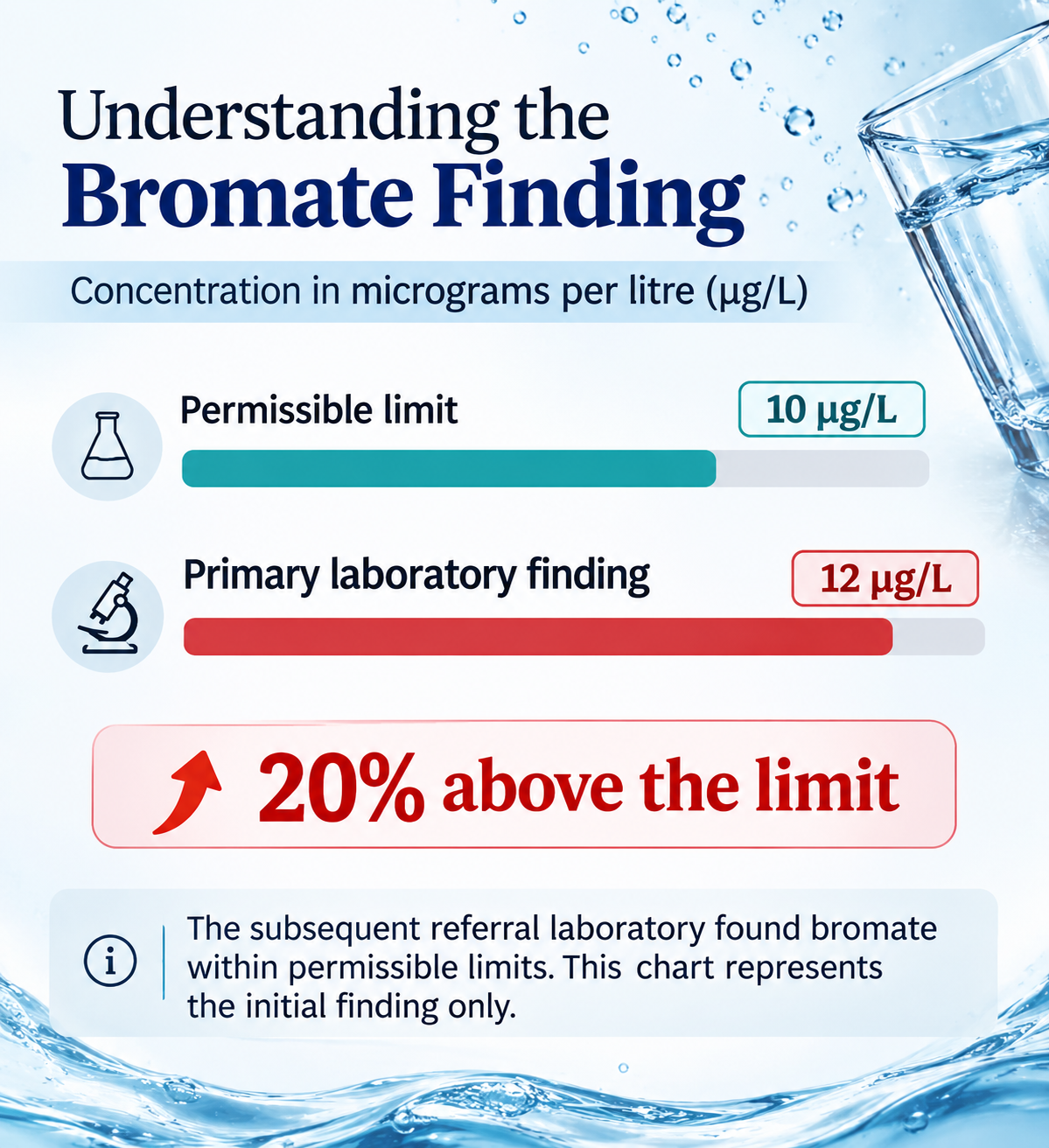
The prescribed bromate limit cited in the case is 0.01 mg/L, equivalent to 10 micrograms per litre.
The primary laboratory reported 12 micrograms per litre, approximately 20% above that limit.
The referral laboratory subsequently reported bromate within permissible levels.
Understanding PAHs
Polycyclic aromatic hydrocarbons are a group of chemical compounds that can originate from environmental contamination and incomplete combustion of organic materials.
Some PAHs are associated with carcinogenic risks under particular exposure conditions.
However, detecting PAHs does not independently establish the magnitude of a health risk. Such an assessment requires information about the specific compounds, concentrations, exposure duration and applicable safety thresholds.
The reports reviewed for this article do not provide sufficient detail to independently assess the health implications of the reported PAH concentration.
5. Bisleri's defence
Bisleri maintains that its products are safe and that the regulatory episode concerns an isolated batch.
According to the company's reported statement:
· Five of the six samples collected from the Goa facility met the applicable standards.
· The referral laboratory found bromate within permissible limits.
· An independent laboratory commissioned by the company also reported compliant bromate levels.
· Independent test results were submitted to FSSAI in February 2026.
· The company conducts more than 90 tests across a 10-step manufacturing process.
· Bisleri intends to cooperate with the regulatory authorities.
These assertions represent the company's position and should not be treated as independent regulatory findings.
A significant question remains unanswered in the reported response: the specific PAH finding that formed the basis of the referral laboratory's adverse conclusion.
Greater disclosure on this issue would help consumers understand the discrepancy between the laboratory results.
6. Reliance and the changing competitive landscape
The controversy has emerged during a period of intensifying competition in India's packaged drinking water industry.
Reliance Consumer Products has expanded its presence in the sector through its Independence and Campa Sure brands, adding further competitive pressure to an industry that includes established players such as Bisleri, Kinley and Aquafina.
Some media commentary has drawn attention to the proximity of Reliance's business expansion and the regulatory action against Bisleri.
However, chronological proximity is not evidence of corporate interference.
The Bisleri investigation began in September 2025, and its appeal was initiated in November of that year, well before the reported prosecution sanction in November 2026.
The sources reviewed establish no connection between Reliance and the sampling, laboratory findings or regulatory decision.
The relevant policy question is therefore not whether a particular competitor influenced the action without supporting evidence, but whether food safety standards are consistently and transparently enforced across all manufacturers.
Uniform regulatory scrutiny is essential for both consumer protection and fair market competition.
7. The economics of India's bottled water market
India's packaged water industry has developed into a significant consumer market, supported by urbanisation, travel, institutional demand and concerns about access to reliable drinking water.
Market estimates attributed to IBEF and reported by Open Magazine suggest substantial growth potential.
Year | Estimated market value |
2025 | ₹32,040 crore |
2032 | ₹57,850 crore (projected) |
These estimates imply approximately 80.6% growth over seven years, equivalent to an indicative compound annual growth rate of around 8.8%.
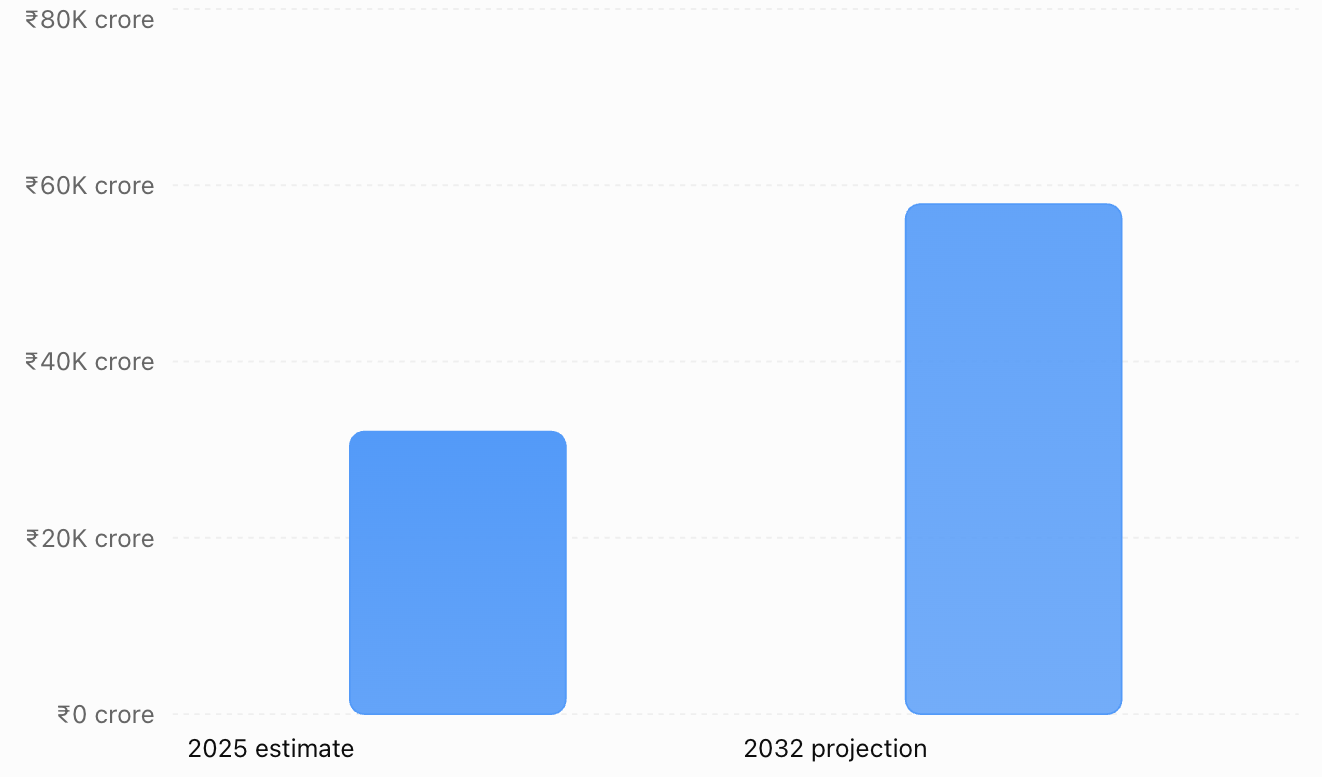
Such projections should be treated as market estimates rather than guaranteed outcomes.
Bisleri's precise market share is also difficult to establish from the available sources. Different estimates published in 2022 placed its share at approximately 26% to 32%, although their market definitions may differ.
The figures nevertheless illustrate Bisleri's established commercial significance.
8. What the controversy could mean for Bisleri
For a packaged drinking water company, consumer trust is fundamental to brand value.
Unlike products that compete primarily on taste, design or technological features, bottled water is purchased largely on the expectation of safety and reliability.
Even a batch-specific regulatory controversy can influence consumer perception beyond the affected product.
Business dimension | Potential consequence |
Consumer confidence | Greater scrutiny of product safety |
Retail demand | Possible switching to competing brands |
Institutional procurement | Increased demand for compliance documentation |
Brand reputation | Greater pressure to demonstrate quality assurance |
Competition | Opportunity for rival brands to attract customers |
Compliance | Increased investment in testing and traceability |
These are potential commercial consequences, not measured outcomes.
No post-incident sales or market-share figures were available in the sources reviewed to establish the actual financial impact.
Short-term outlook
The immediate challenge for Bisleri is likely to involve protecting consumer confidence and reassuring distributors, retailers and institutional buyers.
Transparent communication and credible scientific clarification could help limit reputational damage.
Long-term outlook
The long-term consequences will depend on the regulatory proceedings, the findings of the root cause analysis, the company's corrective measures and whether wider industry testing identifies similar concerns.
A single regulatory incident does not necessarily determine the future of an established national brand.
Its response, however, can significantly influence how the incident is remembered.
9. What the evidence establishes
Established through the reported regulatory record:
· The regulatory action concerns an identified batch, GO 270.
· The primary and referral laboratories reported differing chemical findings.
· FSSAI reportedly sanctioned prosecution and prohibited the sale of the identified batch.
· Bisleri disputes the adverse outcome and maintains that its products are safe.
Not established by the available evidence:
· That all Bisleri products are unsafe.
· That Bisleri has been found guilty by a court.
· That the reported PAH concentration has caused harm to consumers.
· That Reliance influenced the regulatory action.
· That Bisleri has experienced a measurable decline in sales or market share.
The distinction between these two categories is essential to responsible reporting.
10. The COSMINNOX Verdict: Transparency Is the Real Test
The Bisleri controversy should not be reduced to a contest between corporate reputation and regulatory authority. It presents an opportunity to examine how India's food safety ecosystem can become more transparent, scientifically accountable and consistent.
FSSAI should, subject to applicable legal requirements, provide greater clarity regarding the laboratory findings, the scope of the affected batch and the outcome of its root cause analysis.
Bisleri should address the PAH finding directly and communicate any corrective measures supported by verifiable evidence.
The wider packaged drinking water industry should strengthen batch-level traceability, independent testing and consumer-facing quality disclosures.
Consumers, meanwhile, should distinguish between a batch-specific regulatory action and an unsupported conclusion about an entire brand.
Ultimately, the strength of India's packaged drinking water industry will depend not merely on how many bottles it sells, but on how effectively it demonstrates the safety of what those bottles contain.
Water may be the product. Trust is the business.
Sources and references
1. FSSAI clarification reported by ANI — Devdiscourse
2. FSSAI — Scheme of Testing for Packaged Drinking Water and Mineral Water
3. Bureau of Indian Standards — IS 14543:2024
4. FSSAI — Packaged Drinking Water and Mineral Water FAQs
5. Business Standard — Bisleri's response to regulatory action
6. Open Magazine — Bisleri's FSSAI Row
7. Hospitality Biz India — Regulatory action and wider testing
8. Best Media Info — Fact-check on the Reliance allegations