The Question
When a ransomware group breaches a contractor rather than a critical-infrastructure operator itself, does the operator's own network security matter at all — or does the weakest vendor in the chain set the real ceiling on how secure the whole project is? The Kudankulam leak is a live test of that question, and the evidence gathered so far supports a narrower conclusion than either the plant's operator or the loudest alarm would suggest: nothing publicly confirmed points to nuclear safety or reactor-control systems being compromised, but the breach did originate inside the supply chain around India's largest nuclear facility, sat undetected for weeks, and exposed a decade of contractor documentation before anyone outside the attackers knew it was gone.
Part I — What Was Taken, and From Whom
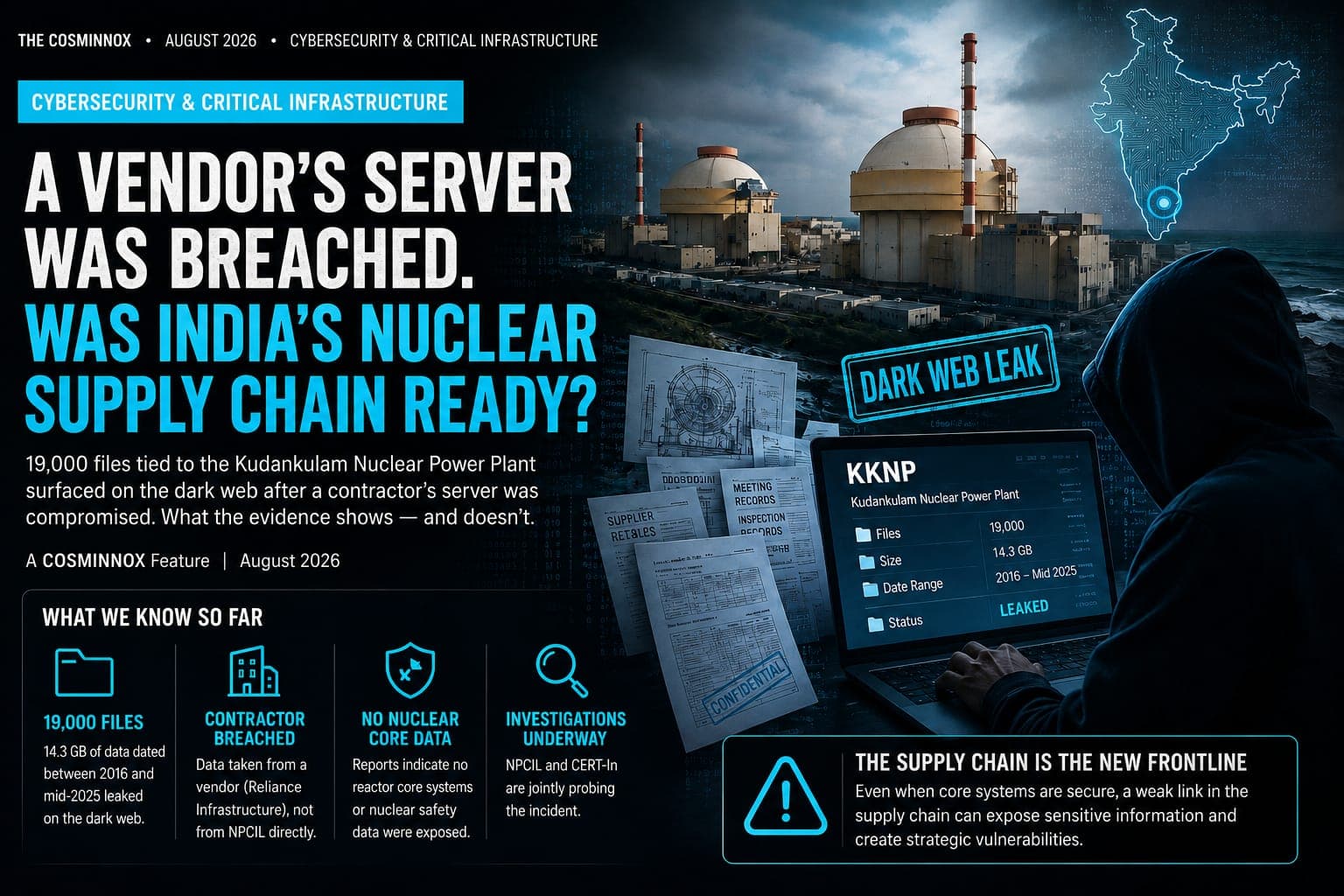
Since June 11, 2026, a cache of roughly 19,000 files — 14.3 gigabytes, dated between 2016 and mid-2025 — has been posted on the dark web under the search term “KKNP,” shorthand for the Kudankulam Nuclear Power Plant in Tamil Nadu, India’s largest nuclear facility. [1] Independent cybersecurity researcher Rakesh Krishnan first flagged the leak and alerted Reuters, which reviewed the documents — purportedly blueprints of parts of the facility, supplier details, meeting and inspection records, equipment reviews and insurance policies — though Reuters could not independently verify their authenticity. [1]
The files form part of a larger 858,000-document leak attributed to Reliance Group, posted by World Leaks, a data-extortion group that anti-ransomware researchers and multiple outlets identify as a rebrand of Hunters International, which wound down its encryption-based operations in mid-2025 and re-emerged focused solely on data theft and leak-site extortion. [2] The same group has claimed breaches at Tata Technologies, Tata Electronics, and Nike (a claimed 1.4 terabyte, roughly 188,000-file leak in January 2026). [2] World Leaks did not respond to Reuters’ requests for comment. [1]
The data did not come directly from Kudankulam’s operator. Reliance Infrastructure, a subsidiary of Anil Ambani’s Reliance Group, won a 2018 public-tender contract to design and build the Common Services–Balance of Plant package for Kudankulam Units 3 and 4 — two additional 1,000 MW reactors, a combined 2,000 MW addition to the site, still under construction. [1] Kudankulam’s full build-out plan adds four more 1,000 MW units beyond the two currently operational, taking total site capacity to 6,000 MW once complete. [3] Reliance Infrastructure told Reuters there had been a “partial breach” of its data on a server managed by third-party data-centre provider Yotta, and that the government had been informed; the company did not disclose the scope of what was taken. [1] One industry account citing sources close to the investigation put the initial detection of suspicious activity at May 29, 2026, flagged internally in late June. [4]
Part II — What the Operator Says, and What Independent Reporting Corroborates
The Nuclear Power Corporation of India Limited (NPCIL), which operates the country’s nuclear plants, has denied that any nuclear-sensitive data was compromised. In a statement issued by Executive Director (Corporate Communications) Prateek Agarwal, NPCIL said the documents in circulation relate only to the Balance of Plant — conventional infrastructure common to any thermal power plant — and have “no connection with nuclear safety or nuclear security systems.” [3] NPCIL said it had supplied only indicative drawings and specifications to bidders during the original tender, and that Reliance Infrastructure’s detailed engineering drawings were reviewed and accepted only after meeting technical specifications. [3] Investigations are being carried out jointly by NPCIL and CERT-In, India’s national cyber incident-response agency. [3]
This is not solely NPCIL’s own account. Reuters reported independently that the documents it reviewed did not appear to include information related to the reactors’ core systems, which are supplied by Russia’s state-owned Rosatom — a detail that corroborates NPCIL’s Balance of Plant framing from outside the operator’s own statement, rather than simply repeating it. [1]
Why experts are still concerned
Nickolas Roth, senior director at the Nuclear Threat Initiative — which benchmarks nuclear-security preparedness globally — told Reuters the breach “could pose a ‘serious’ risk to the safety of the plant,” and that the exposed files could show an adversary “not just who has access to the project, but which systems that access reaches.” [1] That is a materially stronger characterization than NPCIL’s own, and the two should be read side by side rather than one replacing the other: NPCIL’s claim is about what was technically included in the leak; Roth’s is about what can be done with conventional-infrastructure data once it is aggregated and public, regardless of whether it touches reactor control systems directly.
“They could show an adversary not just who has access to the project, but which systems that access reaches.” — Nickolas Roth, Nuclear Threat Initiative, via Reuters
This is not the first cyber incident linked to Kudankulam. In 2019, malware associated with a North Korea-linked hacking group was found on the plant’s administrative network; NPCIL said at the time that plant control systems were unaffected, and a Russian diplomat later told reporters Moscow had been assured the facility was secure. [5]
Part III — The Wider Pattern
The incident lands against a broader backdrop of weak enterprise cyber hygiene in India. India ranked third globally for data breaches over the preceding year, with roughly 28.9 million accounts compromised, behind only the United States and France, according to cybersecurity firm Surfshark, as cited in Reuters’ reporting. [1] A separate joint study reportedly by the Data Security Council of India and Seqrite found that, of 204 Indian organisations surveyed, 73 percent did not know whether they had ever been attacked, and 57 percent lacked basic cyber-hygiene practices. [6]
Editorial note: the DSCI–Seqrite figures above were carried in prior COSMINNOX source material but could not be independently traced to the original study document in this review. Desk should confirm report title, publication date, and exact methodology before this figure runs in print.
What is confirmed, and by whom
Claim | Status | Source |
19,000 files, 14.3 GB, live since June 11 | Confirmed | Reuters, via Al Jazeera / Tribune [1][2] |
Attributed to World Leaks (Hunters International rebrand) | Confirmed | Reuters; independent threat-intel reporting [1][2] |
Reliance Infrastructure server, hosted by Yotta, “partial breach” | Confirmed, scope undisclosed by Reliance | Reuters [1] |
No reactor-core (Rosatom) systems data in the leak | Independently corroborated | Reuters’ own document review [1] |
No nuclear safety/security systems compromised | NPCIL claim, corroborated on scope by [1] | NPCIL statement [3] |
Breach “could pose a serious risk” to plant safety | Expert assessment, contested framing | Nickolas Roth, NTI, via Reuters [1] |
Initial detection May 29, flagged late June | Single-source, unconfirmed elsewhere | Swarajya [4] |
Table: Claim-by-claim evidentiary status as of August 2026. Bracketed numbers correspond to endnotes.
Part IV — Closing the Gaps: What This Requires
Stripped to its structural pattern rather than this specific plant, the exposure here follows a template security researchers have flagged repeatedly across critical-infrastructure supply chains: sensitive-adjacent engineering data sitting with a third-party contractor, hosted on outsourced infrastructure, without controls sufficient to stop mass exfiltration, and no detection until the data was already for sale.
Industry security frameworks (NIST SP 800-161 on supply-chain risk, ISO/IEC 27001 for information-security management) and CERT-In’s own vendor-risk advisories point toward the same set of structural fixes for that pattern:
— Contractual security mandates for vendors: encryption at rest and in transit, strict access logging, and mandatory breach-notification timelines written into contracts at the tender stage, not left to a vendor’s discretion.
— Data segregation and minimisation: even non-classified engineering data can be used to map an organisation’s structure and weak points once aggregated at scale, so it should be kept segregated from anything that could indirectly reveal security architecture.
— Security standards for outsourced hosting: third-party data centres need to meet the same bar as in-house systems — network segmentation, intrusion detection tuned to ransomware precursors, and immutable backups that remove extortion leverage.
— Zero-trust access architecture: least-privilege access and multi-factor authentication so a single compromised credential cannot expose hundreds of thousands of files.
— Mandatory independent audits, not self-certification, for any vendor with access to critical-infrastructure-linked systems.
— Sector-specific pre-breach regulation: a mandatory security baseline vendors must meet before being awarded critical-infrastructure contracts, rather than penalties applied only after a breach.
— Basic cyber hygiene at scale: patching, MFA and incident-response drills — the unglamorous basics that stop most breaches before any single sophisticated defence is tested.
What This Piece Does and Doesn't Establish
The evidence supports a narrow, bounded account: a contractor to Kudankulam’s expansion project was breached through a third-party hosting server; roughly 19,000 files of conventional Balance of Plant documentation were exposed; independent review found no evidence the leak includes reactor-core systems; and NPCIL’s denial of a “sensitive data breach” is corroborated, on that specific point, by Reuters’ own document review — not merely repeated from NPCIL’s statement.
It does not establish that Kudankulam’s nuclear safety or security systems were ever at risk, and it does not establish the full scope of what was actually taken, since neither Reliance Infrastructure nor Yotta has disclosed that publicly. What it does establish is a now-familiar structural gap: contractor and outsourced-hosting security remains the weakest and least-audited link in India’s critical-infrastructure supply chain, and the fixes for that gap are procurement and contractual, not primarily technical.
Sources & Endnotes
[1] Reuters, carried via Al Jazeera, “Data breach reportedly targets India’s Kudankulam nuclear power plant,” July 16, 2026; and The Tribune (Reuters wire), “19,000 files relating to India’s largest nuclear power plant ‘exposed’ in data breach,” July 2026.
[2] BleepingComputer, “Tata Electronics confirms cyberattack as hackers leak data,” June 2026; Infosecurity Magazine, “WorldLeaks Ransomware Group Claims 1.4TB Nike Data Breach,” Jan. 27, 2026; RansomLook, WorldLeaks group profile.
[3] NPCIL statement issued by Executive Director (Corporate Communications) Prateek Agarwal, carried via Telangana Today, “NPCIL says no sensitive data breach at Kudankulam Nuclear Power Project,” July 16, 2026, and corroborating wire coverage (Prokerala/PTI, Asian Mirror, Sanskriti IAS).
[4] Swarajya, “NPCIL Rejects ‘Sensitive Data Breach’ Claims After Ransomware Targets Kudankulam Project Contractor,” July 2026.
[5] Gulf News, “India: Nuclear plant hacking — what you need to know,” Nov. 2019; Hindustan Times / PressReader, “Kudankulam plant safe, Russia told,” Nov. 2019; Deccan Herald, “‘No cyber attack on Kudankulam nuclear plant systems,’” 2019.
[6] Attributed to a joint Data Security Council of India (DSCI) and Seqrite study, as referenced in prior COSMINNOX source material. Original report not independently located in this review — confirm title, date and methodology with DSCI/Seqrite before print.
As of August 2026. The scope of data actually exfiltrated remains undisclosed by Reliance Infrastructure and Yotta; figures here should be re-checked against any NPCIL/CERT-In findings released closer to publication.