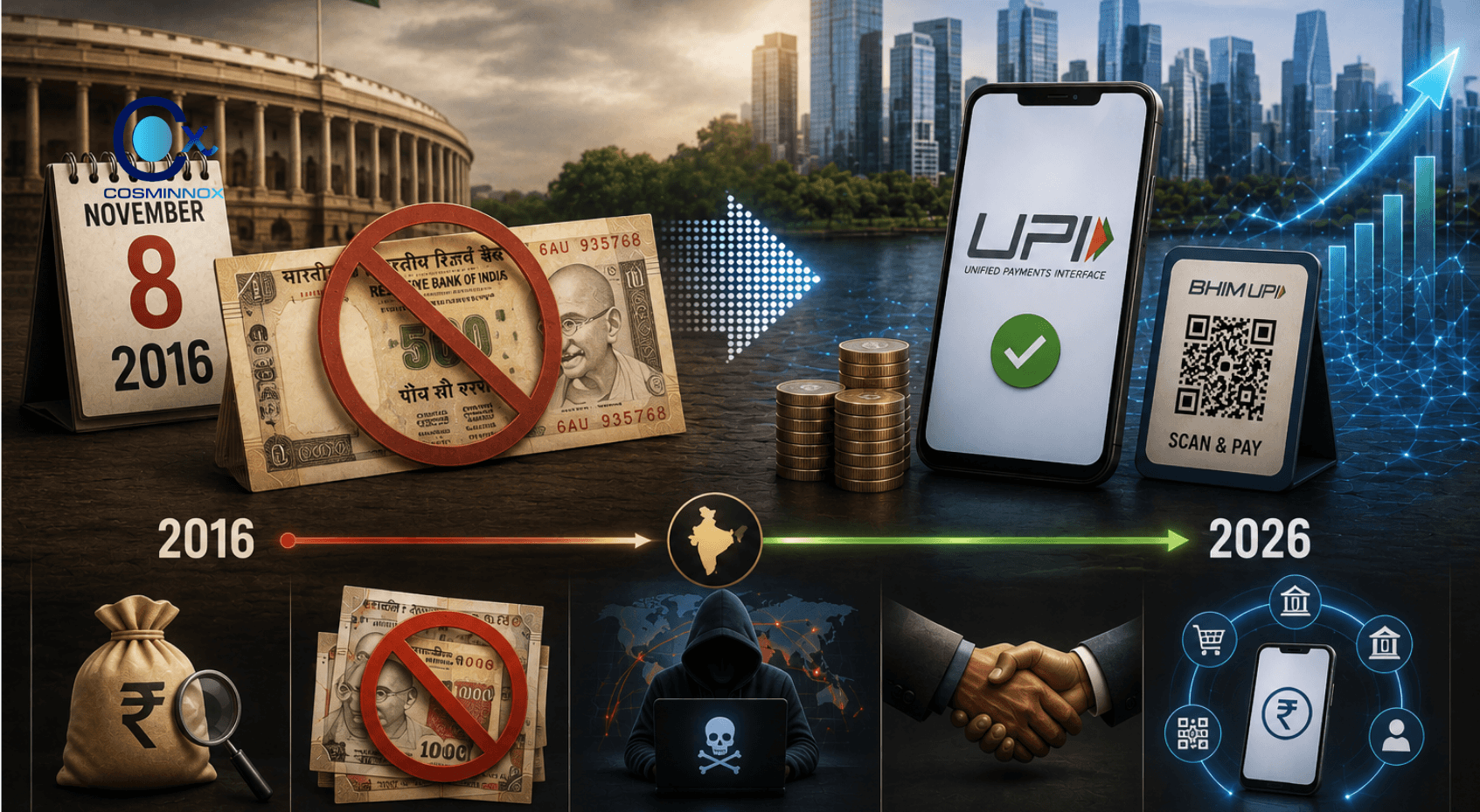
On November 8, 2016, the government withdrew legal tender status from ₹500 and ₹1,000 notes, then comprising 86% of currency in circulation, with three stated aims: curbing black money, choking counterfeit currency, and pushing India towards digital payments. Eight years on from that date, Reserve Bank of India (RBI) data on currency, taxpayer records from the Economic Survey, and government digital-payments statistics offer a way to test each claim against outcomes rather than rhetoric.
The Five Stated Objectives: 2016 vs. 2026
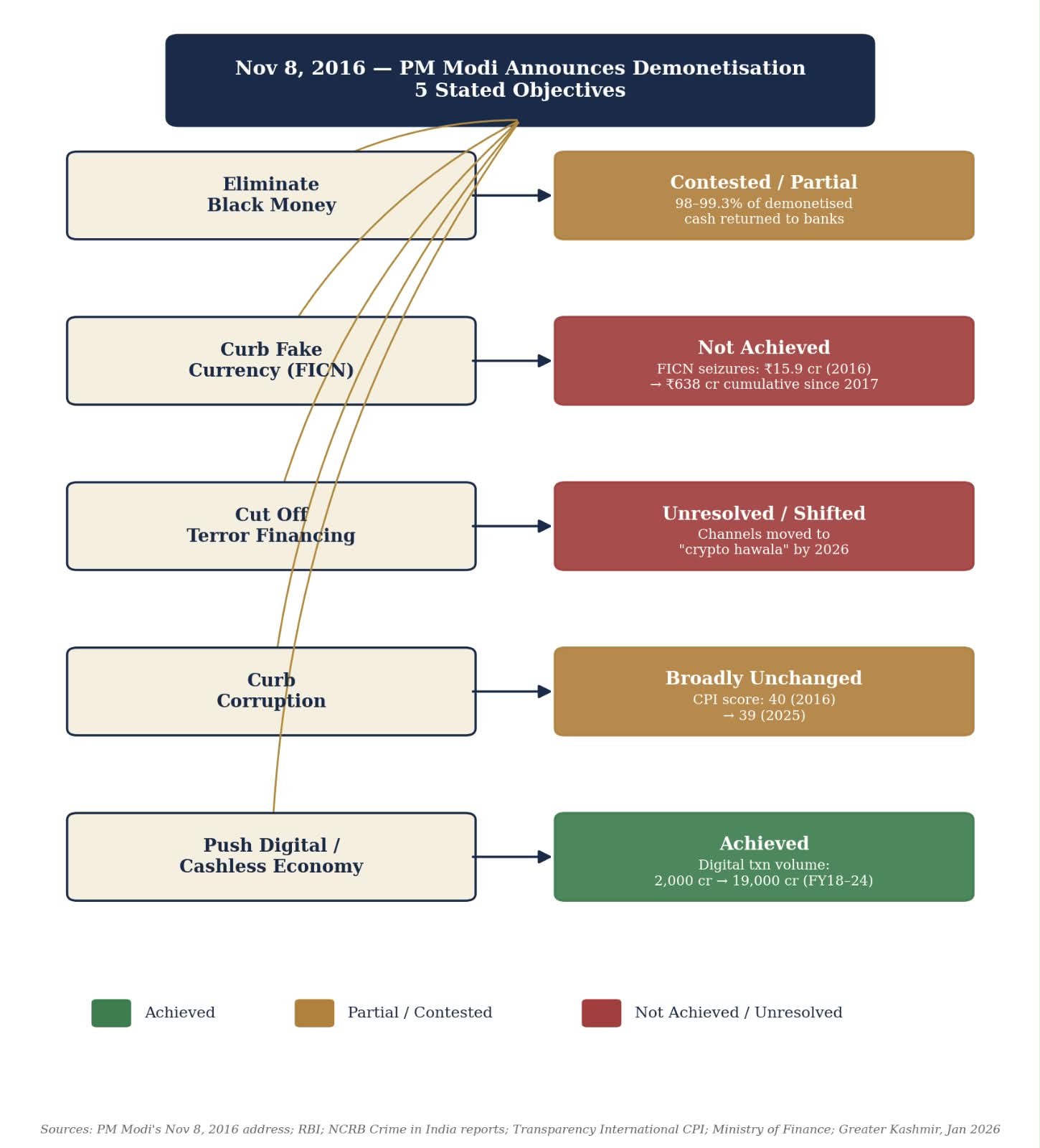
In his televised address on November 8, 2016, PM Modi framed demonetisation as a response to "corruption, black money and terrorism," citing cross-border fake currency as a funding channel for terrorism and "cash under beds" as a symbol of unaccounted wealth. A push towards a less-cash, digital economy was articulated as a related goal in the days that followed. Ten years on, RBI, NCRB, Transparency International and Ministry of Finance data allow each objective to be checked against outcomes rather than restated as rhetoric.
Stated Objective (2016) | Status as of 2026 | Key Data Point |
Eliminate black money / unaccounted cash | Contested / Partial | 98–99.3% of demonetised currency returned to the banking system (RBI); tax base grew 45% but revenue impact was "muted" per the Economic Survey |
Curb fake currency (FICN) | Not Achieved | FICN seizures rose from ₹15.9 crore (2016) to a cumulative ₹638 crore since 2017; RBI reported a 37.3% surge in counterfeit ₹500 notes in FY 2024-25 |
Cut off cross-border terror financing | Unresolved / Shifted | NIA seized ~₹36 crore in demonetised notes in 2017, but by 2026 investigators flagged "crypto hawala" as an emerging J&K funding channel, with only 49 virtual-asset exchanges registered as reporting entities in FY25 |
Curb corruption | Broadly Unchanged | Transparency International's CPI score for India: 40 (2016, rank 79/176) versus 39 (2025, rank 91/182) |
Push towards a digital / cashless economy | Achieved | Digital payment transaction volume rose from ~2,000 crore (FY18) to ~19,000 crore (FY24); UPI reached 84% of digital transaction volume by FY25 |
Table 2: The five objectives stated in PM Modi's November 8, 2016 address, checked against 2026 data. Sources: RBI; NCRB Crime in India reports (2016–2024); Transparency International CPI (2016, 2025); Ministry of Finance; Greater Kashmir, January 2026.
Flowchart: 2016 objectives mapped to their 2026 status. Amber denotes contested or partial outcomes; red denotes objectives not achieved or that have shifted form; green denotes the one objective the data clearly supports as achieved.
Of the five objectives, only the digital-payments push shows an unambiguous, data-backed outcome. Black money elimination and corruption reduction remain contested — supporters point to the tax base expansion and the discipline the exercise imposed on cash-based transactions, critics point to the near-total return of demonetised cash and a roughly flat corruption score. Fake currency and terror financing are the two objectives where the evidence points most clearly away from success: counterfeiting has scaled up rather than down, and financing channels have migrated to less traceable digital forms rather than being cut off.
Did Cash Return? The Currency-in-Circulation Question
Currency in circulation (CIC) stood at ₹17.74 lakh crore on November 4, 2016, fell to a trough of roughly ₹8.98 lakh crore by January 6, 2017, and had recovered to pre-demonetisation levels within about 14 months. As of November 8, 2024 — the eight-year mark — CIC stood at ₹35.66 lakh crore, more than double the pre-demonetisation figure, and had risen further to ₹37.29 lakh crore by October 2025.
Sources: Business Standard, citing RBI data, January 2, 2023 and November 14, 2024; IASPOINT, citing RBI data, November 2025.
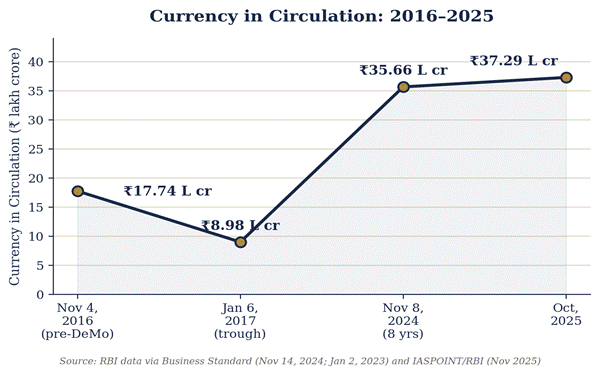
Chart 1: Currency in circulation, November 2016 to October 2025. Source: RBI data via Business Standard and IASPOINT.
The RBI's own currency-to-GDP ratio, however, tells a more layered story: it stood at 12.1% before demonetisation, rose to 14.5% during the 2020–21 pandemic as households built precautionary cash reserves, and has since stabilised at 11.11% as of 2025 — below the pre-demonetisation level despite the absolute rupee value of cash more than doubling, reflecting India's larger economy and the parallel rise of digital payments.
Source: IASPOINT, citing RBI data, November 2025.
Tax Base: A Real but Modest Expansion
The Economic Survey's analysis of taxpayer data between November 9, 2016 and March 3, 2017 found the taxpayer base grew 45%, against 25% growth over the same period a year earlier — an addition of roughly 540,000 taxpayers and about ₹10,600 crore in newly reported taxable income. The Survey itself noted the revenue impact was muted, since the average reported income of these new filers, at ₹2.7 lakh, sat only marginally above the ₹2.5 lakh tax threshold.
Source: Economic Survey, cited in Business Standard, "Did demonetisation meet its intended objectives?"
Metric | Pre-Demonetisation Period (YoY) | Post-Demonetisation Period (Nov 9 '16–Mar 3 '17) |
Taxpayer base growth | 25% | 45% |
New taxpayers added | — | ~540,000 |
Additional reported taxable income | — | ~₹10,600 crore |
Table 1: Tax base expansion following demonetisation. Source: Economic Survey, via Business Standard.
Digital Payments: The Clearest Durable Shift
Of the three stated goals, the push toward digital payments shows the most sustained trajectory. Ministry of Finance data shows overall digital payment transaction volume grew from roughly 2,000 crore in FY 2017-18 to nearly 19,000 crore in FY 2023-24, with UPI transaction value alone reaching ₹200 lakh crore in FY24. By FY25, UPI accounted for 84% of digital transaction volume nationally, up from 37% in FY20.
Sources: Ministry of Finance statement, September 21, 2024; Business Standard "Statsguru," January 2026, citing RBI/NPCI data.
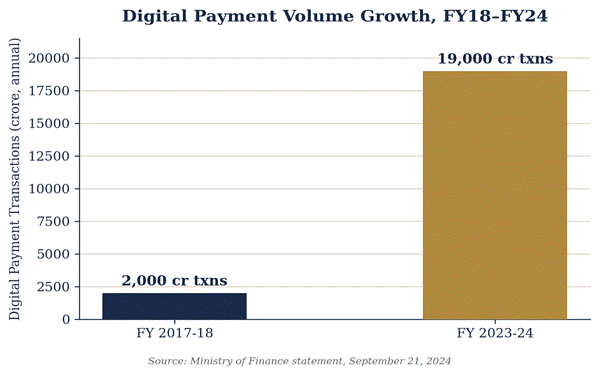
Chart 2: Digital payment transaction volume, FY18 vs FY24. Source: Ministry of Finance, September 21, 2024.
Counter-Evidence: The Dissent and the Costs
The Supreme Court upheld demonetisation's legality on January 2, 2023 by a 4:1 majority, finding no flaw in the decision-making process. Justice B.V. Nagarathna's dissenting opinion called the exercise "unlawful" and "vitiated," arguing it should have been carried out through parliamentary legislation rather than a government notification under the RBI Act, and separately noted that RBI data showed roughly 98% of demonetised currency was eventually returned to the banking system — a figure she cited to question how much unaccounted wealth was actually extinguished.
Sources: Al Jazeera, "India's Supreme Court says 2016 demonetisation decision was legal," January 2, 2023; Deccan Herald, quoting Justice B.V. Nagarathna, NALSAR Courts and Constitution Conference.
Former finance minister P. Chidambaram has separately argued the exercise cost India roughly 1.5 percentage points of annual GDP growth, equivalent to about ₹2.25 lakh crore a year, and that more than 100 deaths were linked to the note-ban period. These figures are his estimates and attribution, not government data, and COSMINNOX has not found a Tier 1 source that independently verifies either the growth-loss or the fatality count.
Source: P. Chidambaram, quoted in Deccan Herald, reporting on RBI's currency-processing completion statement.
What the Evidence Establishes
Eight years of data show a mixed but measurable record. Currency in circulation not only recovered but more than doubled in absolute terms, though the currency-to-GDP ratio — a better measure of "cash dependence" — is lower today than before demonetisation. The tax base expanded on schedule but by an amount the Economic Survey itself called revenue-modest. Digital payments show the clearest and most durable structural shift of the three objectives, though causation is contested: UPI's launch and the pandemic both accelerated trends already underway. What the data does not establish is the scale of black money eliminated — RBI's own return-rate figures, cited by both supporters and the dissenting judge, remain open to opposing readings depending on what one assumes about the cash that came back.
As of August 27, 2026. Figures reflect the most recent RBI, Ministry of Finance, and Economic Survey data available at time of writing; currency-in-circulation and digital-payments figures should be checked against subsequent RBI bulletins for updates.