

From 27 to 29 October, Bharat Mandapam is hosting a programme spanning 13 ministries and 12 technology fields. Three Nobel laureates were announced as participants; their attendance has not been independently confirmed. We welcome it. India puts 0.84% of its GDP into research, against 2.58% in China, and the sharpest gap is not talent or ideas but the hand-offs between laboratory, startup, investor and user. ESTIC is built to sit at exactly those hand-offs. That makes it worth backing, and it means its value will show in what happens after the closing session, not in the size of the crowd.
One platform for the whole pipeline
ESTIC is organised by the Council of Scientific and Industrial Research under the guidance of the Principal Scientific Adviser's office. The first edition, on 3 to 5 November 2025, drew over 3,000 participants, and the Prime Minister used it to launch the ₹1 lakh crore Research, Development and Innovation (RDI) scheme. The 2026 edition adds business-to-business and business-to-government meetings, startup presentations and a technology exhibition that opens to the public from the second day.
That mix changes what the event is for. A science congress puts scientists in front of scientists. ESTIC puts them in front of the people who can fund, test, buy and use what they make.
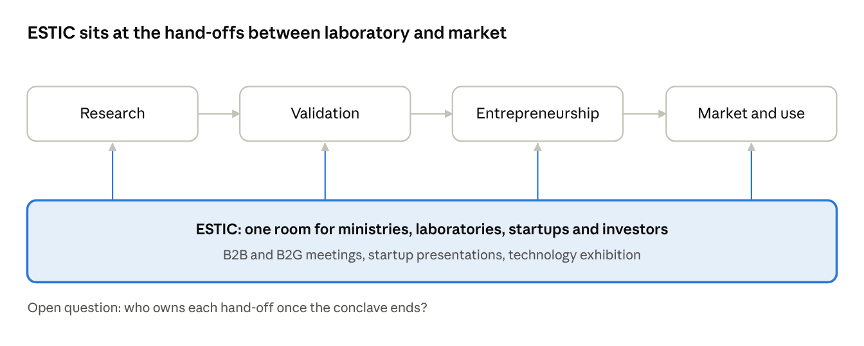
The joints between these stages are where promising work stalls, and they are what ESTIC is aimed at.
India’s research investment gap
The Department of Science and Technology's latest statistics put India's research spending at ₹2,44,768 crore in 2023-24, or 0.84% of GDP, up from 0.64% in 2020-21. Spending has tripled in nominal terms since 2013-14, when it was ₹79,356 crore. A secondary summary reports China at 2.58%, Brazil at 1.19% and Russia at 0.94%; the comparison years are not specified, so these figures should not be read as a like-for-like ranking. India’s 0.84% is about one-third of 2.58%.
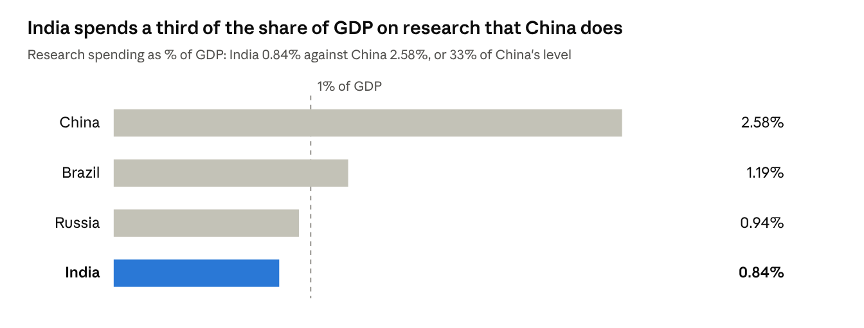
India: DST R&D Statistics at a Glance 2025-26, 2023-24 figure; peer ratios as reported by The Policy Edge, 5 August 2026 (reference years not stated)
The department projects 0.90% for 2025-26, an estimate rather than audited spending. Even that projected level would leave substantial room for improvement. Closing the gap needs more money from more sources and a shorter path from result to use. A conclave cannot print rupees. It can shorten the path.
Industry is catching up with government, from a narrow base
Private industry's share of research spending rose from 32.2% in 2020-21 to 45.2% in 2023-24, close to the combined government sector's 48.2%. Industry belongs in the room because it already pays for nearly half the work.
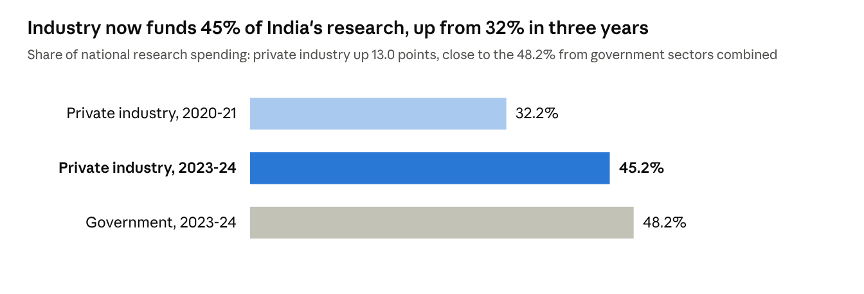
DST R&D Statistics at a Glance 2025-26, as reported by The Policy Edge, 5 August 2026 · government = combined government sectors
The base is narrow. Large companies, Indian and foreign, account for 71.3% of business research, and everyone else shares the remaining 28.7%. Transport and pharmaceuticals together take more than half of industrial spending.
This is where the RDI scheme matters. Spread over six years, its ₹1 lakh crore averages about ₹16,700 crore a year, roughly 7% of 2023-24 research spending. It offers long-term financing and equity support, not grants or short-term loans, so it is aimed at technologies close to commercial use. ESTIC's meetings and exhibition are where such projects and their public-laboratory partners can find each other.
More researchers, more women, more founders outside the metros
Researcher density rose from 262 to 354 per million people between 2020-21 and 2023-24, a 35% jump, to 5.07 lakh full-time-equivalent researchers. Women's share of researchers climbed from 18.6% to 29%, a gain of 10.4 points in three years. Output is keeping pace: 2,07,390 publications in 2022, the third-largest total in the world, and 1,10,375 patent applications in 2024-25, with Indian residents filing 62%.
Reach matters as much as volume. Science and Technology Minister Jitendra Singh said at the curtain-raiser that more than half of India's 2.3 lakh startups now come from smaller towns. No dataset was released with the claim, so we treat it as a ministerial figure. If it holds, a Delhi conclave with a public exhibition is a chance to bring those founders into rooms they could not otherwise enter.
The counterpoint: a conclave can be a show
The sceptic's case is fair. A crowd is not an outcome. The curtain-raiser release asked organisers for a roadmap with short- and long-term milestones, but did not say who approves it, when it will be published or how progress will be tracked, as The Policy Edge noted. Competitive extramural research funding is only 1.4% of research spending, so even good ideas meet a thin funding pipe.
Two facts blunt that case. The 2025 edition was not only talk: the RDI scheme was launched from its stage. And the 2026 format adds what a talking shop lacks, meetings between businesses and government bodies, and a public exhibition. Neither guarantees results. Both give results a place to start.
What it means for society and the next generation
The benefits could reach households, young researchers and founders beyond major cities.
1. A household. Four of the twelve themes, preventive medicine, agri-tech and nutrition, synthetic biology and energy technologies, touch what people eat, how early illness is caught and what power costs. A pilot that moves from laboratory to market in those fields reaches a family faster than a paper does.
2. A student or young researcher. The conclave has a poster corner for young researchers, a stated aim of engaging India's future science leaders, and an exhibition open to the public from the second day. With women now 29% of researchers, the pipeline is widening, and visible pathways help it keep widening.
3. A small-town founder. Meetings with ministries and investors are a shortcut a founder in a smaller city rarely gets. The roadmap, if it carries named owners, turns one meeting into a follow-up.
The longer payoff belongs to children now in school. The twelve themes, from semiconductors and quantum networks to ocean technology and space, are the industries their first jobs will sit in. India is deciding now whether it builds them at home.
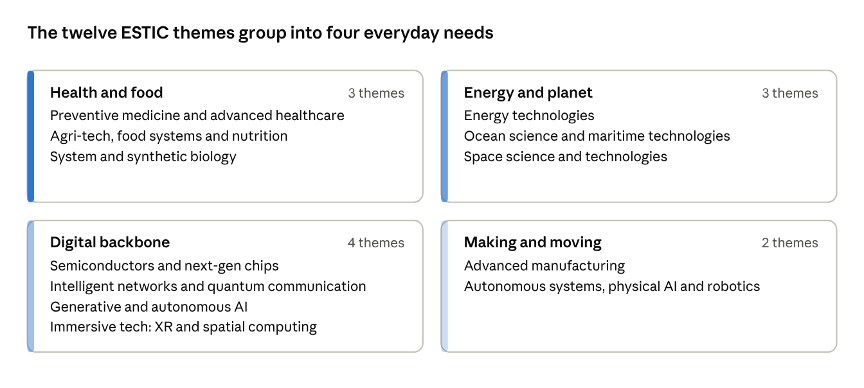
ESTIC-2026 thematic areas (estic2026.in) · grouping into four needs is The COSMINNOX's
The grouping is ours, not the organisers'. The twelve themes are theirs.
The call
ESTIC deserves support, but its success should be measured by partnerships, pilots and funding commitments over the next twelve months—not speeches over three days. We are highly confident it widens who takes part in Indian research, moderately confident it speeds commercialisation, and have low confidence that it lifts national research intensity on its own, since that depends on government and company budgets. These are The COSMINNOX's forecasts, made on 28 October 2026.
A clear test will be whether organisers publish a roadmap with named owners and dated milestones before the next edition.
Sources
• ESTIC-2026 official site: dates, venue, objectives, thematic areas
• The Policy Edge, 10 September 2026: 13 ministries, 12 themes, Nobel laureates, roadmap
• The Policy Edge, 5 August 2026: figures from the Department of Science and Technology's R&D Statistics at a Glance 2025-26
• StartupFeed, 11 September 2026: minister's remarks on startups and the public exhibition
• DD News and PM India: ESTIC 2025 participation and RDI launch
• ETV Bharat, 3 November 2025: RDI outlay of ₹1 lakh crore over six years
• Drishti IAS explainer: RDI financing structure
Editorial note: Figures and event details reflect sources available on 28 October 2026. Attendance and final outcomes remain unconfirmed; recheck before publication after 29 October.