
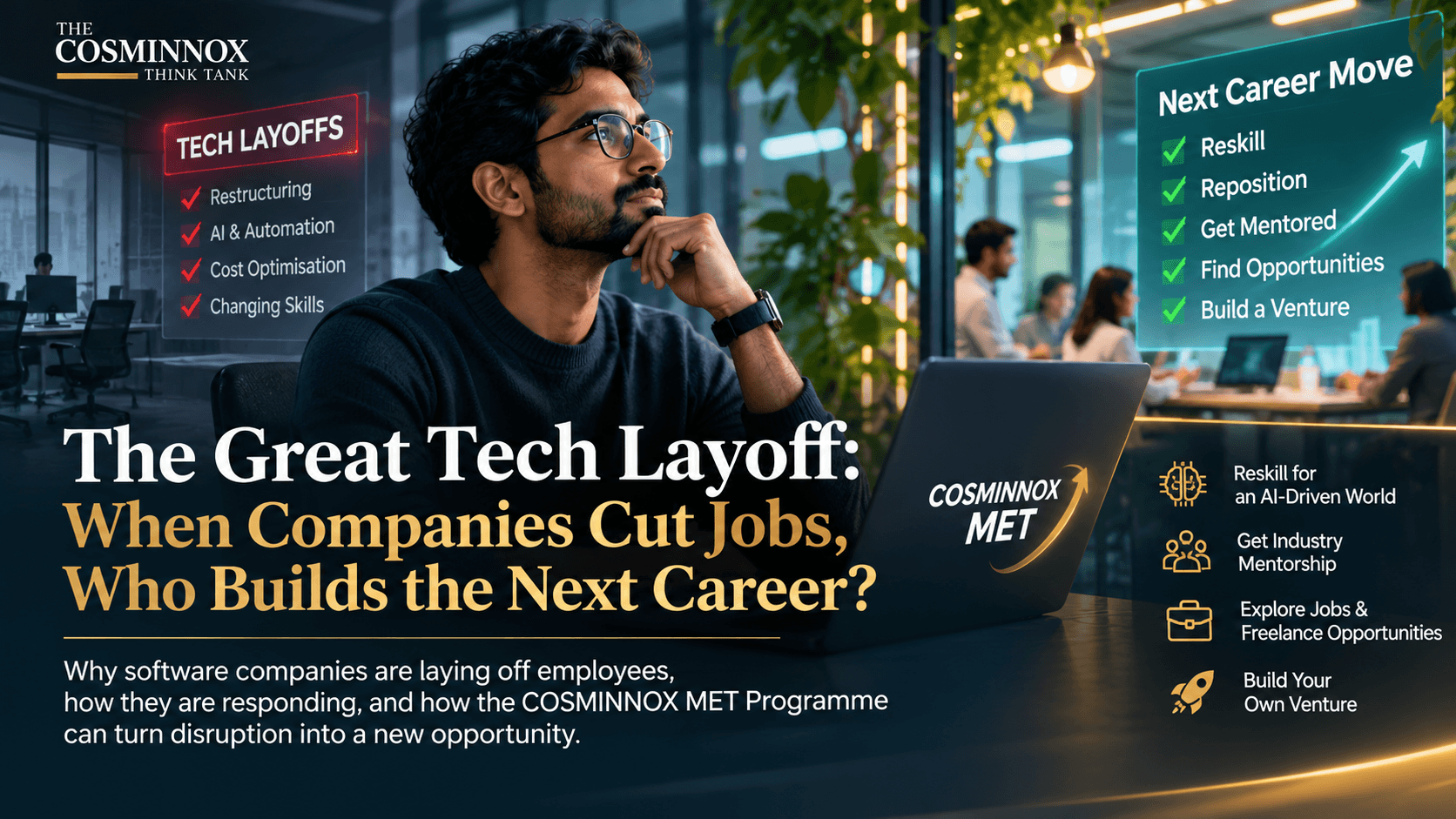
The technology industry, once celebrated for creating millions of jobs and shaping the future of employment, is now witnessing a wave of workforce reductions. From Google and Microsoft to Amazon, Canva and India's IT giants, companies are cutting jobs even as investments in artificial intelligence continue to accelerate. But what is driving these layoffs—economic pressure, technological advancement or a fundamental shift in the skills businesses demand?
Beyond corporate restructuring and profit margins lies a more pressing concern: what happens to the professionals whose careers are suddenly disrupted? As companies redefine their workforce needs, the responsibility to prepare people for the next phase of employment becomes increasingly important. This is where the COSMINNOX MET Programme could play a meaningful role, bridging the gap between job displacement, emerging opportunities and career reinvention.
The Layoff Paradox: Profitable Companies, Disappearing Jobs
For decades, a job in the technology sector represented financial security, professional advancement and participation in a rapidly expanding global industry. Today, that promise is being tested.
According to figures reported by Business Standard from Layoffs.fyi, 128,536 technology employees across 299 companies had been affected by layoffs globally by 10 September 2026—already exceeding the tracker’s reported total for 2025. These are reported tracker figures, not a comprehensive official census of every technology job lost.
Industry News - Business Standard+1
Reported tech layoffs
128,536
January–10 September 2026
Companies affected
299
Across the global tracker
The contradiction is striking. Technology companies continue to invest in artificial intelligence, cloud infrastructure and advanced computing, yet many are simultaneously reducing their workforces.
But these layoffs are not explained by a single factor. Some reflect automation. Others result from excessive hiring during the pandemic, slower customer spending, management restructuring or the diversion of capital towards new technology.
The bigger structural change is that business growth no longer necessarily translates into proportional employment growth.
Why Are Software Companies Laying Off Employees?
Artificial intelligence and automation
AI-assisted coding, customer-service agents, automated testing and routine data processing are changing the amount and type of human labour required. However, AI adoption does not prove that every eliminated position was directly replaced by a machine.
Correction of pandemic-era overhiring
Companies expanded aggressively during the digital boom of 2020–2022. As growth normalised, some discovered that their organisational structures were larger than their current requirements.
Flatter organisations and reduced costs
Businesses are eliminating overlapping departments, reducing management layers and consolidating functions to accelerate decision-making and improve operating margins.
Changing investment priorities
Money previously allocated to conventional expansion and staffing is increasingly being directed towards AI infrastructure, data centres, cybersecurity and specialised computing.
Economic uncertainty and changing client demand
Delayed projects, pricing pressure and cautious corporate technology spending are particularly important for IT services companies dependent on outsourced contracts.
The distinction matters. A company restructuring because of weak demand faces a different problem from one using AI to redesign its operating model. The remedies and the skills employees need—will also differ.
Why companies say they are cutting
Companies give three explanations, and they are not the same thing. Figures are as of 6 November 2026 and come mostly from press reporting of company statements and filings.
1. Funding AI spending. Oracle's annual filing states that adopting and deploying AI across its operations has resulted, and may continue to result, in workforce reductions (TechCrunch, 25 Jul 2026). Atlassian's CEO said the March cuts would "self-fund" further investment in AI and enterprise sales (The People's Board, 16 Mar 2026). Meta tied its cuts to making room for AI spending, per Quartz's review of 18 companies (Quartz).
2. Reshaping the skill mix. TCS said its 2025 reductions, about 2% of staff (12,261 people), were mainly in middle and senior grades where redeployment was not feasible (PTI via The Week, 27 Jul 2025). Its CEO told Moneycontrol the move was about skills mismatch, not an AI productivity gain (Moneylife, 28 Jul 2025).
3. Correcting earlier hiring. One report says an activist investor argued Snap had over-hired before its April cut of roughly 1,000 jobs (Intellizence tracker). This is a third-party claim, not Snap's own statement.
Quartz found that seven of ten enterprise-software firms it reviewed tied job losses to AI through executive statements or press reports (Quartz). The wording matters: a stated link is not proof that AI caused the cut.
Which Companies Are Laying Off Employees—and What Are They Saying?
The following figures describe reported 2026 workforce reductions or announcements, not necessarily identical reporting periods.
Company | Reported scale | Company's explanation or response |
|---|---|---|
Oracle | About 21,000 over 12 months | Workforce restructuring alongside major AI and cloud investment |
Amazon | Approximately 16,000 in January | Fewer management layers, greater ownership and reduced bureaucracy |
Meta Platforms | Approximately 8,000 in May | Efficiency measures and resource allocation towards AI investment |
Microsoft | Approximately 4,800 in July | Changing customer needs, business restructuring and workforce redeployment |
Salesforce | Fewer than 1,000 in February | AI-enabled efficiencies, including lower support staffing requirements |
Tata Consultancy Services | Approximately 12,200 planned for FY2025–26 | Skills realignment and organisational restructuring, particularly in middle and senior roles |
Sources: company statements and reporting by Reuters, TechCrunch, The Guardian and Business Standard. TCS is shown separately because its figure refers to a financial-year plan announced in 2025.
What corporate responses reveal
Amazon: Organisational simplification. Amazon's January 2026 communication emphasised reducing bureaucracy and increasing ownership. It offered most affected US-based employees a 90-day internal job-search period, followed by applicable severance and transition support. The company also stated that hiring would continue in strategic areas.
Microsoft: Redeployment alongside reductions. Microsoft's leadership linked its restructuring to changes in how technology is developed and used. The company reported that more than 4,000 employees had been redeployed into new roles over the preceding year, illustrating an alternative to relying exclusively on separation.
Salesforce: A more direct automation argument. Salesforce acknowledged that efficiencies from its Agentforce technology had reduced its need to refill certain support positions. This represents a clearer corporate connection between AI productivity and staffing requirements.
TCS: A warning for India's employment model. The planned reduction of approximately 2% of its workforce challenged the assumption that India's largest IT services employers could indefinitely sustain traditional staffing structures. Its restructuring also reflected changing client requirements and the need for different capabilities.
These explanations may be commercially rational, but they are not complete assessments of whether every affected employee was treated fairly. Corporate efficiency and employee welfare must be evaluated separately.
Who has cut, and how much
Trackers count differently, so totals are a range, not a figure. A Financial Times analysis cited by TechCrunch put US tech cuts near 140,000 by late July 2026; TechRepublic reported about 196,000 workers affected by 23 October; Quartz reports more than 200,000. For context, Layoffs.fyi recorded 122,549 tech layoffs in 2025 and 152,922 in 2024 (NerdWallet).
Company | Announced | Scale | Stated reason (as attributed) |
Apr–Jun 2026 | About 21,000, per its annual filing | Filing says AI adoption has led to workforce reductions | |
Jan–Feb 2026 | About 16,000 corporate roles (about 30,000 with Oct 2025 round, per Layoffs.fyi-based rankings) | Reported as shifting resources to AI infrastructure and data centres | |
May 2026 | About 8,000 (10%); about 7,000 moved to AI roles | CEO told staff success in AI "isn't a given" | |
Jul 2025 (FY26) | 12,261 (about 2%), mainly middle and senior grades | Company: redeployment not feasible; CEO: not an AI productivity gain | |
Apr 2026 | Voluntary retirement offered to about 8,750 US staff (7%) | Reported alongside AI capital spending; first such offer in its history | |
May 2026 | About 4,000 (under 5%) | Refocus on AI chips, optics and security | |
11 Mar 2026 | About 1,600 (10%); about 16% of cuts in India | CEO: to self-fund AI and enterprise sales | |
16 Apr 2026 | About 1,000 (16%) | CEO cited AI advances | |
May 2026 | About 1,000 (20%) | AI cited; CEO also pointed to a currency squeeze (Quartz) | |
Jul 2026 | About 630 (20%) | Pivot to an AI platform | |
3 Jun 2026 | About 350 (14%) | To fund AI infrastructure and handle AI-driven traffic | |
Canva | 4 Nov 2026 | Up to 1,271 roles (22% of headcount) affected by layoffs, role changes or relocations; its first major restructure | CEO Melanie Perkins called 2026 its "hardest year yet" as growth slowed for the first time in a decade; coverage reviewed frames it around slower growth, not AI |
Google (Alphabet) | Rolling, Feb–Aug 2026 | No company-wide total verified; tracker lists buyouts in a business unit (10 Feb), Cloud reductions and local cuts such as 52 roles in Washington (Aug) | Coverage links it to AI-led restructuring; no company-wide statement found in sources reviewed |
Figures for Amazon, Cisco, Wix and Monday.com come from tracker compilations, not company filings. They should be checked against primary disclosures before being quoted elsewhere.
Canva sources: In Daily, 4 Nov 2026, Forbes Australia, ACS Information Age. Canva has not published a detailed severance schedule in the sources reviewed. Google source: a third-party tracker compiling Business Insider and CNBC reports; treat it as Tier 3 until checked against Alphabet's filings.
How companies responded
Responses fall into four types: cash severance, voluntary exit, internal redeployment, and public explanation. The table lists what each company stated or what was reported, with criticism shown where a named source recorded it.
Company | Exit terms or alternatives | Communication and criticism on record |
At least 16 weeks' base pay, extra pay by years of service, prorated FY2026 bonus, up to six months' healthcare | CEO published a memo and apology video; one report says affected staff were emailed 20 minutes after it and given six hours of Slack access (LetsDataScience) | |
Voluntary retirement for staff whose age plus service is 70 or more; 30-day decision window; severance, healthcare and stock vesting reported (TechRepublic) | Commentators described it as a buyout framed as a benefit (The Next Web) | |
Internal job search before separation dates; otherwise severance, outplacement and extended health cover | Business Insider's review found Amazon the only "Magnificent Seven" firm to disclose severance costs fully: $2.7 billion through 2025 (via Startup Amsterdam) | |
About 7,000 staff moved into AI roles while about 8,000 were cut; about 6,000 open roles closed (Quartz) | Blind's Future of Work 2026 report calls Meta the severance benchmark (Blind); this is a platform report based on employee discussion, not an audit | |
Severance reported at up to 26 weeks (figure from a secondary summary) | Criticised for a 6 a.m. email and system lockout, per HR Executive's coverage | |
Says it is tripling entry-level hiring for AI and hybrid-cloud roles alongside cuts | Company statement, not independently verified | |
Notice pay, severance, extended insurance, outplacement and counselling | Unions alleged forced resignations (TNM); the Karnataka Labour Department convened a conciliation meeting (Analytics India Magazine). These are allegations and a process, not findings | |
Voluntary exit and buyout programmes since 2025; its CEO said they followed employee requests for an alternative to blanket layoffs (CNBC, via a tracker) | More than 4,500 employees signed an Alphabet Workers Union petition delivered 16 Jul 2026, seeking guaranteed severance and buyouts before mandatory layoffs. Google's reply was not found in sources reviewed | |
Canva | Some staff to be asked to move to centralised hubs rather than exit; severance terms not located | CEO said the restructure followed months of thinking about the next chapter. Context: investor Blackbird cut its valuation of Canva 17% to US$34.9 billion in Aug 2026 |
One India-specific legal point: unions argued that employers with more than 100 workers need prior government permission for retrenchment under the Industrial Disputes Act, 1947 (Business Today). Karnataka's labour minister said sunrise-sector firms had been exempt from some labour provisions, and the state would review that leniency (Dhanam). This piece does not assess whether the Act applied to TCS's case.
Which company handled it well?
The evidence does not support naming one winner, and COSMINNOX does not rank companies without an outside source doing so. What the sources do support is a set of practices that employees and HR researchers treat as better, and where each company shows them.
• Pay relative to peers. Blind's report says employees read generous severance as a sign of respect and names Meta as the benchmark for the first half of 2026 (Blind). HR Executive's coverage examined Oracle's severance package against peer benchmarks (HR Executive via Pulse). Atlassian's floor was 16 weeks plus service-based pay.
• Choice before compulsion. Microsoft offered voluntary exit first, and more than 4,500 Google employees petitioned in July 2026 for buyouts to come before layoffs. HR Executive's headline describes its approach as buyouts first, layoffs second (HR Executive).
• Redeployment. Randstad Enterprise, an outplacement vendor, calls redeployment one of the most effective ways to manage downsizing (Randstad). Meta's move of about 7,000 staff into AI roles and Amazon's internal job search are examples; TCS also cites redeployment efforts.
• How the news is delivered. Oracle's 6 a.m. lockout drew criticism, and one report describes a similar tight window at Atlassian. Blind's report concludes that employees remember how layoffs are handled as much as the layoffs themselves.
A cost sits behind all four. A Glassdoor analysis reported by The Queen Zone found that current employees' ratings fall after layoffs and stay lower for at least 21 months (The Queen Zone). That is a secondary account of the analysis.
None of the sources reviewed scores companies across all four practices. A reader choosing an employer, or a firm designing its own process, should compare the terms above rather than rely on a single label.
Counter-evidence: hiring has not stopped
The strongest data against a collapse narrative is India's own IT services sector. In the September quarter of fiscal Q2 FY27 (Jul–Sep 2026), the five largest firms added a combined 13,918 net employees, and first-half additions reached 24,398 against 2,689 a year earlier (Free Press Journal).
Company | Net headcount change, Q2 FY27 |
HCLTech | +6,450 |
Tech Mahindra | +5,446 |
+4,480 | |
TCS | +4,258 |
−6,716 |
Six points qualify this picture:
• Net is not gross. Infosys hired more than 8,000 freshers in the quarter and kept its FY27 target of about 20,000. A net figure also reflects departures.
• The year view is weaker. Xpheno data reported by The Economic Times, via The People's Board, shows combined headcount across six large IT firms fell by nearly 24,000 over the past year (The People's Board).
• Mix is changing. Angel One's summary says demand for AI, cloud, cybersecurity and specialised engineering talent grew about 16% year on year while overall IT hiring fell about 3%, and that experts do not yet see a broad recovery (Angel One).
• Wipro's cause is undisclosed. Its datasheet shows the 2.8% fall but gives no reason; large-deal bookings also fell 58.6% sequentially (HRKatha; Lapaas Voice). One analysis stresses the fall alone does not prove AI caused it.
• AI attribution is contested. TCS's CEO denied an AI productivity gain was behind its cuts. Atlassian's CEO said its approach is not that AI replaces people. One analysis of Atlassian's cuts concludes the honest answer for many firms is both transformation and cost reduction (AI2 Work).
• Some firms are hiring at the entry level. IBM says it is tripling entry-level hiring for AI and hybrid-cloud roles (TechCrunch).
The COSMINNOX MET Programme: From Job Displacement to Career Reinvention
Proposed programme framework for COSMINNOX, subject to confirmation of MET's existing scope, partnerships and delivery capabilities.
This disruption presents an opportunity for the COSMINNOX MET Programme to develop a focused workforce-transition initiative.
Rather than functioning as another certificate-oriented training course, MET could position itself as a mentorship, employability and career-transition ecosystem, connecting professionals with emerging industry requirements, practical projects and entrepreneurial opportunities.
Its purpose should not be to promise that every displaced employee will find a job. Its purpose should be to make career transitions more informed, structured and measurable.
PROPOSED MET CAREER-TRANSITION MODEL
Career assessment
Identify experience, strengths, skill gaps and financial constraints
Employment pathway
AI skills, technical projects, employer readiness
Enterprise pathway
Freelancing, consulting, startup validation
Mentorship + Industry Projects + Professional Network
Portfolio evidence, interviews, referrals and business opportunities
Measurable Career Outcomes
Job transitions • Freelance contracts • Business launches • Demonstrated skills
How MET could distinguish itself
The strongest differentiator would be combining technical adaptation with professional and entrepreneurial development.
A laid-off software engineer may not need another introductory coding course. They may need help translating ten years of experience into an AI-enabled consulting service, a cybersecurity specialisation, a product-management role or a technology venture.
MET could offer individual transition planning, practical mentorship, industry-relevant assignments and introductions to prospective employers or clients, where partnerships are available.
The programme could also support organisations undertaking restructuring by providing a structured external outplacement pathway.
7. A Proposed 90-Day MET Career-Transition Plan
Illustrative programme design, not a confirmed existing MET curriculum.
01
Days 1–15
Assess and Reposition
Career counselling, skill-gap assessment, professional profile review and selection of an employment or entrepreneurship pathway.
Target output: Individual Career Transition Roadmap
02
Days 16–35
Build Future-Ready Capabilities
Role-specific learning in AI-assisted workflows, data analytics, cybersecurity, cloud operations, product thinking or business development, based on individual needs.
Target output: Skill assessment and learning evidence
03
Days 36–60
Apply Skills to Real Problems
Mentor-guided portfolio projects, practical case studies, client simulations or business-model validation.
Target output: Demonstrable project portfolio
04
Days 61–75
Connect with Opportunities
Interview preparation, portfolio presentations, networking, employer outreach, freelance proposals and entrepreneurship mentoring.
Target output: Applications, professional introductions or tested business proposals
05
Days 76–90
Launch the Next Career Move
Targeted job-search support, freelance market entry, startup pitching or a further specialised development plan.
Target output: Career action plan with measurable next steps
The 90-day period should be understood as a structured intervention, not a guaranteed timeline for employment or business success.
What Could Participants Gain from Joining MET?
Participant | Potential benefits |
|---|---|
Laid-off IT professional | Career repositioning, updated skills, portfolio development and job-search support |
Fresh graduate | Practical projects, professional mentoring and stronger entry-level readiness |
Mid-career manager | Leadership transition, AI-enabled management skills and consulting opportunities |
Aspiring entrepreneur | Business-model development, market validation and pitch preparation |
Freelancer | Service packaging, client communication, pricing and business-development guidance |
Employer | A potential partner for responsible outplacement and workforce redeployment |
The value of membership should come from demonstrable outcomes rather than the number of sessions attended.
Participants should receive clearly defined deliverables, access to suitably qualified mentors and transparent information about any fees, employer connections or placement assistance. Certificates, if offered, should reflect verified learning rather than imply an employment guarantee.
What Should COSMINNOX Do to Make MET Work?
A credible programme requires more than a compelling concept. COSMINNOX could begin with a limited pilot before attempting national expansion.
Proposed 6-Month Pilot
50
Initial participants
90
Days of guided transition
6
Months of pilot evaluation
Recommended implementation priorities
Recruit a first cohort of 50 participants, prioritising displaced professionals and job-seeking graduates.
Establish a mentor network drawn from software engineering, AI, HR, consulting and entrepreneurship.
Develop employer and project partnerships before promising industry exposure.
Offer a limited number of sponsored places where financially feasible.
Track skills gained, portfolio completion, interviews, verified placements, freelance earnings and participant satisfaction.
Publish an independently reviewed pilot-outcome summary through COSMINNOX.
The cohort size and duration are proposed planning assumptions, not existing programme commitments.
For a think-tank platform, this final point is particularly important. COSMINNOX should assess MET using the same evidence standards it applies to the companies and institutions it examines.
If a participant obtains employment, the programme should report it. If participants remain unemployed after completing training, that result should also inform programme improvement.
The Business Opportunity: Employers Can Become Part of the Solution
MET could also develop a business-to-business model in which companies fund career-transition services for employees affected by restructuring.
A responsible employer could offer departing staff access to a defined MET transition package covering assessment, mentoring, skills development and professional networking.
This could create three forms of value.
For employees, it provides practical support beyond severance. For employers, it offers a more constructive approach to workforce transition and may strengthen trust in the organisation. For COSMINNOX, it creates the possibility of a sustainable programme supported by employer partnerships, sponsored cohorts and carefully priced professional services.
However, sponsorship must not influence COSMINNOX's independent editorial coverage. Programme partnerships, financial relationships and outcomes should be disclosed where relevant.
The COSMINNOX Verdict
“The future of work should not be measured only by the jobs technology eliminates, but by the opportunities institutions help people create.”
The technology industry is undergoing a structural transition. Artificial intelligence is changing tasks, organisations are questioning traditional staffing models, and professionals are being asked to adapt faster than conventional education systems can often support.
Companies have a legitimate responsibility to remain commercially viable. But when workforce reductions become necessary, responsible leadership should extend beyond announcing efficiencies and paying severance.
Airbnb's historical example demonstrates that employers can invest in the future of people they can no longer employ. Microsoft's reported redeployment efforts show that internal mobility can form part of restructuring. Neither approach eliminates the need to scrutinise whether the layoffs themselves were necessary or fair.
For India, the challenge is especially urgent. A workforce-development strategy built only around producing more graduates will be insufficient if the structure of entry-level employment continues to change.
The proposed COSMINNOX MET model offers one possible response: connecting professional reinvention with mentorship, applied learning, employment opportunities and entrepreneurship.
Its success, however, should not be declared at launch. It must be demonstrated through participant outcomes.
The next chapter of the technology economy will not belong exclusively to those who develop the most powerful machines. It will also depend on those who create credible pathways for people to work alongside them.
Group in the evidence | Problem on record | MET track | Intended role |
Graduates and early-career staff | Overall IT hiring fell about 3% while AI, cloud and cybersecurity demand grew about 16% (Angel One) | Employability | Direct training and project work toward the skills in growing demand |
Mid and senior professionals | TCS said cuts fell on roles where redeployment had not worked, including legacy-technology specialists (Moneylife) | Hybrid / Intrapreneur | Reskilling that keeps a person deployable inside an employer, or lets them lead new work there |
Professionals leaving or choosing to leave | Founder / Startup | Support to build and test a venture rather than only seek another post |
The programme cannot change hiring decisions at Oracle, Amazon or TCS. Its plausible contribution is narrower: helping an individual move from a role the data shows under pressure toward one it shows growing, or into self-directed work.
Indicative plan and benefits for a participant
The 90-day outline below is an indicative framework written for this article. Final curriculum, fees, batch dates and mentors are set by the programme and should be confirmed at enrolment.
Period | Focus | Output a participant can show |
Days 1–30 | Diagnose current skills against the demand areas named above (AI, cloud, cybersecurity, data); choose a track | A written skills gap and track choice |
Days 31–60 | Build one applied project in the chosen area; for Founder track, test a venture idea with real users | A completed project or a venture test with results |
Days 61–90 | Present the work; apply for roles, an internal move, or a first venture milestone | A portfolio piece and a dated next-step plan |
Benefits the design is aimed at
• A direction tied to published demand data, not to a job title that may be shrinking.
• A checkable output, such as a project or venture test, which a hiring manager can read.
• A choice among three routes, employment, intrapreneurship and venture-building, instead of one.
These are design aims, not guaranteed outcomes. No placement or income result is claimed here.
Questions to put to the programme before joining
• What is the duration, fee and assessment method for each track?
• Who teaches, and what industry experience do they have?
• What outcomes have previous participants recorded, and how were they measured?
What the evidence does and does not establish
Established, as of 6 November 2026: software and technology cuts in 2026 are large by any tracker, concentrated in a few big firms, and many of those firms, including Oracle, Meta and Atlassian, state a link to AI spending or AI-driven restructuring. Canva's November restructure was framed around slower growth, and Google's 2026 record shows buyouts and local cuts but no verified company-wide total. Indian IT services added jobs net in the September quarter, though the one-year view and the skill mix are weaker.
Not established: that AI itself caused any given cut; that any one company handled its layoffs best; or that the COSMINNOX MET programme improves participants' outcomes, since no outcome data is cited.
The practical reading is narrow. The roles under pressure in the reporting are legacy-technology and middle-management positions, and the roles in demand are in AI, cloud, cybersecurity and specialised engineering. A professional's best-supported response is to move toward the second group and to compare exit and training terms carefully before committing to any employer or programme.
Sources
Figures are as of 6 November 2026. If any figure is updated after publication, add a dated correction note rather than editing silently.
• TechCrunch running list of 2026 AI-cited layoffs, 25 Jul 2026
• Quartz, 10 sectors hit by 2026 tech layoffs and 18 companies by share of workforce cut
• Programs.com, AI-driven layoffs list (Oracle filing figure)
• TechRepublic, 2026 layoffs tracker, 23 Oct 2026
• NerdWallet, tech layoffs 2024 and 2025 totals
• PTI via The Week, TCS layoffs, 27 Jul 2025; Moneylife, 28 Jul 2025
• Business Today, Atlassian layoffs, 12 Mar 2026; The People's Board, 16 Mar 2026
• HR Executive, Microsoft buyouts first, layoffs second; The Next Web, 23 Apr 2026
• Free Press Journal, Indian IT hiring Q2 FY27; Angel One, H1 FY27 hiring; HRKatha, Wipro, 16 Oct 2026
• Business Today, union complaint on TCS, 31 Jul 2025
• In Daily, Canva restructure, 4 Nov 2026; Forbes Australia; ACS Information Age
• Business Today, Google employee petition, 22 Jul 2026; Careery tracker, Google layoffs