The constitutional design: what the office is built to do
Before assessing any presidency's record, the office's formal powers need stating plainly, because they are frequently misunderstood.
Article 52 establishes the office of President of India; Article 53 vests the executive power of the Union in the President, to be exercised directly or through subordinate officers.
Article 74 requires the President to act on the aid and advice of the Council of Ministers headed by the Prime Minister. Following the 44th Amendment (1978), the President may return advice once for reconsideration, but must act on the Council's advice once reconsidered — meaning the President's day-to-day role in most formal acts (assenting to bills, addressing Parliament, receiving foreign dignitaries) is constitutionally bound rather than independently discretionary.
Article 111 governs assent to bills passed by Parliament: the President may give assent, withhold assent, or return a non-money bill for reconsideration once. If Parliament re-passes it, assent is not textually mandatory but has, by convention, generally followed.
Article 123 allows the President to promulgate ordinances when Parliament is not in session, again on ministerial advice.
Article 72 grants the power to pardon, and to suspend, remit or commute sentences, including death sentences — one of the few areas where individual presidents have historically exercised visible discretion in practice.
Article 143 allows the President to refer questions of law or fact of public importance to the Supreme Court for an advisory opinion; the Court may decline to answer, and its opinion is not binding, though it carries strong persuasive weight.
Article 60 binds the President by oath to preserve, protect and defend the Constitution; Article 61 provides the sole removal mechanism, impeachment for constitutional violation, a power never yet used.
The design, in short, gives the President formal primacy over the paper record of the Republic — every Act of Parliament, every ordinance, every pardon carries the President's name — while leaving substantive policy discretion with the elected Council of Ministers. Individual presidencies are distinguished not by how much power they hold on paper, which is constant, but by how they use the narrow bands of genuine discretion the office does have: returning advice, timing pardons, and — rarely — invoking Article 143.
The record of the first term, July 2022–July 2026
President Droupadi Murmu, born June 20, 1958, in Uparbeda village, Mayurbhanj district, Odisha, to a Santhal family, was sworn in as the 15th President on July 25, 2022, with the oath administered by then Chief Justice N.V. Ramana [Office of the President of India, "Profile"; ThePrint, July 25, 2022]. She had served as the ninth Governor of Jharkhand from 2015 to 2021, the longest tenure of any governor of that state, and is recorded as the first President born after Indian independence, the youngest to hold the office, the second woman after Pratibha Patil, and the first from a Scheduled Tribe [Office of the President of India, "Profile"].
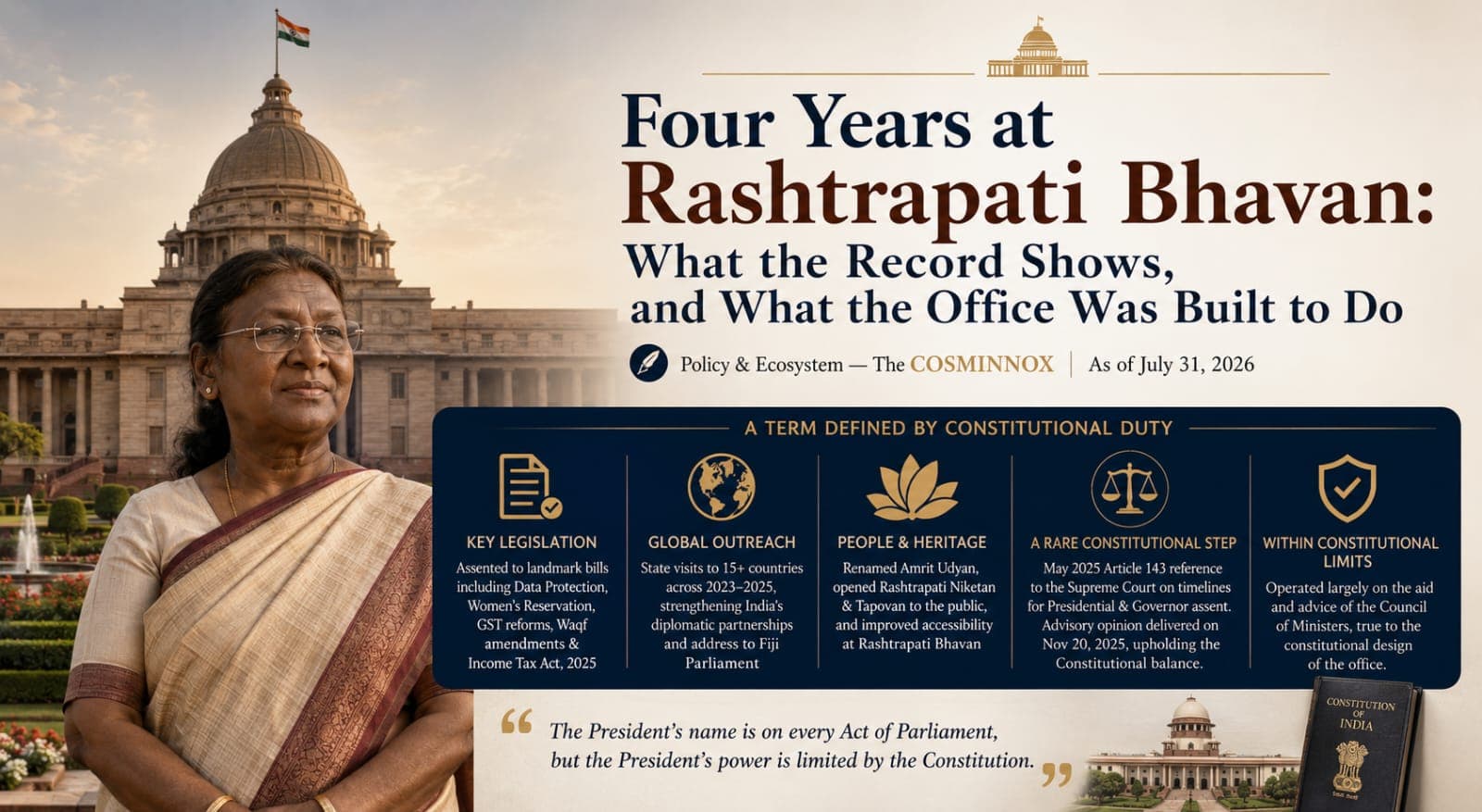
Over the term, the office's assent record includes the Digital Personal Data Protection Bill (August 2023), the Women's Reservation Bill (Nari Shakti Vandan Adhiniyam, September 2023) providing 33 percent reservation for women in the Lok Sabha and state assemblies, GST amendment legislation the same year, and in 2025 the Waqf (Amendment) Bill, the Mussalman Waqf (Repeal) Bill, and the Income Tax Act, 2025. In June 2025, a Jammu and Kashmir Reservation (Amendment) Ordinance extended job reservation to Ladakh residents. Foreign engagements included state visits to Suriname and Serbia (2023); Mauritius, Fiji, New Zealand, Timor-Leste, Algeria, Mauritania and Malawi (2024), including an address to Fiji's Parliament; and Vatican City, Portugal, Slovakia, Angola and Botswana (2025). Domestically, changes at the estate include the renaming of the Mughal Gardens to Amrit Udyan, the opening of Rashtrapati Niketan and Rashtrapati Tapovan to the public, and accessibility modifications for persons with disabilities.
Under the constitutional framework above, this body of activity is best read as the record of formal acts performed on ministerial advice, foreign visits undertaken as head of state, and estate-management decisions within the President's own administrative remit — not as evidence, on its own, of independent policy initiative by the office.
The genuine exception: the May 2025 Article 143 reference
The one item in the four-year record that sits outside routine, advice-bound function is the reference President Murmu made to the Supreme Court on May 15, 2025, posing 14 questions under Article 143(1) — the 16th Presidential Reference in the Court's history — asking whether courts may impose timelines on the President and Governors for acting on bills, following an April 8, 2025 Supreme Court ruling in the Tamil Nadu Governor case that had set such timelines and invoked "deemed assent" [Bar & Bench, May 16, 2025; Supreme Court Observer, November 20, 2025]. A five-judge Constitution Bench delivered its advisory opinion on November 20, 2025, holding that Governors and the President cannot be bound by judicially prescribed timelines to act on bills, that courts cannot deem a bill to have received assent, and that the Tamil Nadu Governor ruling's reasoning on Article 200 was erroneous on those specific points [Supreme Court Observer, November 20, 2025]. The Centre had argued before the Bench that Articles 200 and 201 deliberately contain no deadlines and that judicially imposed timelines would upset the constitutional balance between the executive, legislature and judiciary [PIB/News on Air, August 16, 2025].
This is worth flagging precisely because the original record, compiled closer to the reference's filing, described the matter as still pending before the Court. As of July 2026, the advisory opinion has been delivered, and it resolved substantially in favour of the position the reference itself advanced.
How this compares with previous presidencies
Comparing the exercise of genuine discretion — as opposed to the routine paper record — situates the current term within a longer pattern:
Giani Zail Singh (1982–87) used the so-called "pocket veto" on the Indian Post Office (Amendment) Bill, 1986, neither assenting to it, rejecting it, nor returning it, leaving it to lapse — the most cited instance of a president unilaterally stalling legislation he considered a threat to privacy.
A.P.J. Abdul Kalam (2002–07) returned the Office of Profit Bill for reconsideration in 2006, exercising the Article 111 return power explicitly, though Parliament re-passed it and he then gave assent.
K.R. Narayanan (1997–2002) was noted for sending Council of Ministers' recommendations under Article 356 (President's Rule) back for reconsideration on more than one occasion — an unusually visible use of the "return advice once" mechanism under Article 74.
Fakhruddin Ali Ahmed (1974–77) signed the 1975 Emergency proclamation on the night it was presented, an episode frequently cited in constitutional discussion as the clearest illustration of how binding ministerial advice can be even in matters of the highest consequence.
Article 143 references themselves are rare. The Murmu reference was only the 16th in the Supreme Court's history since 1950, underscoring that invoking this specific power — as opposed to routine assent or ceremonial functions — is exceptional regardless of which President exercises it.
Set against this history, the current term's profile — heavy on routine assent and diplomatic activity, with one high-visibility Article 143 reference — is consistent with, rather than a departure from, the pattern of most modern presidencies: long stretches of constitutionally bound activity, punctuated occasionally by a single visible assertion of the office's narrow independent powers.
What the evidence does and doesn't establish
The four-year record shows a presidency whose formal activity — legislative assent, foreign visits, estate administration — falls within the ordinary, advice-bound functioning the Constitution assigns the office under Articles 53 and 74, and is not, by itself, evidence of expanded presidential power. It does show one clear instance of the office exercising a rare, constitutionally provided independent power — the Article 143 reference — whose eventual resolution in November 2025 became part of the binding jurisprudence on Governor and President assent timelines going forward. Whether that single reference marks a lasting shift in how future presidents use Article 143, or remains, like most such references, an isolated event, is not something the four-year record on its own can establish.
Correction protocol: if any figure or procedural detail in this piece is updated following further reporting, a dated correction note will be added here rather than a silent edit.