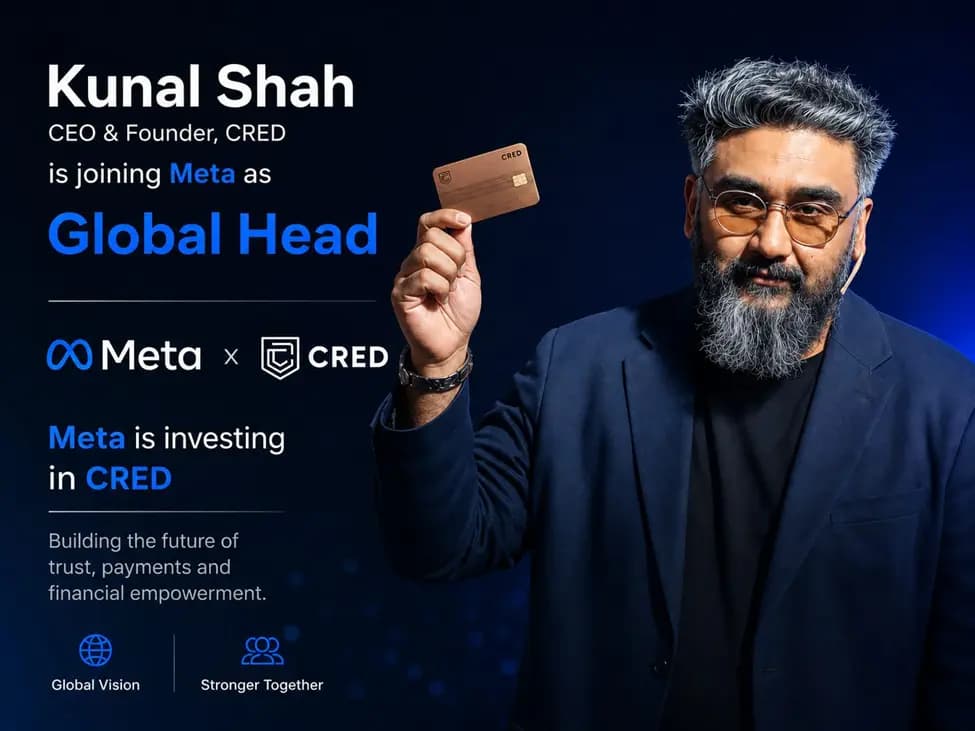
The man who built CRED on a single question — why can’t trust be rewarded? — is stepping back to run WhatsApp for 3 billion people, as Meta writes a $900 million cheque into the company he leaves behind. It marks a monumental shift in the global technology landscape, combining an unprecedented financial layout with an equally rare talent acquisition.
From FreeCharge to a Founder's Pause
Shah sold FreeCharge to Snapdeal in 2015 for roughly $400–450 million, then spent three years as one of India's most prolific angel investors — backing more than 250 startups — while turning over a problem FreeCharge had only brushed against: India rewards spending but has no real system for rewarding discipline. CRED, founded in 2018 with $1 million of his own money, answered that with deliberate exclusivity — membership capped to users with a credit score above 750.
By FY25 it counted 17 million monthly active users moving ₹8.5 lakh crore a year, with average revenue per user nearly one-and-a-half times the broader UPI norm.
Meta's Third Attempt at Indian Payments
On June 22, 2026, Meta led a $900 million round into CRED — fresh capital plus secondary purchases — valuing it at $4.5 billion, an approximate 20% stake, no board seat, and, Shah said explicitly, no access to member data. It is Meta's third crack at the same equation: WhatsApp Pay launched in India in 2018 but stayed capped by regulation for years, and the $5.7 billion Jio bet in 2020 didn't move the needle either. This time Meta is buying into India's highest-value user cohort rather than building one from scratch.
“Why can’t trust be rewarded?”
— Kunal Shah, Founder, CRED
The Real Prize: Kunal Shah Himself
The bigger move is personnel. Shah is stepping down from CRED's daily operations to become Global Head of WhatsApp, relocating to Menlo Park and succeeding Will Cathcart, who grew the app from one billion to three billion-plus users. Mark Zuckerberg credited Shah with building “one of India's most important technology companies” and the “builder mentality” the role needs.
The brief centres on advertising, subscriptions, business messaging, commerce, and AI agents — with India, WhatsApp's largest market at 500 million-plus users, central to it.
The Last Word
Strip away the valuation and the relocation, and what's left is a familiar Shah pattern: spot a system that misallocates trust, build something narrow to fix it, then hand it off and chase the same question at a larger scale. WhatsApp, three billion users deep with a famously thin monetisation layer, may simply be that question asked again — at the size of the entire world.
The Cosminnox • Reporting based on public statements from Kunal Shah, Mark Zuckerberg, and Miten Sampat, and reporting from TechCrunch, Reuters/Yahoo Finance, Inc42, Business Today, and CRED's official disclosures.