AUGUST 2026
01 THE SCALE, BY THE GOVERNMENT'S OWN NUMBERS
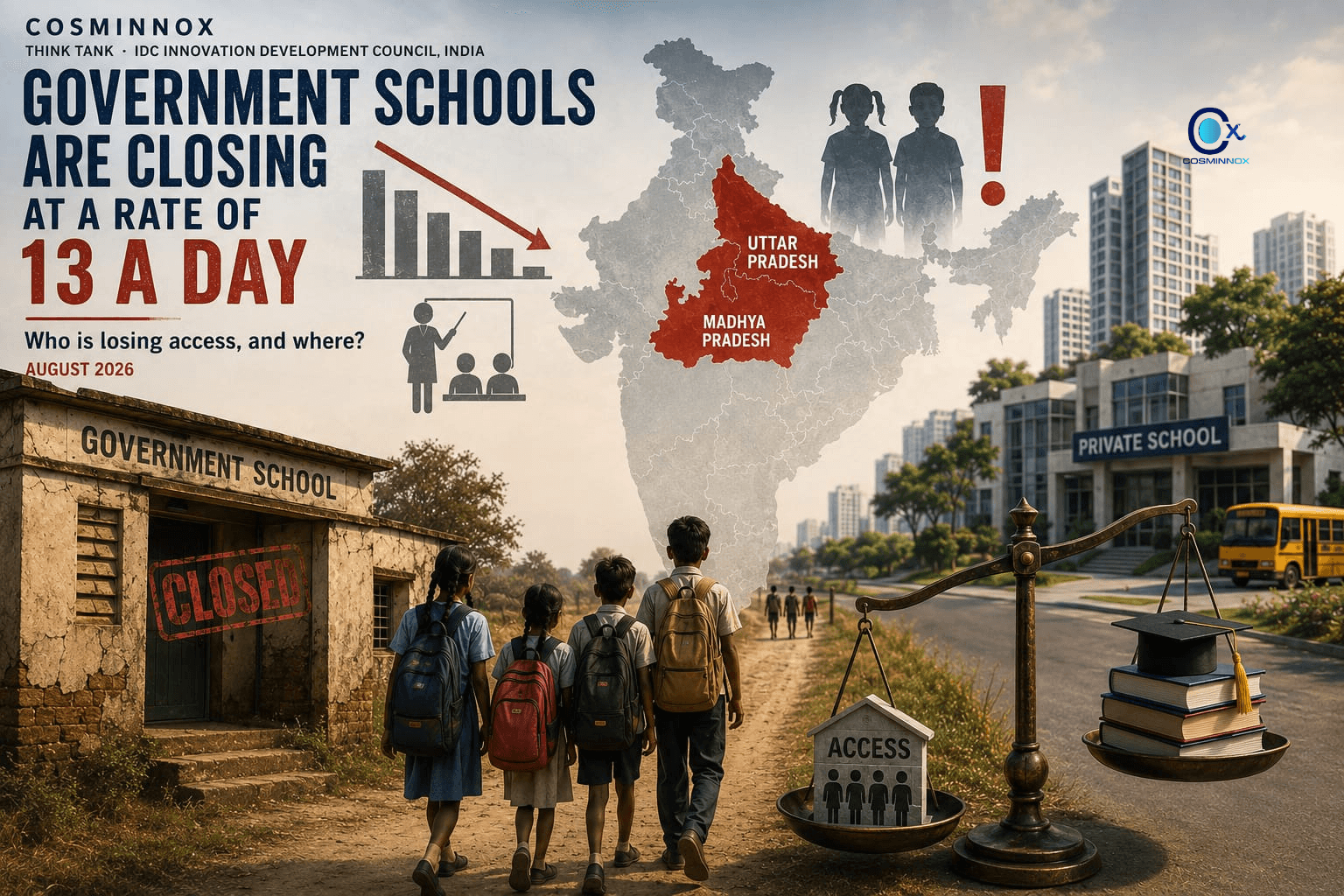
Responding to a Lok Sabha question from CPI(M) MP Amra Ram, the Union Minister of State for Education told Parliament that India closed more than 93,000 schools over the preceding ten years, with the steepest phase concentrated between 2014-15 and 2019-20.
Source: Lok Sabha written reply, Union Ministry of Education, February 2, 2026.
Period | Schools closed | Source |
2014-15 to 2019-20 | 70,000+ | Lok Sabha written reply |
2020-21 to 2024-25 | 18,727 | Lok Sabha written reply |
— of which 2023-24 to 2024-25 | 4,338 | UDISE+ 2024-25 |
2024-25 to 2025-26 | 8,077 | UDISE+ 2025-26 |
10-year total (to 2024-25) | 93,000+ | Lok Sabha written reply |
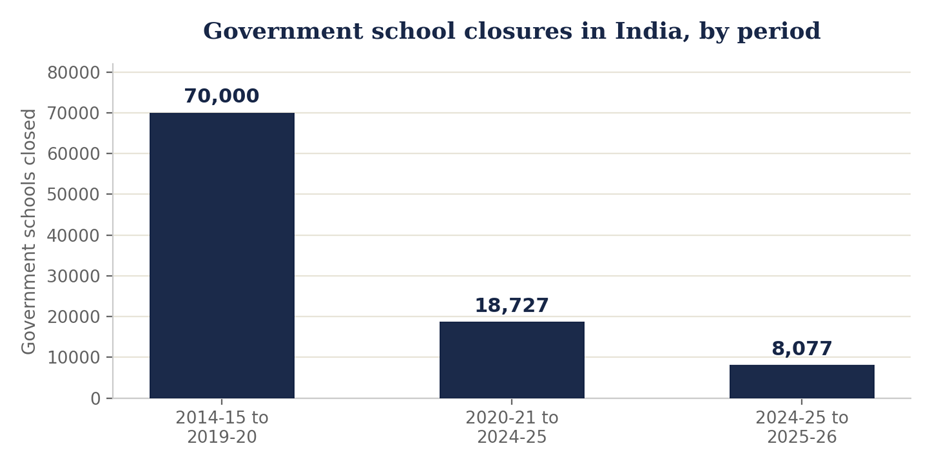
Closure pace has slowed year-on-year but has not stopped.
The pace of closure has slowed year-on-year, but the 10-year total remains concentrated in two states. Media analysis of the latest UDISE+ cycle found Madhya Pradesh alone accounted for 2,426 of the most recent year's closures — over half the national total in that count — while national government-school enrolment fell by over 26 lakh children even as private-school enrolment rose by 30 lakh in the same period.
Sources: UDISE+ 2025-26, Ministry of Education; NDTV analysis, cited in Himalayan Geographic.
State | Closures, 2014-15 to 2024-25 | Rank |
Uttar Pradesh | 24,590 | 1st nationally |
Madhya Pradesh | 22,438 | 2nd nationally |
Over the longer term, government schools' share of total enrolment fell from more than 70% in 2005 to below 50% by 2024-25.
Source: Policy Circle analysis of UDISE+ data.
02 WHO IS DOCUMENTED AS BEARING THE COST
State-level tracking data — not a single national study — links these closures to rising dropout risk, concentrated in the most-affected states:
State | Documented impact | Source (Tier 3, attributed) |
Madhya Pradesh | 7.37 lakh children with no active school record; ~29,000 at immediate dropout risk in Jhabua, Shivpuri; 3,500+ schools with zero admissions; 6,500 schools with under 10 students | School Chalen Hum state campaign data, cited by Akka IAS |
Uttar Pradesh | 56,000 girls dropped out in 2025; 99,218 total out-of-school children | State data (Sehgal 2025), cited in The India Forum |
Gujarat | ~5,000 government schools closed; dropouts rose 341% in 2025; adolescent girls out of school rose to 1.1 lakh, from 54,541 the year before | State data (Sehgal 2025), cited in The India Forum |
National | 29.8 lakh girls dropped out over five years — nearly half of 65.7 lakh total out-of-school children | State data (Sehgal 2025), cited in The India Forum |
An independent tracking analysis of UDISE+ compliance data found that RTE distance-norm compliance fell by an average of 7% following school consolidation, worsening further in 2024-25 — a proxy for how many children now live farther from the nearest functioning government school than the law requires.
Source: Education for All in India, analysis of UDISE+ data.
03 THE COUNTER-EVIDENCE: THE GOVERNMENT'S RATIONALISATION CASE
The Union government's position, restated in courts and Parliament, is that closures are driven by declining enrolment and demographic change, not policy intent to reduce access.
In Krishna Kumari v. State of UP (2025), the Allahabad High Court approved a school merger, accepting the state's argument that larger consolidated schools offer better infrastructure, while acknowledging RTE's neighbourhood-school mandate. The Union government has also argued in Parliament that school education falls under the Concurrent List, making closures principally a state administrative matter. Karnataka's education minister has publicly stated in the state assembly that no government school in the state is being shut, even as activist groups report merger orders reaching individual schools. |
Sources: Allahabad High Court judgment, cited in The India Forum; Lok Sabha proceedings, cited by KPI Academy; Careers360, December 8, 2025.
04 WHY SCHOOLS ARE CLOSING
Sourced data points to several compounding factors rather than a single cause.
Factor | What the data shows |
Demographic shift | Falling fertility rate and consolidation account for part of the decline in government school count. |
Private-school shift | NITI Aayog's 2026 report identifies a growing shift of students toward private institutions as a key driver of declining government enrolment. |
State rationalisation policy | States apply explicit enrolment thresholds — e.g. Uttar Pradesh's 2025 directive to merge schools with enrolment under 20 students. |
NEP 2020 framework | NEP 2020 endorses rationalisation while cautioning it should not endanger the concept of neighbourhood schools. |
Under-resourced schools | In Uttar Pradesh, 9,508 schools function with a single teacher covering ~6.2 lakh students, alongside poor infrastructure — linked to parental shift to private schools. |
Youth labour-market pull | NITI Aayog's report notes gig-economy jobs are drawing some youth out of school early for low-skilled work. |
Sources: Policy Circle (UDISE+ analysis); NITI Aayog, “School Education System in India,” May 2026; Careers360, June 19, 2025; NEP 2020, cited by KPI Academy; SA News (UDISE+ analysis); The Magpost, NITI Aayog 2026 analysis.
05 WHAT'S BEING PROPOSED, AND BY WHOM
NITI Aayog's 2026 policy roadmap
Thirteen recommendations across 33 implementation pathways, including: reforming school structure through composite schools and evidence-based rationalisation, strengthening infrastructure, governance reform, State and District Task Forces on School Quality, strengthened School Management Committees, and improved teacher deployment. The report separately recommends extending the RTE Act up to Class 12, and pairing any rationalisation with transportation subsidies and improved infrastructure at merged sites.
Sources: NITI Aayog, May 6, 2026, via Press Information Bureau; The Magpost, NITI Aayog 2026 analysis.
RTE activists and education-policy reviewers
A more precautionary sequencing is proposed: protecting neighbourhood schools, conducting social impact assessments before closures, providing safe transport, filling teacher vacancies, reviving School Management Committees, and creating Centre-State monitoring of RTE compliance.
Source: KPI Academy, UPSC Mains review, August 2026.
Cited precedent
Under the NITI Aayog-backed SATH-E project, Jharkhand merged 4,380 schools and reported savings of ₹400 crore by cutting teacher and infrastructure needs — offered by NITI Aayog as evidence that consolidation can be cost-effective, though the same assessment does not isolate its effect on dropout or access outcomes.
Source: NITI Aayog SATH-E assessment, cited by Careers360.
06 WHAT THE DATA DOES AND DOESN'T ESTABLISH
The UDISE+ and Lok Sabha figures establish that closures are real, large in scale, and concentrated in a small number of states — chiefly Uttar Pradesh and Madhya Pradesh. State-level tracking data links these closures to rising dropout counts and falling RTE distance-compliance in the same districts and years, with girls and SC/ST/migrant children appearing disproportionately in the affected categories across multiple state datasets.
What the available data does not establish is a controlled causal estimate isolating school closure from other contributing factors — migration, declining fertility, private-school shift — for India as a whole; the association is documented at state level, not proven nationally through a single study.
The Cosminnox · Think Tank · Sources: Lok Sabha written reply (Union Ministry of Education, Feb 2026); UDISE+ 2024-25 and 2025-26 (Ministry of Education); NITI Aayog, “School Education System in India: Temporal Analysis and Policy Roadmap for Quality Enhancement” (May 2026, via Press Information Bureau); Policy Circle, Careers360/NDTV analysis, Himalayan Geographic, Akka IAS, The India Forum, KPI Academy, SA News, The Magpost (secondary reporting of the above, attributed inline).