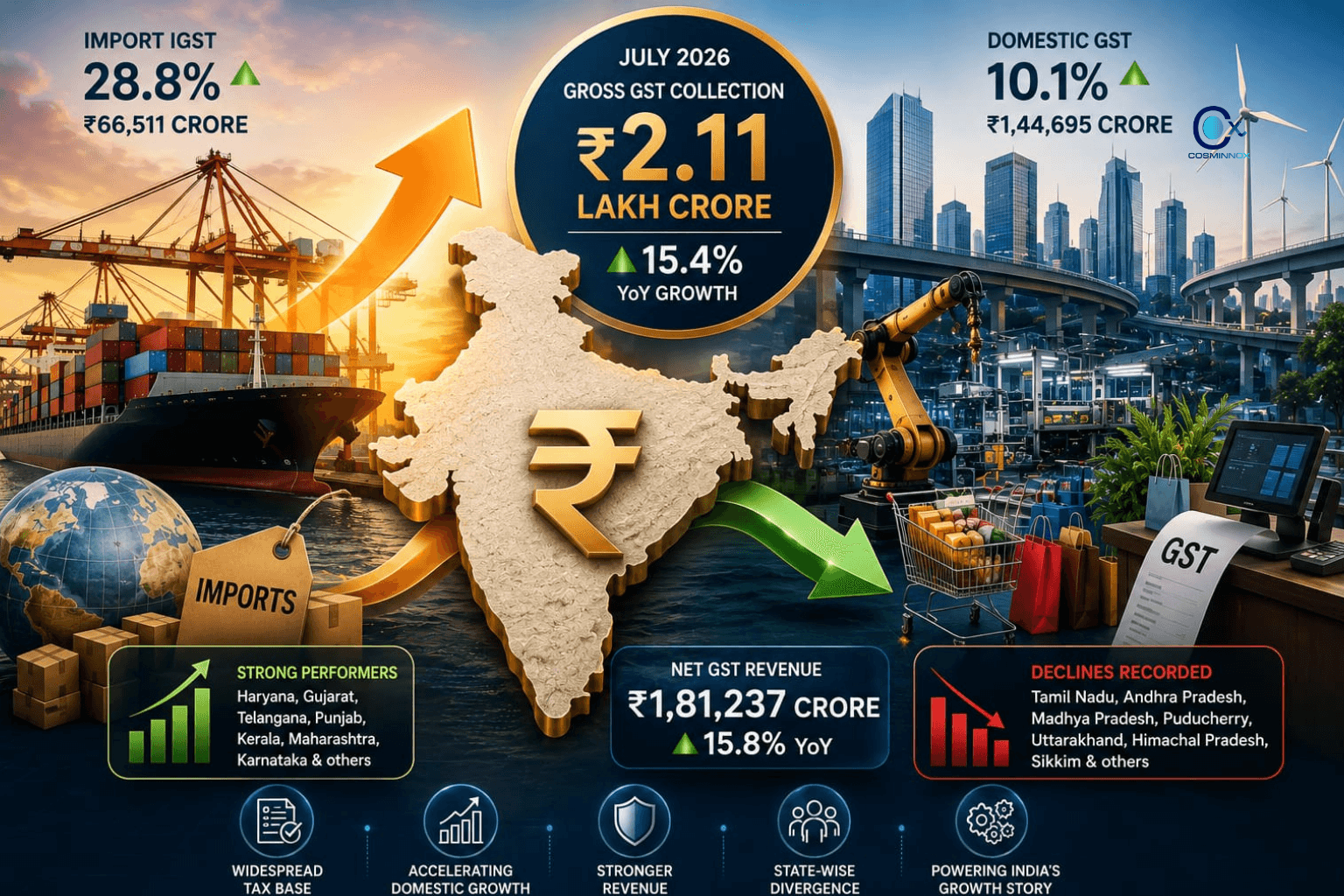
India's gross GST collections rose 15.4% year-on-year to ₹2,11,205 crore in July 2026, the fastest monthly growth in 14 months and the second time this fiscal year that collections have crossed ₹2 lakh crore. The analytical question this raises is not whether the headline number is strong — it is — but what is generating it: broad-based domestic production and consumption, or a narrower surge in import-linked tax collection. The data available for July points more toward the latter, though the domestic component has itself accelerated from the previous month.
The Headline, Decomposed
Gross GST collections split into two broad streams: tax on domestic transactions, and Integrated GST (IGST) collected on imports. In July 2026, domestic GST rose 10.1% year-on-year to ₹1,44,695 crore, while import IGST rose 28.8% to ₹66,511 crore. After refunds of ₹29,968 crore (up 13.1%), net GST revenue stood at ₹1,81,237 crore, up 15.8%. Within net revenue, net domestic collections rose 10.5% to roughly ₹1.27 lakh crore, while net customs GST rose a sharper 30.3% to ₹54,223 crore.
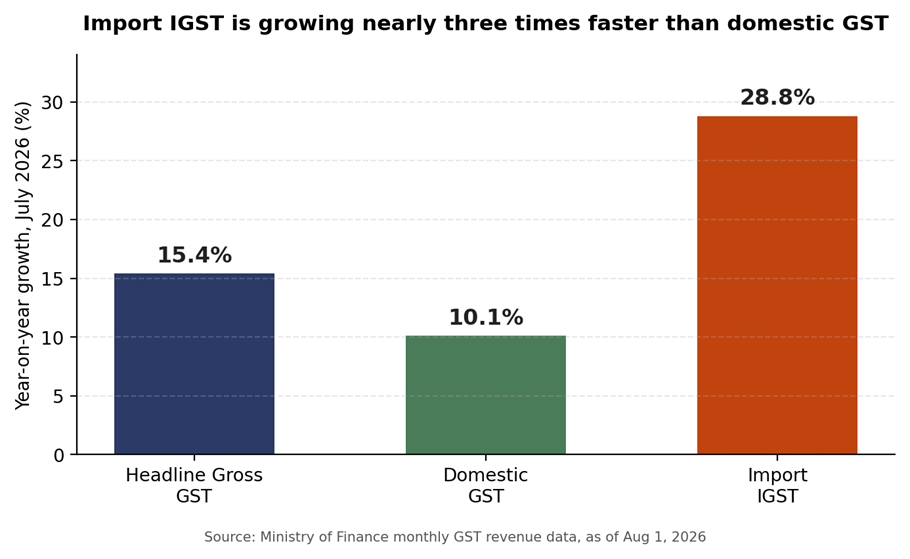
Chart 1: Import-linked GST is growing at nearly three times the rate of domestic GST, July 2026.
Metric | July 2026 | July 2025 | YoY growth |
Gross GST collection | ₹2,11,205 cr | ₹1,83,065 cr | 15.4% |
Domestic GST (gross) | ₹1,44,695 cr | ₹1,31,439 cr | 10.1% |
Import IGST (gross) | ₹66,511 cr | ₹51,626 cr | 28.8% |
Refunds | ₹29,968 cr | — | 13.1% |
Net GST revenue | ₹1,81,237 cr | — | 15.8% |
Net customs GST | ₹54,223 cr | — | 30.3% |
Table 1: National GST snapshot, July 2026. Source: Ministry of Finance monthly GST revenue release, as of Aug 1, 2026.
Cumulatively, gross GST collections for the first four months of FY27 (April–July) reached ₹8,42,905 crore, up 10.1% over ₹7,65,607 crore in the same period of FY26. Net revenue for the same period stood at ₹7,21,457 crore, up 9.2%. The four-month trend is closer to the domestic growth rate than to the July import spike, suggesting the July figure sits above the fiscal year's underlying run rate.
The State-Level Picture
State-wise domestic GST growth for July 2026 diverges sharply around the 10.1% national average. Haryana (25%), Gujarat and Telangana (19% each), Punjab, Kerala and Jharkhand (16% each), Uttar Pradesh (15%), Maharashtra (13%) and Karnataka (12%) all exceeded the national average. Tamil Nadu (-1%), Andhra Pradesh (-5%), Madhya Pradesh (-10%), Puducherry (-17%), Uttarakhand (-18%), Himachal Pradesh (-22%) and Sikkim (-59%) recorded declines. Maharashtra remained the largest single contributor in absolute terms at ₹32,210 crore, followed by Karnataka at ₹13,854 crore.
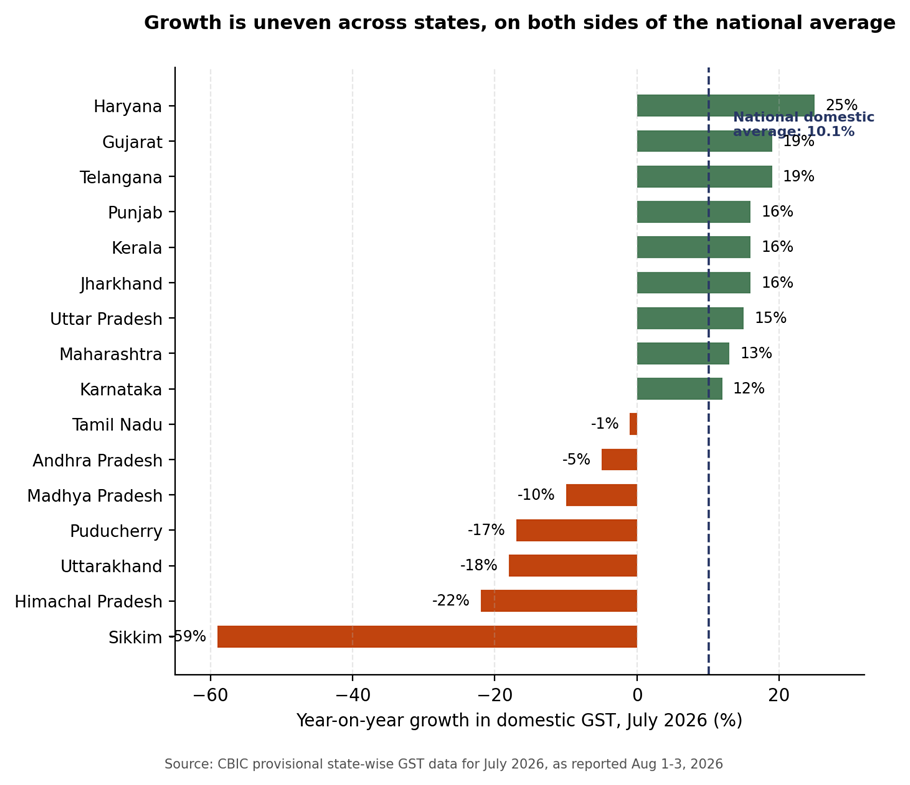
Chart 2: State-wise domestic GST growth, July 2026, against the national average. Source: CBIC provisional data, as reported Aug 1–3, 2026.
Counter-Evidence: Domestic Growth Is Also Accelerating
The import-driven reading of July's numbers is not the only one the data supports. Domestic GST growth of 10.1% in July is itself an acceleration from June 2026, when year-on-year domestic growth was reported at 6.5% — a faster pace that points to strengthening business activity independent of the import surge. Separately, CRISIL Ratings' FY26 outlook had projected state-level GST collections growing 9-10% for the year, a range July's domestic figure sits within rather than exceeds. Both data points complicate a reading of July as an anomaly driven purely by trade and currency factors; they indicate the domestic base was already on an upward trajectory before the import spike is factored in.
What the Data Does and Doesn't Establish
The July 2026 data establishes that headline GST growth was disproportionately carried by import-linked IGST (28.8%) relative to domestic GST (10.1%), and that state-level performance varied widely, with a cluster of states — several of them hill states and Puducherry — posting outright declines against a national gain. It also establishes that domestic collections accelerated compared to the prior month. The data does not, on its own, establish the cause of the import surge — rupee movement, global commodity prices, and capital goods import volumes are all plausible contributors cited in current reporting, but the July release does not disaggregate import IGST by commodity or capital-versus-consumption goods, and that breakdown would be required before attributing the surge to any single factor.
Sources
1. BusinessToday, "GST collections jump 15.4% to ₹2.11 lakh crore in July, import tax revenues surge nearly 29%," Aug 1, 2026 — national gross/net GST, domestic vs. import IGST split, refunds.
2. CAclubIndia, "July 2026 GST Revenue Surges to Rs 2.11 Lakh Crore, Registers 15.4% YoY Growth," Aug 2026 — cumulative April–July FY27 gross and net GST figures.
3. StudyCafe, "GST Collections Jump 15.4% to Rs 2.11 Lakh Crore in July 2026; Haryana Tops State-Wise Growth," Aug 2026 — state-wise growth rates (Haryana, Gujarat, Telangana, Punjab, Kerala, Jharkhand, Uttar Pradesh, Maharashtra).
4. StartupTalky, "Which State Collected the Most GST in July 2026? A State-wise Analysis," Aug 2026 — state-wise absolute collections, Maharashtra/Karnataka/Gujarat contribution share, June-vs-July domestic growth comparison (6.5% to 10.1%).
5. NewKerala, "GST Collections Rise 15.4% to Rs 2.11 Lakh Crore in July," Aug 2026 — Karnataka, Telangana, Uttar Pradesh absolute figures; state-wise declines (Tamil Nadu, Andhra Pradesh, Madhya Pradesh, Sikkim, Himachal Pradesh, Uttarakhand).
6. Business Standard, "India's top 18 states' revenues to grow 7-9% in FY26, says Crisil report," Nov 24, 2025 — CRISIL Ratings' FY26 state-level GST growth projection of 9-10%.
All figures are provisional, drawn from Ministry of Finance/CBIC monthly GST revenue releases as reported by the sources above, current as of Aug 1–3, 2026. Figures may be revised in subsequent official releases.