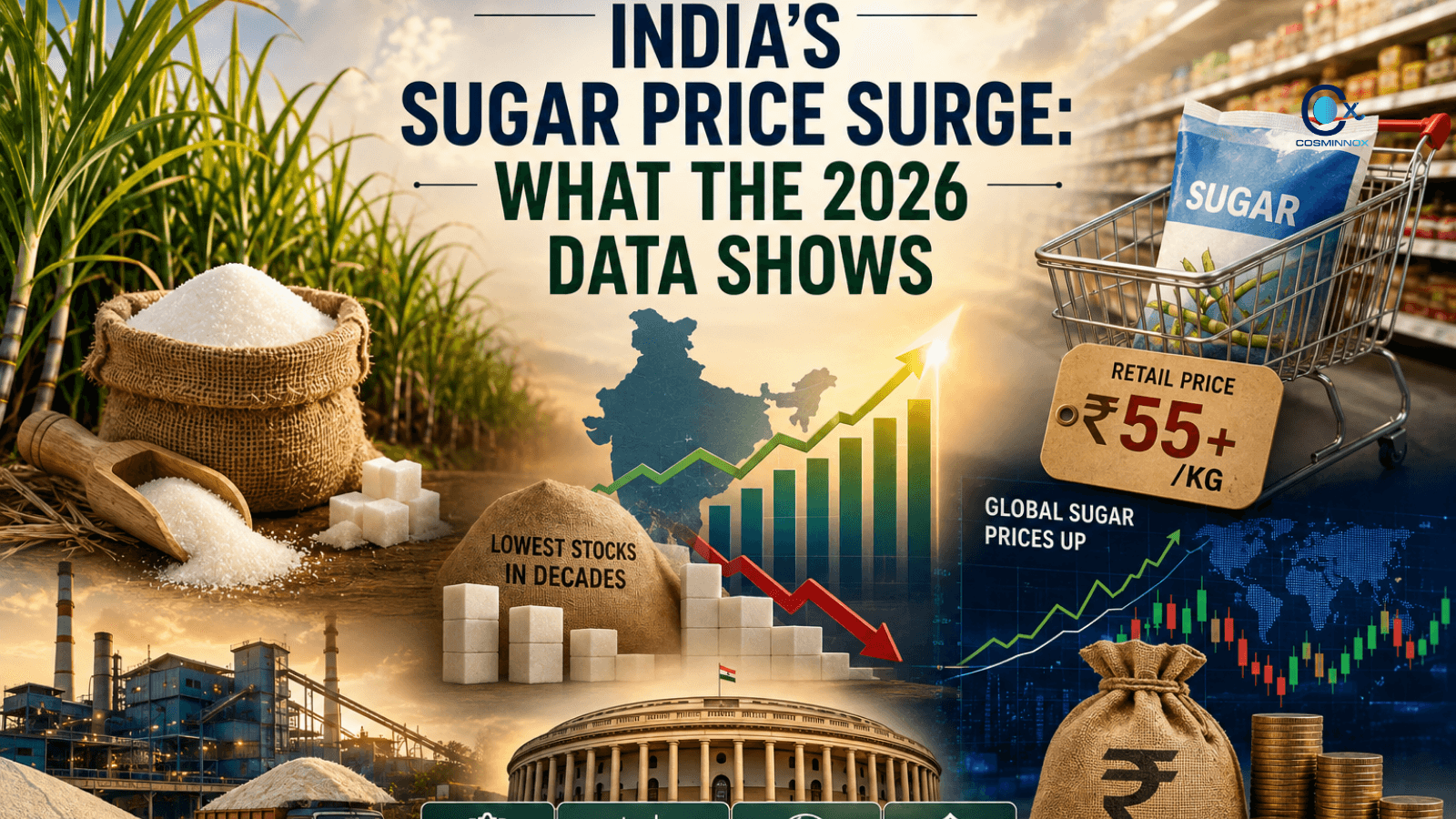
Retail sugar prices in India climbed from roughly ₹48/kg in mid-July 2026 to over ₹55/kg by August 20, with the all-India modal price reportedly touching ₹65/kg in parts of the country by late August [Vajiram & Ravi, “India’s Sugar Hike,” August 2026]. Wholesale rates jumped nearly 30–32% in the same two-month window [ChiniMandi, “Sugar Prices Hit Record Levels,” August 2026]. This piece sets out what the available production, stock, retail and wholesale price data say is driving the spike — and separately, what the longer sugarcane-pricing record in Uttar Pradesh, India’s largest cane-growing state, shows about how farmgate prices have moved in past election years.
What is driving the 2026 surge
The government's stated explanation, and the one best supported by production data, is a supply shock. India's 2026-27 sugar output estimate was cut to roughly 306 lakh tonnes from an initial 343 lakh tonnes, citing excess rainfall, waterlogging, and Red Rot and Top Borer disease damage in Maharashtra, Karnataka, Gujarat and Uttar Pradesh [IAAN Express, “Sugar Prices Surge in India,” August 2026]. Closing stocks are projected at 3–3.3 million tonnes by September 30, among the lowest in decades [Global Blog Post, August 2026].
International prices have also risen — global sugar futures rose over 16% between June and August 2026, and the International Sugar Organisation's outlook shifted from surplus to a projected 3.3-million-tonne global deficit [IAAN Express, August 2026]. Officials have additionally cited festive demand and speculative hoarding as amplifying factors [Vajiram & Ravi, August 2026]. The government has responded with stock limits on traders, approval for duty-free imports of up to 1 million tonnes, and a curb on sugar exports [Global Blog Post, August 2026; Vajiram & Ravi, August 2026].
India's 2026-27 production is separately forecast to recover to around 35 million tonnes if a strong monsoon materialises, which analysts suggest could ease prices later in the season once the new crushing cycle begins in October [Global Blog Post, August 2026].
Retail vs. wholesale: what the price data shows
Retail price is what the consumer pays at the shop counter; wholesale (mandi/ex-factory) price is what mills and traders charge before GST, transport, and dealer margins are added. Comparing the two shows both series moving in the same direction over the same window, though from different bases and at different paces.
Retail price movement
Date | National/City Avg. (₹/kg) | Source |
Mid-July 2026 | ~48.00 | Vajiram & Ravi |
July 2026 (Delhi monthly avg., all-time high in DCA series since 2014) | 47.00 | DCA / CEIC |
Aug 19, 2026 (official daily average) | 51.68 | DCA Price Monitoring Division |
Aug 19-20, 2026 (select markets, upper range) | 58–65 (range) | Babushahi; Vajiram & Ravi |
The Department of Consumer Affairs' Price Monitoring Division — the government's own daily-tracked, Tier 1 series — put the official national average retail price at ₹51.68/kg as of August 19, 2026, even as select markets were quoting ₹58–₹65/kg [Babushahi, August 2026; Vajiram & Ravi, August 2026]. Delhi's DCA monthly average for July 2026 (₹47/kg) was the highest recorded in that city's series going back to 2014 [DCA data via CEIC].
Wholesale / ex-factory price movement
Market | Rate (₹/quintal) | ≈ ₹/kg | Source |
UP, ex-factory (pre-GST) | ~5,400 | ~54.00 | Babushahi, Aug 2026 |
Maharashtra, ex-factory (pre-GST) | ~5,300 | ~53.00 | Babushahi, Aug 2026 |
Maharashtra, ex-factory (post-GST) | ~5,550–5,600 | ~55.50–56.00 | Babushahi, Aug 2026 |
Delhi, wholesale mandi | ~5,775 | ~57.75 | Babushahi, Aug 2026 |
Muzaffarnagar, wholesale mandi | ~5,754 | ~57.54 | Babushahi, Aug 2026 |
National wholesale avg. (Aug 22, 2026, vs. ~2 months prior) | ~4,400 → ~5,800 (+32%) | ~44.00 → ~58.00 | ChiniMandi, Aug 2026 |
Ex-factory and mandi rates in the top cane-growing states have moved to similar levels as the retail average — UP ex-factory around ₹54/kg pre-GST, Maharashtra around ₹53–₹56/kg, and wholesale mandi rates in Delhi and Muzaffarnagar both near ₹58/kg [Babushahi, August 2026]. Nationally, wholesale rates rose from roughly ₹4,400/quintal to about ₹5,800/quintal between roughly mid-June and August 22, 2026, a rise of about 32% [ChiniMandi, August 2026].
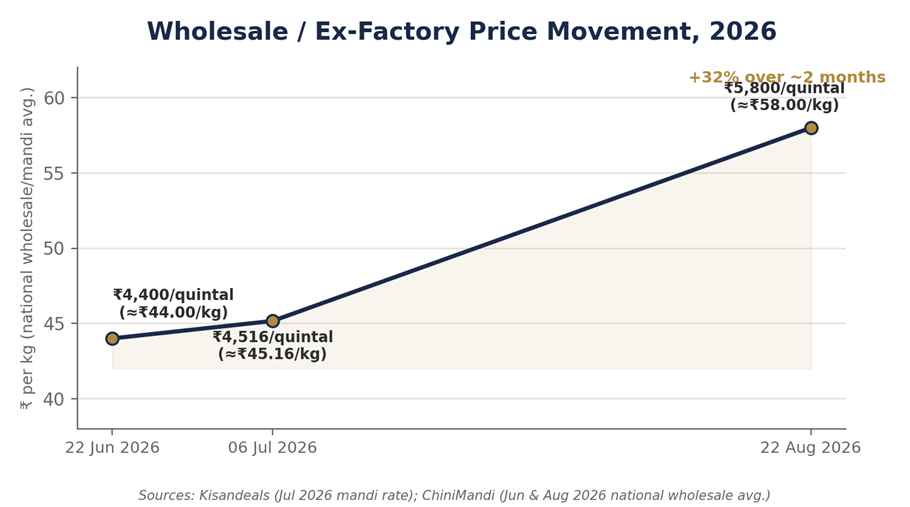
The national wholesale/mandi average moved from ₹4,400/quintal (≈₹44.00/kg) around June 22, 2026, to ₹4,516/quintal (≈₹45.16/kg) by July 6, to ₹5,800/quintal (≈₹58.00/kg) by August 22 — a roughly 32% rise over the two-month window, with most of the increase concentrated after mid-July [Kisandeals, July 2026; ChiniMandi, August 2026].
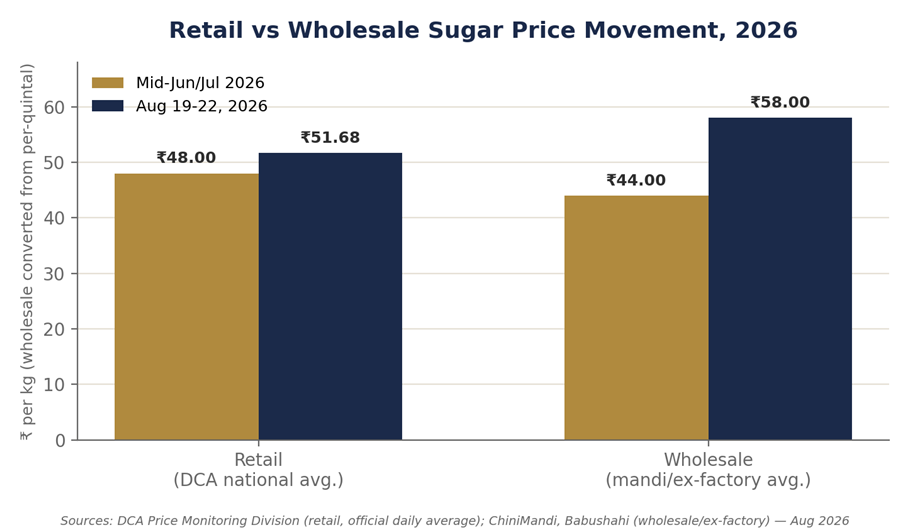
The gap between the two series is narrow at present — wholesale rates in several markets are now within ₹3–4/kg of the national retail average — which is consistent with a supply-driven spike moving through the chain relatively quickly, rather than retail margins alone widening. Neither series should be read as national in the strict sense: retail figures are DCA's official daily/monthly averages, while wholesale figures are drawn from specific mandis and ex-factory quotes rather than an all-India average, so state-to-state variation exists.
A side note: UP's cane-price record in past election years
A distinct but related data point concerns Uttar Pradesh's State Advised Price (SAP) for sugarcane — the farmgate price the state government sets independently of the Centre's Fair and Remunerative Price. Over the eight years to 2025, UP's SAP was raised only three times: by ₹10 in 2017-18, ₹25 in 2021-22, and ₹20 in 2023-24 — a cumulative rise of ₹55 [Rural Voice, “No Hike in Sugarcane Price in UP,” February 2025]. Two of those three increases preceded major elections: the ₹25 hike was announced in September 2021, months ahead of the February 2022 UP Assembly election [Deccan Herald, “UP Hikes Sugarcane Purchase Price,” 2021], and the ₹20 hike for 2023-24 came ahead of the 2024 Lok Sabha election [Business Standard, “UP Raises State Price for Sugarcane,” January 2024]. In the intervening non-election years, SAP was left unchanged. Agricultural economist Sudhir Panwar has publicly characterised the timing of these announcements — often made late in the crushing season — as designed to limit farmers' scope to organise protests, a view attributed to him rather than established as fact [Rural Voice, February 2025]. The most recent SAP hike, ₹30 for the 2025-26 season, was the largest since 2017 [Drishti IAS, “UP Government Hikes SAP for Sugarcane,” October 2025].
Counter-evidence
Two things complicate a simple election-driven reading. First, the current retail and wholesale price surge is a national and global phenomenon — driven by weather, crop disease and international deficits — and is separate from the UP-specific SAP mechanism, which affects what farmers are paid, not what consumers or wholesalers pay downstream. Second, SAP hikes have not occurred in every pre-election window; the 2022-23 season, following the 2022 UP election, saw no increase at all [Rural Voice, November 2024], and the Centre's FRP hikes (a different, national instrument) have followed their own recovery-rate formula rather than an electoral one.
What the evidence supports
The 2026 price surge is best explained by the production and stock data, with retail and wholesale figures both confirming the same broad move: a sharp downward revision in output, decades-low closing stocks, and a global tightening of supply, working through mandi/ex-factory rates into the retail price consumers see. The UP cane-price record is a separate strand — it shows SAP hikes clustering in three of the last four election-adjacent years, out of eight years examined — but it speaks to farmgate pricing decisions, not to the retail or wholesale spike itself, and any read-through to the 2025-26 season or the UP Assembly election due before May 2027 remains a data point to watch rather than a conclusion the current numbers establish.
Sources: Vajiram & Ravi (Aug 2026); Global Blog Post (Aug 2026); IAAN Express (Aug 2026); ChiniMandi (Aug 2026); Babushahi (Aug 2026); Kisandeals (Jul 2026); DCA Price Monitoring Division / CEIC; Rural Voice (Feb 2025, Nov 2024); Deccan Herald (2021); Business Standard (Jan 2024); Drishti IAS (Oct 2025); BOOM Live Elections Tracker.