Major Highlights & Key Statistics
Global Footprint of the 11-Nation Bloc:
• Population: Representing nearly half of the world's population.
• Economy: Accounting for roughly 40% of global GDP.
Future Energy Targets:
• Overall Bloc Storage Goal (by 2032): 410 GWh of energy storage capacity.
• India's Pumped Hydro Storage Target: 100 GW (out of a 260 GW identified potential).
• India's Battery Storage (BESS) Target: 80 GW.
Then vs. Now: Energy Evolution Comparisons:
• India's Solar Capacity: Skyrocketed from 3 GW in 2014 to over 154 GW today.
• Biofuel Progress: Successfully achieved a 20% ethanol blending milestone.
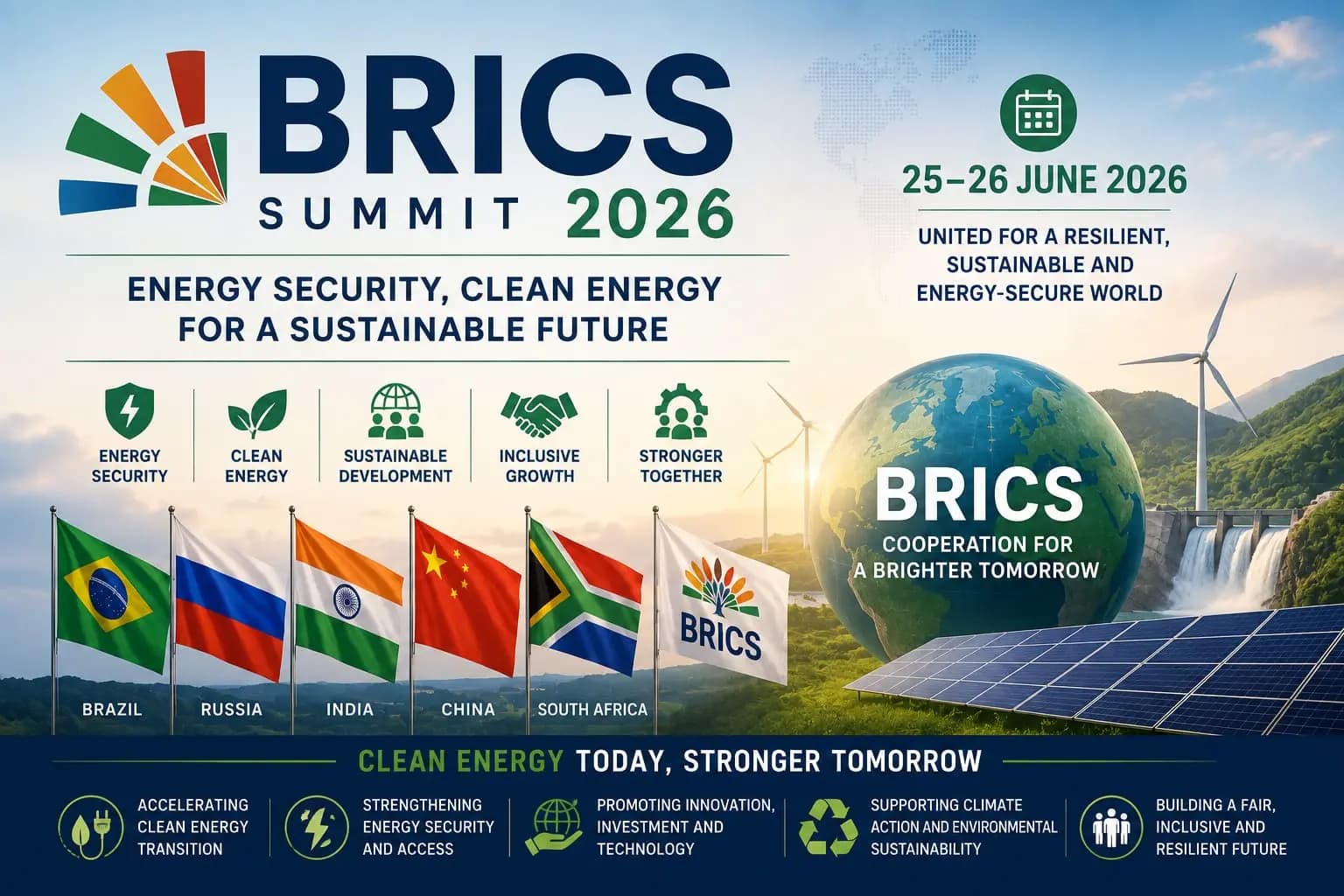
While the traditional Western energy cartels grapple with geopolitical gridlock, a massive shift occurred in Gurugram, Haryana. On June 25–26, 2026, India hosted the 11th BRICS Energy Ministers' Meeting. Operating under the guiding philosophy of “सर्वेषां ऊर्जम्” (Energy for All), the expanded 11-nation BRICS bloc—representing nearly half the world’s population and roughly 40% of global GDP—quietly hammered out a blueprint that could reshape energy security, clean tech, and global sustainability for decades to come.
The Big Takeaways: What Happened in Haryana?
The summit concluded with the adoption of the 11th BRICS Energy Ministers' Joint Communiqué. Far from just diplomatic prose, the meetings yielded actionable strategies focused on three core pillars:
1. Launch of the BRICS Digital CoE for Smart Grids & Energy Storage
The headlining breakthrough of the summit was the official launch of the BRICS Digital Centre of Excellence (CoE) for Smart Grids and Energy Storage. As renewable energy moves to the center of global power grids, managing real-time demand and multi-source integration becomes incredibly complex. This center serves as a joint tech-hub to co-develop smart grid architectures, AI-driven distribution systems, and next-generation energy storage solutions.
2. A Massive Leap in Energy Storage Targets
With India's Union Minister Manohar Lal leading the charge, the bloc put down aggressive numbers for energy storage—the holy grail of making solar and wind power reliable round-the-clock. India showcased its roadmap targeting:
• 100 GW of Pumped Hydro Storage capacity (out of a 260 GW identified potential).
• 80 GW of Battery Energy Storage Systems (BESS).
• An overarching bloc goal to hit 410 GWh of energy storage capacity by 2032.
3. High-Tech Diversification: CCUS & AI
Before the main ministerial dialogue, the bloc held targeted seminars on two critical frontiers:
• Carbon Capture, Utilization, and Storage (CCUS): Developing affordable tech to trap emissions from heavy industries.
• Artificial Intelligence in Energy: Deploying AI to optimize grid transmission networks and prevent massive blackouts.
Balancing Green Futures with Hard Realities
What makes the BRICS approach radically different from Western climate mandates is its hyper-focus on Energy Equity. The ministers explicitly reaffirmed the importance of respecting diverse "national circumstances and energy pathways."
Developing economies cannot shut down traditional power plants overnight without plunging millions into darkness. Therefore, the Haryana summit prioritized a dual-track strategy: aggressively scaling up ultra-clean tech while simultaneously investing in "Clean Coal Technologies" and tightening "Electrical Appliance Standards" to curb waste.
India used the platform to highlight its own staggering transition, moving from just 3 GW of solar capacity in 2014 to over 154 GW, alongside hitting its 20% ethanol blending milestone in biofuels.
The Global South Speaks Up
“Developing countries require adequate time, resources, and policy space to pursue sustainable development while meeting the legitimate aspirations of their people.”
— Manohar Lal, Union Minister of Power
Why the World is Watching
By unifying regional grid networks via initiatives like One Sun One World One Grid (OSOWOG) and building deep supply-chain resilience for critical minerals (essential for EV batteries and solar panels), BRICS is positioning itself as an independent, self-sustaining energy superpower.
The Haryana summit sent a clear signal: the future of clean energy will not be dictated by a select few. It will be built on the collective, pragmatic needs of the developing world.
Sources: Press Release Page | Press Information Bureau, Drishti IAS, Utkarsh Classes, FinTechBizNews, ddnews.gov.in
The Cosminnox • Reporting compiled from BRICS Energy Ministers' Joint Communiqués, Press Information Bureau (PIB) India releases, regional grid development analysis, and ministerial policy frameworks.