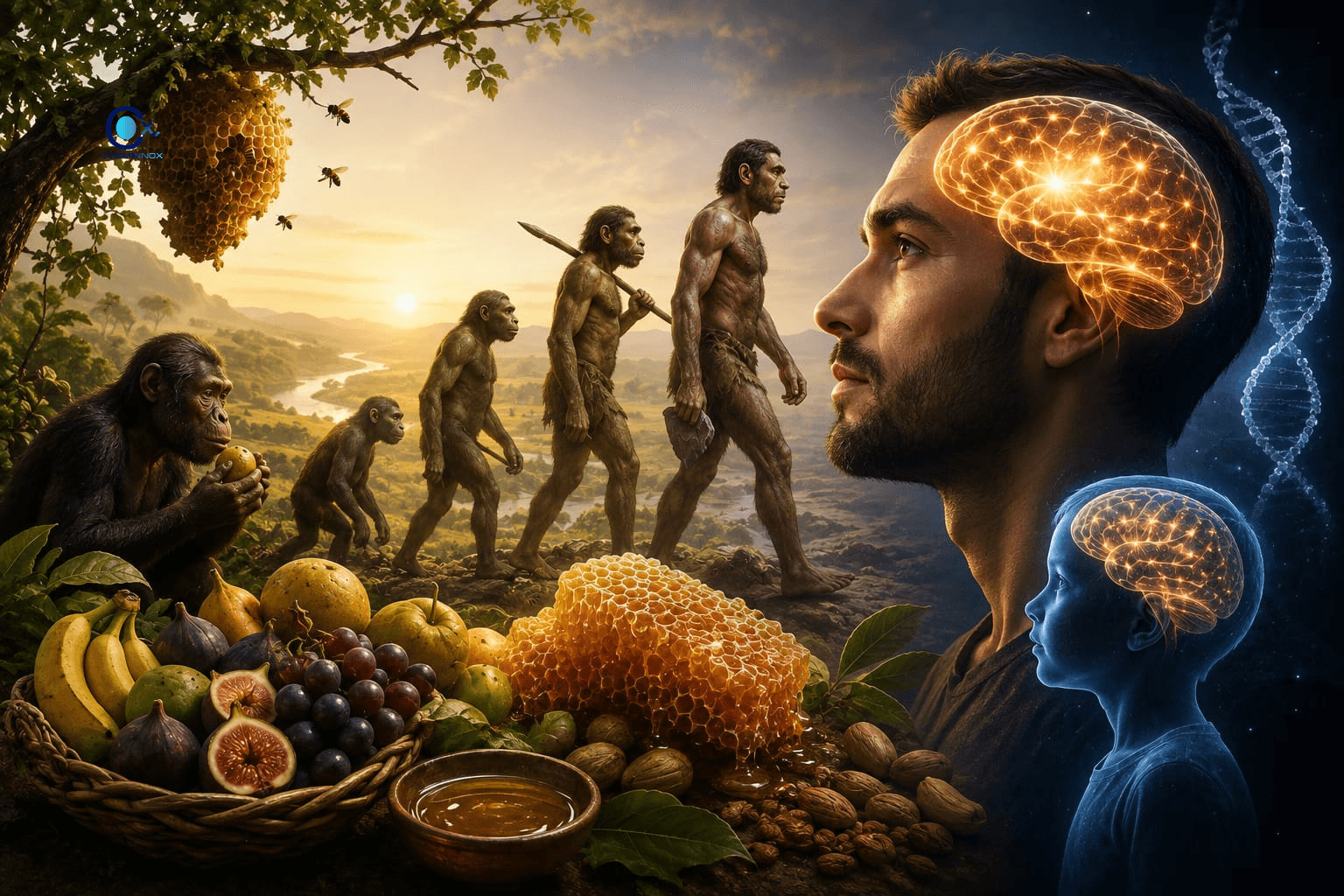
For half a century, the story of how humans got smart has largely belonged to meat. Hunting, in the popular telling, made us clever — bigger kills meant richer protein, richer protein meant bigger brains. A new study complicates that story, and it does so with a number: over four million years of human evolution, carbohydrates — not meat or fat — may have supplied more than half of our ancestors' total energy needs.
The case rests on basic biochemistry. The brain runs almost exclusively on glucose, and meat doesn't supply much of it; protein and fat convert to that fuel slowly and inefficiently. Professor Jennie Brand-Miller of the University of Sydney's Charles Perkins Centre and Professor Karen Hardy of the University of Glasgow built a model tracking the glucose demands of the human lineage as brains grew nearly fivefold — from roughly 300 grams in early hominins such as Australopithecus afarensis to about 1,500 grams in modern Homo sapiens. The organ that resulted is a spectacular energy hog: it makes up barely 2% of an adult's body weight yet consumes about a fifth of the body's resting energy — in a five-year-old child, that figure climbs to nearly two-thirds.
“Glucose is the brain's primary energy source, and for much of human evolution, would have come from carbohydrates found in foods such as fruit and honey.” — Prof. Jennie Brand-Miller, University of Sydney |
Before the Cooking Fire, There Was the Beehive
The timing is the twist. Cooking, which unlocks the energy in starchy tubers and grains, is a relatively recent human trick — the earliest evidence of grinding stones for flour dates back only 65,000 years. For nearly all of the four million years the brain spent growing, that shortcut didn't exist, and raw starch, the researchers note, barely releases usable glucose at all. So where did the sugar come from? Fruit and honey, the study argues — foods that deliver glucose with no preparation required, bundled with fibre, vitamins and minerals that make them, in Brand-Miller's words, far more than "empty calories."
The Fossil Record Agrees
The model doesn't stand alone. The researchers point to a cluster of independent evidence: wear patterns on fossil teeth, isotope ratios preserved in ancient bone, colour vision precisely tuned to spot ripe fruit against green foliage, and genetic adaptations tied to sugar metabolism and taste that show up across the human lineage. Even the seasonal rhythm of fruiting and honey availability, the team suggests, may have shaped how early hominins foraged and moved — and, in some cases, which groups survived at all. The findings build on earlier University of Sydney research establishing honey as "nature's original antibiotic," one more reason it was prized long before refined sugar existed.
A Modern Mismatch
The findings also help explain a modern puzzle: why humans, unlike most primates, hang onto such a persistent sweet tooth. If sugar cravings were hardwired at a time when fruit and honey were scarce, seasonal prizes rather than supermarket staples, then today's food environment — concentrated sugar available year-round — represents a mismatch between ancient wiring and modern abundance, one nutrition scientists increasingly link to rising rates of obesity and type 2 diabetes. Brand-Miller, who has spent much of her career studying carbohydrates and helped popularise the glycaemic index as a measure of how quickly foods raise blood sugar, brings that same lens to the deep past. The new study doesn't resolve the modern sugar debate, but it does reframe the starting point: understanding why we crave sugar today, the researchers argue, begins with understanding why our ancestors needed it in the first place.
None of this is licence to reach for the sugar bowl. The honey and fruit our ancestors ate came whole, seasonal and scarce — nothing like the concentrated, year-round sugar of a modern diet, and the researchers are careful to draw that line. What the study does offer is a fuller ledger of how humanity got here: not meat alone, but a hard-won mix of protein, fat and, crucially, the sugars that kept a hungry brain running. "Understanding the role of carbohydrates alongside meat, fat and protein," Brand-Miller said, "provides a more complete picture of the human evolutionary journey." Four million years in the making, humanity's biggest organ, it turns out, may owe as much to the beehive as to the hunt.
The Cosminnox • Reporting based on findings published in Science (August 2026) and statements from the University of Sydney and the University of Glasgow.