
The Starting Point
India's nominal GDP stood at roughly $4.15 trillion in 2026, ranking sixth globally, per IMF estimates. Real GDP growth for FY26 came in at 7.6%, revised up from an initial 7.4% estimate. For FY27, the consensus among major forecasters has narrowed to a tighter band.
Forecaster | FY27 Growth Projection |
Deloitte India | 6.5% – 6.8% |
Reserve Bank of India | 6.6% |
IMF (medium-term) | ~6.4% |
Sources: Deloitte India Economic Outlook (July 2026); Reserve Bank of India; IMF World Economic Outlook.
That is a strong number in a weak global growth environment — India remains among the fastest-expanding major economies on official figures. Whether that description survives scrutiny of the underlying growth rate is itself now a live and contested question, taken up in the third section below. On the official numbers alone, the growth rate is also, on its own, short of what the 2047 target requires.
The Target, As Defined
NITI Aayog's Vision for Viksit Bharat@2047 approach paper (July 2024) sets out the core ask: growing the economy roughly ninefold from its then-base and per capita income roughly eightfold, over 23 years.
Metric | ~2024 Base | 2047 Target | Implied Annual Growth |
GDP | $3.36–3.6 trillion | $30 trillion (NITI Aayog); up to $34.7T–$40T cited by PHDCCI, Bain & Co. | ~9.2%–9.25% nominal |
Per capita income | $2,392–2,572 | $18,000–$18,182 | ~9.25%–10.19% nominal |
Sources: NITI Aayog, “Vision for Viksit Bharat@2047: An Approach Paper” (July 2024); PHDCCI; Bain & Company estimates as cited in public reporting.
Some independent estimates push the required per capita growth rate higher still — up to 11.4% — once long-run exchange-rate drift is factored in, according to research cited in industry briefings.
Where the Gap Sits
The comparison that matters is not 6.5% versus 9.2% in the abstract — it is what each rate compounds into by 2047. Using India's 2026 nominal GDP base of $4.15 trillion (IMF) over the 21 years to 2047, an illustrative compounding shows the following:
Sustained Annual Growth Rate | Resulting GDP by 2047 |
6.5% (current FY27 consensus) | ≈ $15.6 trillion |
8.0% (recent nominal GDP growth, per Finance Ministry) | ≈ $20.9 trillion |
9.25% (NITI Aayog's implied requirement) | ≈ $26.6 trillion |
10.0% | ≈ $30.7 trillion |
Figures above are an illustrative compounding calculation based on the cited 2026 base and growth rates, not a forecast from any single source.
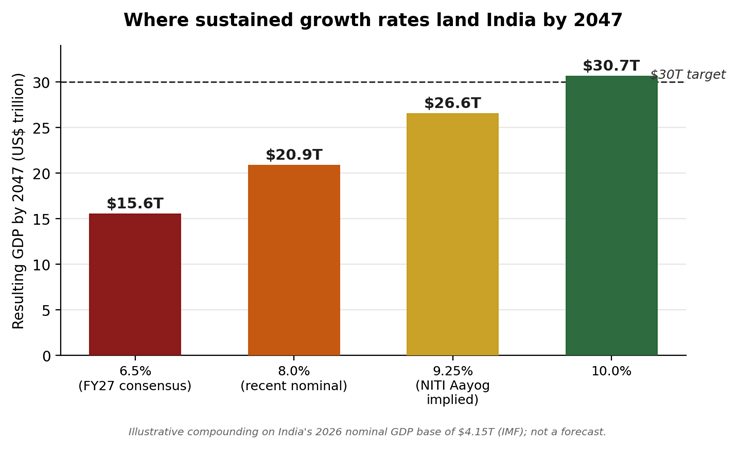
Fig. 1 — Illustrative compounding of India's 2026 GDP base at four sustained growth rates through 2047.
At the current real-growth consensus of 6.5%–6.8%, India's 2047 economy would land somewhere in the $15–16 trillion range — roughly half the stated target. Closing that gap requires sustained growth near 9%–10% for over two decades, a pace India has touched in individual quarters but not held as a multi-decade average.
There is also a measurement nuance worth flagging: current forecasts (6.5%–6.8%) are typically real, rupee-denominated growth figures, while the $30 trillion target is a nominal, dollar-denominated one — meaning inflation, nominal GDP growth, and the rupee's exchange-rate path all factor into which number ultimately counts.
The Growth-Rate Dispute: Is 6.5%–7.6% Even the Right Number?
The arithmetic above assumes the official growth figures are the relevant baseline. That assumption itself came under direct challenge in May 2026, when economist Surjit Bhalla — a former Executive Director for India at the IMF and a member of the Economic Advisory Council to the Modi government — argued in The Indian Express (“BJP is winning elections but losing the economy,” May 21, 2026) that the growth numbers underpinning the “fastest-growing major economy” narrative do not hold up.
According to Bhalla's column, India's real growth rate is closer to 4.7% once adjustments he applies are factored in — below Bangladesh's approximately 8.3%, which he cites as the faster-growing economy in the region. On that basis, Bhalla has argued that India should retire the “fastest-growing” description rather than continue using it as shorthand for economic health.
“It is better to dispense with the moniker that we are the fastest growing.” — Surjit Bhalla, The Indian Express, May 21, 2026 (as widely quoted in subsequent commentary) |
Bhalla's 4.7% figure is a minority position, not a consensus one. The Reserve Bank of India, the IMF, and Deloitte India's own FY27 projections cluster at 6.4%–6.8% (see table above), and none of those institutions has adopted Bhalla's alternative estimate. The dispute is nonetheless not new to Indian economic commentary: economists including Arvind Subramanian, Raghuram Rajan, Pronab Sen, P. C. Mohanan, Ashoka Mody, and Jean Drèze have, at various points since 2011, separately questioned whether India's GDP methodology fully captures informal-sector activity, employment trends, and other indicators — though each has approached the question on different grounds and arrived at different estimates than Bhalla's. Whichever figure is correct, it does not change the arithmetic in the previous section: even the official 6.5%–6.8% consensus falls well short of the 9.2%+ pace the $30-trillion target implies.
The Currency Signal
Bhalla's column points to a second data set as evidence that the growth story and the currency story have diverged: the rupee's multi-year slide against the dollar, even as headline macro indicators — the current account deficit, inflation, and reported growth — have looked comparatively stable.
Indicator | Figure Cited |
Consecutive years of rupee depreciation | 7 years |
Rupee depreciation, most recent year | ~12% against the US dollar |
Regional currency performance, 2025 | Among the worst-performing in South Asia |
USD/INR exchange rate | ₹96.3 as of May 21, 2026 |
Source: Surjit Bhalla, “BJP is winning elections but losing the economy,” The Indian Express, May 21, 2026, as cited in subsequent commentary and reporting on the column.
Bhalla's reading of this pattern is that political stability and macro-indicator stability have not translated into currency or investor confidence — a gap he attributes chiefly to India's investment climate rather than to global conditions such as the Iran-linked oil-price shock in mid-2026.
The Investment Climate Case
Bhalla's central prescription in the column is that India's growth and currency problems are structural, not cyclical, and that the fix runs through the investment climate rather than through moral appeals to save foreign exchange or invest domestically. He points to several specific frictions:
Friction Cited | Detail |
Quality Control Orders (QCOs) | Grew from 14 in 2017 to nearly 765 in 2024, which Bhalla characterises as a source of bureaucratic delay for importers and manufacturers. |
Bilateral Investment Treaty (2015 model) | Requires foreign investors to exhaust Indian court remedies and wait five years before pursuing international arbitration; a government review has proposed cutting this to three years. |
“Big market” framing | Bhalla argues the government overstates India's market size as a draw for investors, citing that India's nominal GDP (~$3.92–$4.1 trillion, 2025 estimates) is comparable to California's (~$4.25 trillion, 2025), despite India's population being roughly 35 times larger. |
FDI trend | Bhalla describes FDI inflows as slowing, and argues domestic investors are themselves increasingly looking to invest abroad rather than at home. |
Source: Surjit Bhalla, “BJP is winning elections but losing the economy,” The Indian Express, May 21, 2026, as cited in subsequent commentary; California and India GDP figures per Statista-sourced estimates cited in the same commentary.
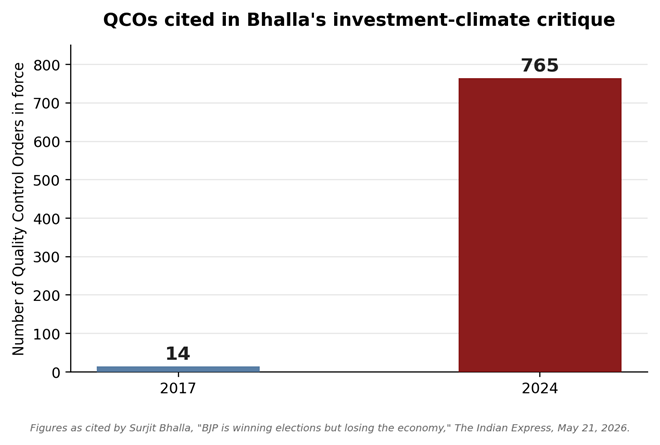
Fig. 2 — Growth in Quality Control Orders, 2017–2024, as cited in Bhalla's column.
On this reading, Finance Minister Nirmala Sitharaman's public statements that foreign investors are “dying” to enter the Indian market are, in Bhalla's characterisation, a claim in tension with the observed FDI slowdown and with the government's own decision to review the BIT framework — since a review implies the current framework is itself seen as a deterrent.
Counter-Evidence: What the Optimistic Case Rests On
Set against Bhalla's structural critique are three data points that support the government's more optimistic framing:
Point | Basis |
NITI Aayog's own growth band is wider than the target implies | NITI Aayog's approach paper frames 7%–10% sustained growth as the operating range across its five strategic themes for Viksit Bharat, rather than presenting 9.2% as a fixed requirement with no margin. |
India has posted above-8% nominal growth in recent years | Ministry of Finance data cited in the compounding table above uses an 8.0% “recent nominal GDP growth” scenario as one of four illustrative paths, indicating the higher end of the range is not without precedent. |
Bhalla's 4.7% estimate is not the institutional consensus | The RBI (6.6%), the IMF (~6.4% medium-term), and Deloitte India (6.5%–6.8%) all project growth materially above Bhalla's figure for FY27, even though none of the three has offered a rebuttal specifically addressed to his column. |
What the Evidence Does — and Doesn't — Establish
Two things can be said with reasonable confidence from the data assembled here. First, on the official consensus growth figures (6.4%–6.8% for FY27), India's trajectory toward the $30-trillion, 2047 target falls well short of the arithmetic NITI Aayog's own approach paper implies — a gap of roughly $10–11 trillion by 2047 at current consensus rates versus the stated target, per the illustrative compounding above. Second, a separate and distinct critique — Bhalla's argument that the underlying growth rate is itself overstated, and that currency depreciation and investment-climate frictions are the more reliable signal — is a minority position among forecasters, not one adopted by the RBI, IMF, or major consultancies, but it has been raised prominently and publicly by an economist with a formal advisory role in the current government.
What the evidence does not establish is which of these two growth figures — the official 6.5%–7.6% band or Bhalla's alternative estimate closer to 4.7% — is the more accurate description of the Indian economy today; that dispute remains open and is not resolved by the data available for this piece. Nor does it establish that the 2047 target is unreachable: NITI Aayog itself frames 7%–10% as the sustained range required, and India has posted above-8% nominal growth in some recent years. The distance between the current consensus trajectory and the 2047 arithmetic — and the fact that a government-linked economist has now questioned the growth number underlying that trajectory — is the story the topline $30-trillion figure tends to leave out.
The Cosminnox • Sources: NITI Aayog, “Vision for Viksit Bharat@2047: An Approach Paper” (July 2024); IMF World Economic Outlook (April 2026); Reserve Bank of India; Deloitte India Economic Outlook (July 2026); Ministry of Finance; PHDCCI; Bain & Company estimates as cited in public reporting; Surjit Bhalla, “BJP is winning elections but losing the economy,” The Indian Express, May 21, 2026, as cited in subsequent commentary and reporting.
Editor's note: The Bhalla column was accessed for this piece through secondary reporting and commentary quoting and summarising it, as the original could not be independently re-verified against the primary text at time of publication. Figures attributed to Bhalla above should be read as reported, pending direct verification against the original Indian Express column.