When VinFast rolled its first electric SUVs onto Delhi's streets this June, it wasn't selling cars. It was renting itself credibility, one ride at a time — and betting that India's most price-sensitive market can be won from the back seat before it's won from the showroom floor.
On World Environment Day this June, a fleet of seven-seater electric SUVs pulled out of a depot in the Delhi National Capital Region wearing a livery most Indian commuters had never seen: Green SM. The cars were VinFast's. So were the drivers' salaries, the charging schedule, and the decision to launch on a date built for symbolism. For a Vietnamese carmaker trying to crack one of the world's most brand-loyal, price-sensitive auto markets, the math was simple — don't wait for India to buy the car. Put it on the road yourself, and let India ride in it first. Here is the twist beneath VinFast's India entry: this was never really a taxi launch. It was a market-entry strategy wearing a taxi's clothes.
VinFast is Vietnam’s breakout automotive unicorn—a high-growth, multinational tech player shaking up the global EV market. Launched in 2017 with the full venture backing of Vingroup (Vietnam’s premier private conglomerate), the brand scaled at hyper-speed from a regional leader to a disruptive global challenger in the sustainable mobility ecosystem.
One Company, Three Jobs
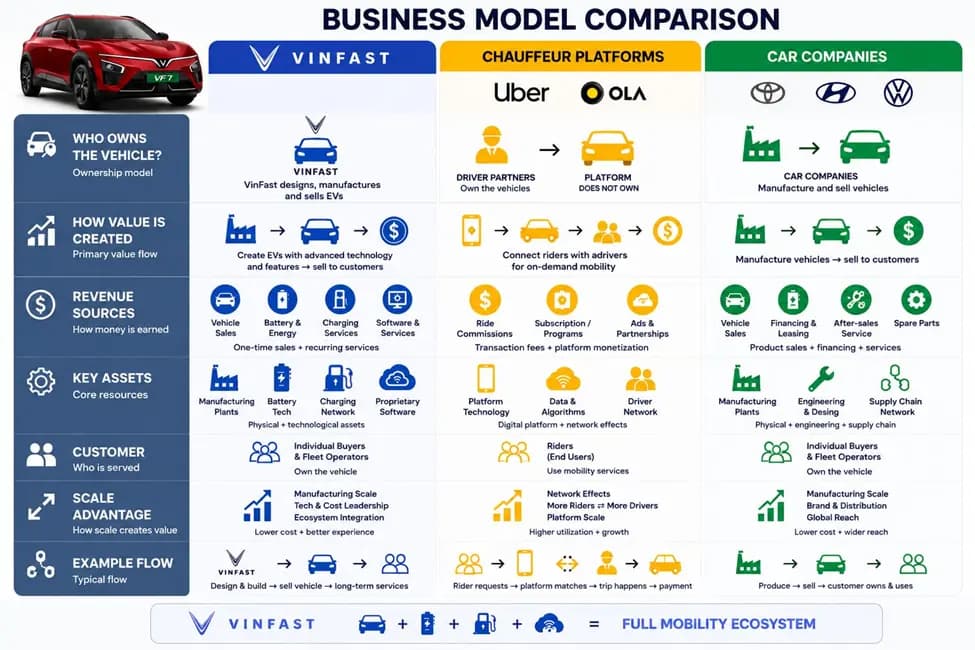
India's mobility market runs on a clean separation of labour. Uber and Ola own no metal — they rent an app to drivers who bring their own Maruti or Hyundai. Tata, Maruti and Hyundai own the metal but nothing after the showroom door. VinFast collapses both roles into one. Through Green SM — the ride-hailing arm of its parent, Vingroup — it manufactures the car, owns the fleet, salaries the driver, and runs the app the passenger taps. No other entrant into Indian mobility has tried to be the factory and the fare at the same time.
The Free Trial That Pays For Itself
Brand trust in the Indian car market is typically a years-long accumulation, built showroom visit by showroom visit. VinFast is trying to compress that timeline into a few thousand ride-hailing trips. Each Green SM fare, the company's logic goes, is a free test-drive for a brand that has barely advertised in the country. The strategy doubles as a data-collection exercise — every trip generates real readings on range, charging behaviour and component wear under Indian conditions, which is precisely the operating data a new entrant needs before it scales retail sales.
“India is one of the most important mobility markets in the world. Its scale, rapid growth, and strong spirit of innovation are opening up many opportunities for the future of green transportation.”
— Nguyen Van Thanh, Global CEO, GSM (Green and Smart Mobility)
The Battery Is the Catch — So VinFast Rents It Out
The same logic runs through VinFast's retail pitch. Because the battery pack accounts for roughly four to five-tenths of an EV's sticker price, VinFast lets private buyers separate car from battery, paying a monthly subscription instead of owning the pack outright. It is the same instinct as the taxi play, applied to the showroom: lower the price of entry first, and let trust — and revenue — compound after the sale.
Why It Matters: The Scoreboard
1. Detail Point: Distribution without ads. Visibility on the road substitutes for a marketing budget VinFast hasn't spent.
2. Detail Point: A demand floor in a downturn. If retail sales slow, factory output can be redirected into the fleet instead of idling.
3. Detail Point: A credibility play in a wary market. After BluSmart's collapse rattled riders' trust in premium EV cabs, a salaried-driver fleet is a deliberate answer.
The Last Word
Every carmaker entering India eventually asks the same question: how do you earn trust faster than the market wants to give it? VinFast's answer is to skip asking and start driving — to let the product make its own case, one airport run at a time. Whether that converts into showroom sales, or simply into a very large, very expensive taxi fleet, is the bet Delhi's traffic will start answering first.
The Cosminnox • Reporting compiled from Vingroup Corporate Disclosures, GSM Global Public Communications, Delhi-NCR Transport Department registration metrics, and regional automotive industry analysis.