01 THE QUESTION
Does Apple's decision to hand the CEO role to a hardware engineer, over a software chief widely seen as the more obvious AI-era pick, reflect a considered bet on where the AI competition will actually be won — in silicon and devices rather than in frontier models — or is it continuity dressed up as strategy? The evidence supports a real, if unproven, thesis: Apple has chosen to compete on integration rather than model capability, and its first two weeks in office are the clearest test of that bet the company has offered so far.
02 WHAT HAPPENED
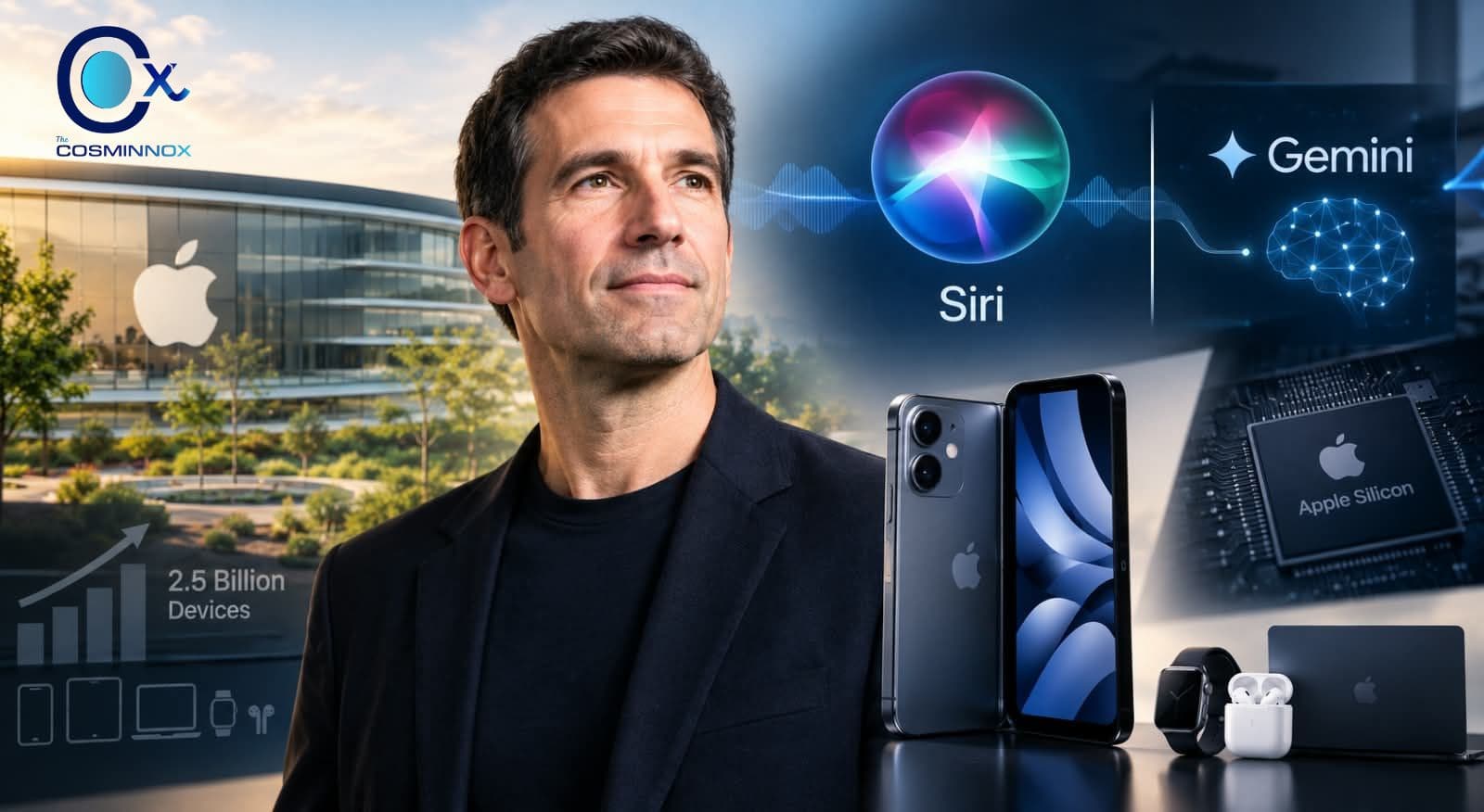
John Ternus succeeded Tim Cook as Apple's chief executive on September 1, 2026, ending Cook's fifteen-year run. Cook becomes executive chairman and, according to Apple's own account, will continue managing the company's relationships with the White House and Beijing, while Art Levinson becomes lead independent director. Ternus, 51, joined Apple's design team in 2001 and rose to senior vice president of hardware engineering in 2021, leading the teams behind the iPhone, AirPods, and the M-series chips. He had eight days between taking office and Apple's September 9 product event.
Key facts
Fact | Detail |
Succession date | September 1, 2026 |
Outgoing CEO | Tim Cook, 15-year tenure; becomes Executive Chairman |
New CEO | John Ternus, 51 — joined Apple 2001, SVP Hardware Engineering since 2021 |
Lead Independent Director | Art Levinson (effective Sept 1, 2026) |
First major event as CEO | September 9, 2026 product launch — 8 days after taking office |
Siri AI licensing partner | Google — custom Gemini model, ~$1 billion/year, deal signed January 2026 |
Model size comparison | Licensed Gemini model reported at 1.2 trillion parameters — approx. 8x the size of Apple's own on-device models |
Apple capex (% of revenue) | ~2%, vs. Alphabet's reported ~40% |
Active device base | ~2.5 billion devices, cited as Apple's distribution advantage |
03 THE AI POSITION HE INHERITS
Apple's AI strategy, set before Ternus took over, is a licensing arrangement rather than an in-house model effort. In January 2026 Apple agreed to pay Google roughly $1 billion a year to license a custom Gemini model — reported at 1.2 trillion parameters, about eight times the size of Apple's own on-device models — to power a rebuilt Siri. That Siri rebuild has slipped repeatedly, originally targeted for 2024 and now arriving in stages through iOS 27. Cook told investors on his final earnings call that Apple still does not have a complete plan for the compute costs as Gemini usage scales — an open financial question Ternus now owns without having negotiated the deal himself.
04 THE HARDWARE-FIRST THESIS
Ternus has not publicly diverged from the Gemini arrangement or Apple's on-device, privacy-framed approach. His visible mark instead falls on the product pipeline: a foldable iPhone launching alongside the Gemini-powered Siri on September 9, reported smart-glasses development targeting late 2026 or 2027, and continued investment in Apple Silicon for on-device inference. Apple's capital expenditure, at roughly 2% of revenue against Alphabet's spending near 40%, reflects a strategy of distribution and device reach — 2.5 billion active devices — over frontier-model spending.
05 THE COUNTER-READ
Some analysts had argued that software chief Craig Federighi was the more logical pick for a company racing to close an AI gap, since the immediate crisis — Siri's repeated delays and Apple's models trailing competitors on independent evaluations — is a software problem, not a hardware one. Creative Strategies analyst Carolina Milanesi countered that this framing misreads how consumers actually adopt technology, per the same reporting. Wedbush's Dan Ives, meanwhile, expects Ternus to lean into what he already knows — hardware — rather than reinvent Apple's approach. The disagreement is genuine and unresolved: it is a bet on whether AI competition is won by owning the best model or by owning the best integrated device, and reasonable analysts sit on both sides of it.
06 WHAT THIS DOES AND DOESN'T ESTABLISH
Apple's board chose a builder over a dealmaker or a software leader, and Ternus's early signals — an unchanged Gemini deal, a foldable-iPhone-led launch, continued silicon investment — confirm the company is doubling down on integration rather than pivoting to an in-house frontier-model race. What the succession does not yet establish is whether that bet closes the gap independent evaluations have already documented, or whether Apple's AI position remains structurally dependent on a competitor's models regardless of who leads the company. That answer sits in Siri's actual performance after September 9 and in Apple's compute economics over the next several quarters, not in the leadership change itself.
As of September 3, 2026. Sources: The Washington Post, Bloomberg, Al Jazeera, CNBC, The Express Tribune, Fortune, PYMNTS, Tech Times, TheNextWeb, The Daily Upside (August–September 2026). Figures and quotes sourced from named outlets above; hyperlinks lead to the original reporting cited.