Picture a seesaw with an elephant sitting on one end. That is roughly what South Korea's stock market looks like right now. One index, the KOSPI, has become so dependent on two giant chipmakers that whenever they sneeze, the entire market catches a cold — and whenever they're in good health, the whole country's portfolio seems to glow. In 2026, that seesaw has swung harder than almost any other major stock market on Earth.
And the story behind the swings is not just about chips and AI hype. It is also about a years-long Korean government effort to fix a market that investors have long mistrusted — a campaign now quietly working in the background of every headline-grabbing drop and rally.
First, What Exactly Is the KOSPI?
KOSPI stands for the Korea Composite Stock Price Index. It is simply a scoreboard — it adds up the value of all the major companies listed on South Korea's stock exchange and tracks how that combined value moves, day to day. It plays the same role in Korea that the Sensex or Nifty plays in India, or the Dow Jones in the United States.
So when a headline says "KOSPI rose 3%" or "KOSPI fell 10%," it means the value of Korea's biggest listed companies, taken together, moved by that amount on average that day.
The Real Reason for the Wild Swings: Two Companies, Half the Market
Here is the single biggest reason the KOSPI moves the way it does. Two companies — Samsung Electronics and SK Hynix — together make up roughly half of the entire index. Both make memory chips, the tiny components that power everything from smartphones to the giant computers running today's artificial intelligence systems.
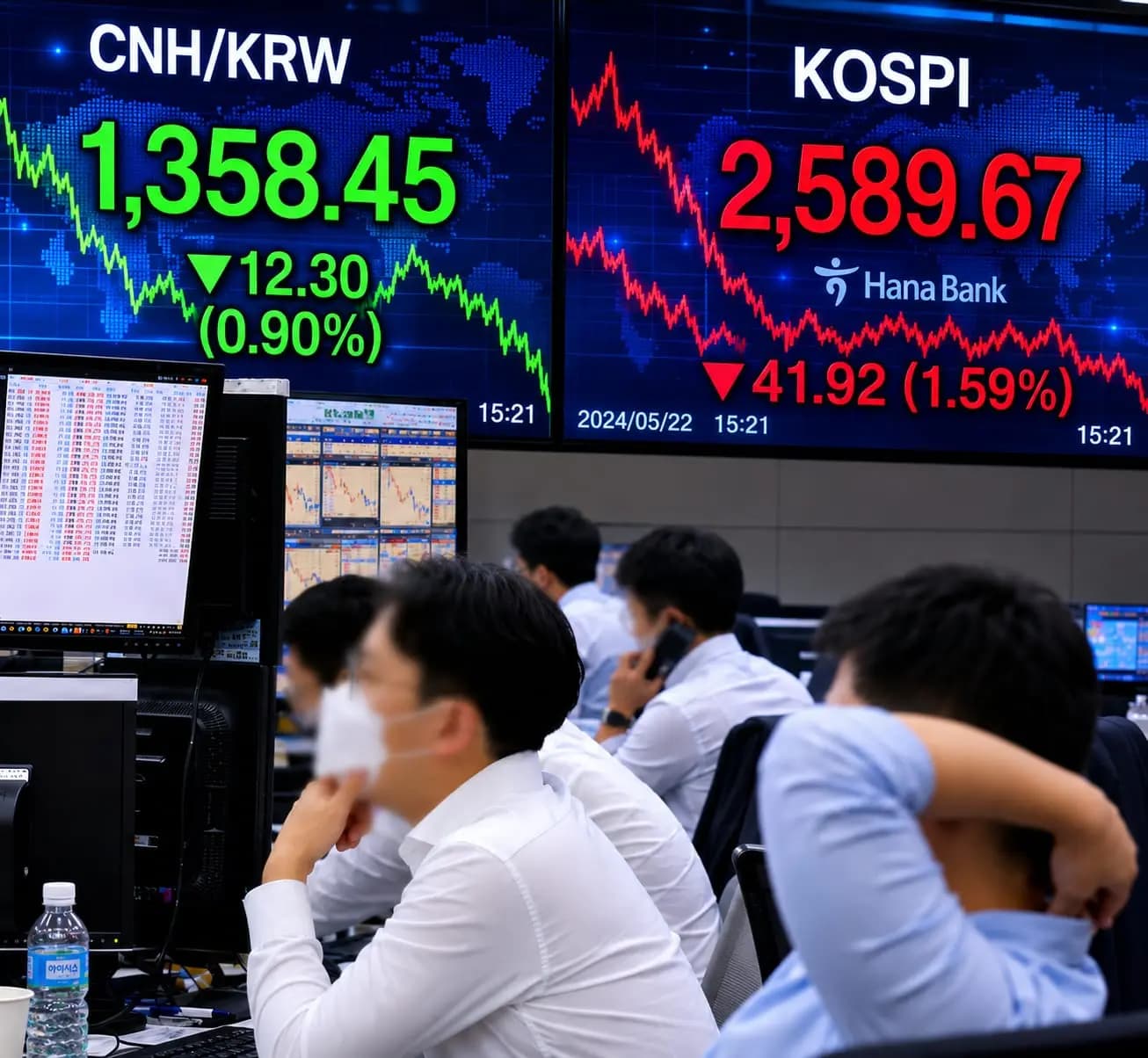
Because these two companies are so large relative to everyone else, their fortunes are the market's fortunes. When SK Hynix and Samsung Electronics tumbled more than 12% in a single session this June, they dragged the rest of South Korea's stock market down with them.
"Over the last six sessions, the KOSPI is up 12.15%. Yet breadth was negative each day, and not by a little bit. That is what happens when a few of the largest names make up about half of an index."
— Jonathan Krinsky, Chief Market Technician, BTIG
The Engine Behind the Boom: An AI-Driven Chip Supercycle
None of this would matter much if the underlying business were weak. It isn't. The world is in the middle of an enormous boom in artificial intelligence, and AI systems need huge quantities of memory chips to run. South Korea happens to make more of those chips than almost anywhere else, which is the single biggest reason the KOSPI has surged roughly 100% so far this year, making it one of the best-performing major stock markets anywhere in the world.
Wall Street has taken notice. Goldman Sachs strategists have called Korea their highest-conviction market in the region, forecasting that 2026 earnings growth for Korean companies could be the strongest seen in any Asian market since the recovery from the 1999 Asian financial crisis — driven by what they describe as a once-in-a-generation memory chip supercycle.
Why It Matters: The Scoreboard
1. Detail Point: Memory chips, not general optimism, are doing almost all the work — Samsung's newest AI memory chip alone crossed $1 billion in sales within four months of launch.
2. Detail Point: The rally is narrow: foreign investors have been heavy net sellers on down days, meaning the same money that rushes in during good weeks can rush out just as fast.
3. Detail Point: A single bad session can trigger an automatic 20-minute trading halt — a built-in circuit breaker the exchange has had to use more than once this year.
Why It Also Crashes: Fragile Booms and Fast Money
A market this concentrated cuts both ways. The same two giants that power the rally can just as easily sink it. In one dramatic session this June, nerves about whether AI-linked stocks had become too expensive spiralled into panic selling — the KOSPI tumbled 10% in a single day, tripping a circuit breaker that forced a 20-minute cooling-off pause in trading, with SK Hynix and Samsung Electronics both sliding more than 12%.
Foreign investors add to this whiplash. Large funds based outside Korea hold substantial stakes in Korean shares, and they tend to move quickly — pouring money in when confidence is high, and pulling it out fast the moment global worries flare up. That fast in-and-out movement is a major reason the swings feel so sharp.
Myth vs. Reality
1 (A) MYTH: A 10% one-day crash means the Korean economy is in trouble.
1 (B) REALITY: Recent sharp falls have mostly reflected swings in sentiment around two chip stocks, not a change in Korea's broader economic fundamentals — the index bounced back within a day or two each time.
2 (A) MYTH: If the KOSPI is up 100% this year, every Korean company must be thriving.
2 (B) REALITY: Market breadth has been negative on most up days — a small handful of chip-linked names are driving the index, even as Korea's wider economy deals with sluggish wage growth and weak job creation.
The Slower Story Underneath: Fixing the "Korea Discount"
Long before the AI boom, Korean companies had a reputation problem. For years, they traded at lower valuations than similar companies elsewhere, even when they were just as profitable — a gap investors nicknamed the "Korea Discount." Much of it traced back to chaebols, the large family-run business groups that dominate Korean industry, where minority shareholders often felt sidelined.
In 2024, Korea's government launched the Corporate Value-Up Program to chip away at that discount — encouraging listed firms to disclose clear plans for improving shareholder returns, treat all shareholders more fairly, and pay out more in dividends.
Inside the Movement: A Short Timeline
1. Early 2024 — Financial Services Commission launches the Corporate Value-Up Program to tackle the “Korea Discount.”
2. September 2024 — Korea Exchange launches the Korea Value-Up Index, tracking companies with strong shareholder-friendly practices.
3. July 2025 — Commercial Act amended so directors must act in the interests of all shareholders, not just the company or its controlling family.
4. December 2025 — National Assembly cuts dividend income tax from 45% to 14–30%, to encourage companies to pay out more.
5. February 2026 — Tax rules tightened further, tying dividend tax benefits to companies actually disclosing a Value-Up plan.
6. June 2026 — KOSPI crosses 9,000 for the first time, even as single-day swings of 5–10% become a regular feature of trading.
The Last Word
Strip away the record highs, the circuit breakers and the breathless headlines, and the KOSPI story in 2026 is really two stories layered on top of each other. The fast one is about two chip companies riding the biggest technology wave of the decade, swinging the whole market with them in both directions.
The slow one is about a government quietly trying to convince the world that Korean companies are worth trusting with their money for the long haul. The chip story will keep making the dramatic headlines. But it is the slower story — fairer treatment of shareholders, real legal accountability for boards — that will decide whether today's gains are a moment, or the beginning of something that lasts.
The Cosminnox • Reporting compiled from Trading Economics, Bloomberg, CNN Business, Goldman Sachs Research, AllianceBernstein, and Janus Henderson Investors public market commentary.