The constitutional starting point
In Sakal Papers (1962), the Court struck down restrictions affecting newspaper pages and pricing. In Bennett Coleman (1972), it examined how newsprint controls could constrain circulation and editorial choice. These cases are best understood as safeguards against disproportionate interference with publication and circulation, not as a categorical exemption of the press from generally applicable law.
A timeline of eight significant decisions
Year | Case | Principal issue |
1962 | Sakal Papers | Newspaper circulation and page-price restrictions |
1972 | Bennett Coleman | Newsprint policy and editorial/circulation freedom |
2021 | Election Commission v. M.R. Vijaya Bhaskar | Reporting of open-court observations |
2021 | Pegasus / Manohar Lal Sharma | Surveillance, privacy and chilling effects |
2023 | Madhyamam Broadcasting (MediaOne) | Broadcast security clearance and procedural fairness |
2024 | Bloomberg v. Zee | Exceptional nature of ex parte pre-trial takedowns |
2025 | Wikimedia v. ANI | Disproportionate court-directed removal |
2026 | Abhishek Upadhyay v. State of U.P. | Disproportionate collection of social-account data |
Figure 1. Selected judgments over time; the number of plotted cases is editorial selection, not a measure of annual press-freedom litigation.
Four recurring pressure points
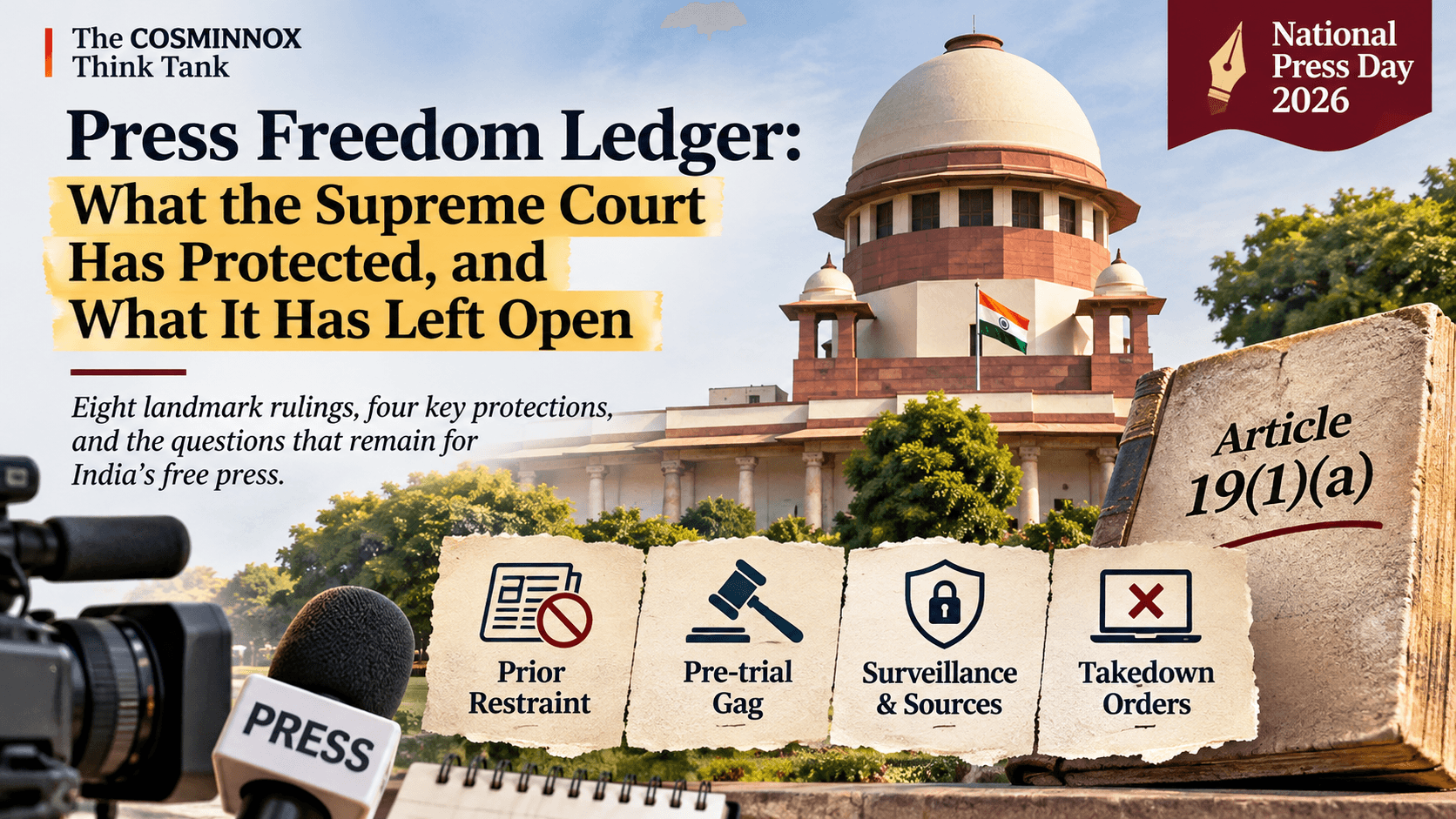
1 | Restricting publication and circulation
Sakal Papers and Bennett Coleman demonstrate that measures presented as economic regulation can interfere with editorial freedom. The legal question is not merely what a regulation is called, but what it does to the ability to publish and circulate news. [1–3]
2 | Silencing reporting before a full hearing
In Bloomberg v. Zee (22 March 2024), the Court set aside an ex parte interim direction to remove a news report and stressed the exceptional character of pre-trial injunctions against publication. The Court discussed the risk of strategic lawsuits against public participation (SLAPPs). It did not declare that defamation claims or all injunctions are impermissible. [4]
3 | Monitoring journalists and exposing digital footprints
The Pegasus proceedings recognised the chilling effect that allegations of surveillance can have on speech and journalism. More concretely, on 14 October 2026, the Court quashed a Ghaziabad Police notice to X seeking journalist Abhishek Upadhyay’s login, IP, location and device data across a period largely preceding an alleged road-rage incident. It required attention to privacy, proportionality and less intrusive investigative alternatives. This was a case-specific order, not a blanket immunity from lawful investigation. [5–6]
4 | Court-directed takedowns and public scrutiny
In Wikimedia Foundation v. ANI Media (9 May 2025), the Supreme Court set aside directions concerning removal of a Wikipedia page. Its reasoning reinforced the importance of necessity and proportionality when courts consider restricting public discussion of pending proceedings. The ruling does not make defamatory content or contempt immune from judicial scrutiny. [7]
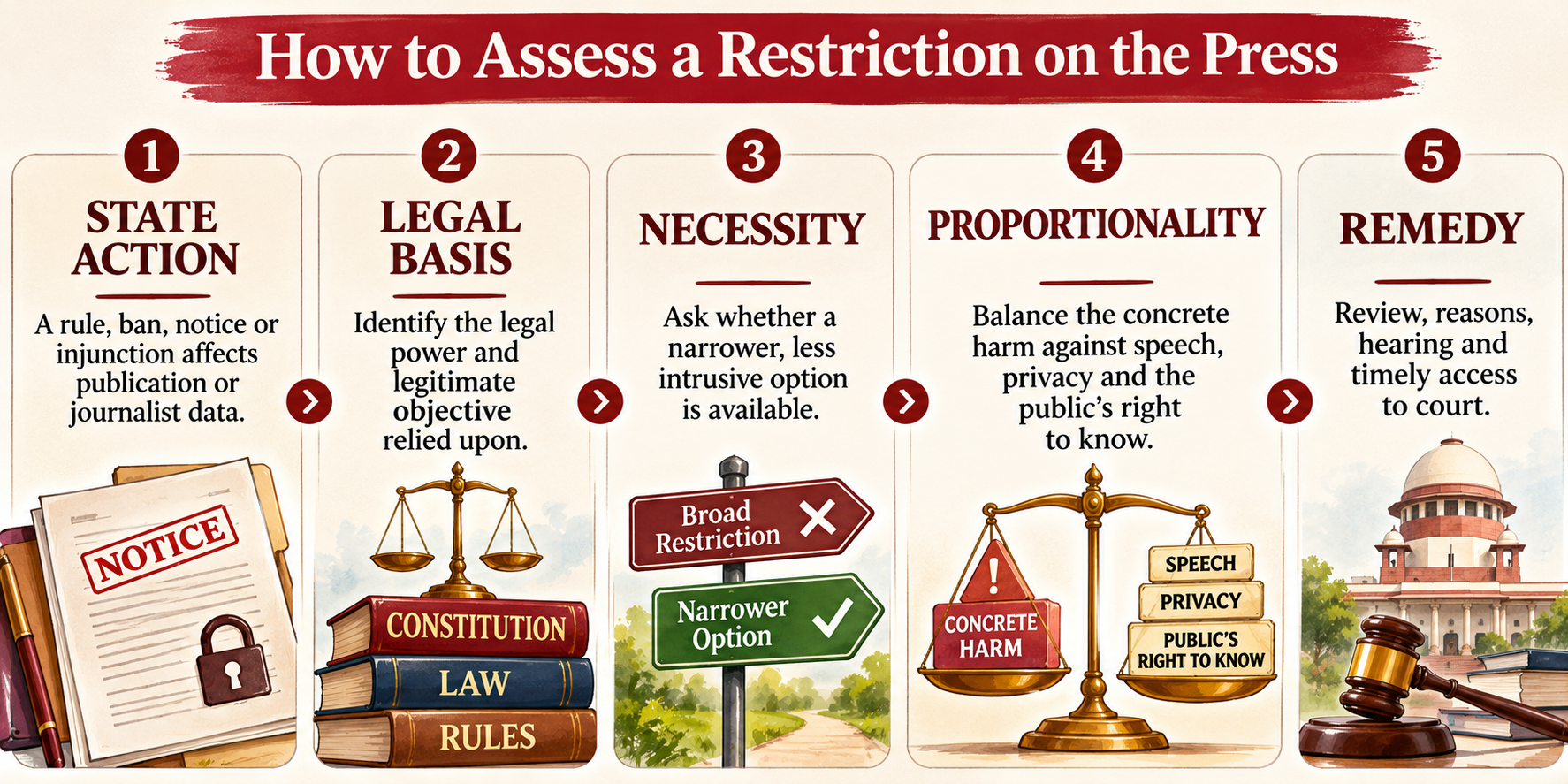
Illustration | How to assess a restriction
The 2026 digital-data ruling: a closer look
The police notice dated 22 August 2026 sought information from X covering 1 June to 22 August, including login and logout IP records, device identifiers and location-related information. The FIR concerned an alleged incident on 18 August. In its 14 October order, the Supreme Court noted the mismatch between the police explanation that the data was needed to locate the journalist and the breadth and timing of the request. The Court quashed the notice, prohibited use of information collected under it, continued protection against arrest until further orders and left the journalist free to challenge the FIR before the High Court. It expressly did not decide the truth of the FIR allegations. [5]
What these rulings do not settle
A constitutional principle is not identical to an affordable, prompt remedy. The cases do not quantify how many reporters are threatened with litigation, how often police demand account data, or how consistently lower courts apply these standards. Nor do they establish a universal journalist-source privilege. The strongest defensible conclusion is narrower: judges have repeatedly imposed constitutional limits on distinct kinds of interference, while the day-to-day reach of those limits requires separate empirical investigation.
The COSMINNOX verdict
India’s press-freedom jurisprudence is not an empty promise, but neither is it a complete shield. The Supreme Court has defended the conditions that make journalism possible: circulation, reporting, editorial independence, freedom from disproportionate surveillance and meaningful judicial scrutiny before speech is suppressed. The next test is institutional rather than rhetorical: can a local reporter obtain the same protection quickly, predictably and without ruinous cost? That question deserves the next ledger.
Source verification and editorial notes
[1] Sakal Papers (P) Ltd. v. Union of India, AIR 1962 SC 305; [1962] 3 SCR 842. Citation and central holding corroborated by Supreme Court discussion in Anuradha Bhasin (2020).
[2] Bennett Coleman & Co. v. Union of India, (1972) 2 SCC 788 / AIR 1973 SC 106. Note corrected spelling: Bennett, not Bennet.
[3] Supreme Court, Anuradha Bhasin v. Union of India, 10 Jan 2020, discussion of Sakal Papers and Bennett Coleman: https://api.sci.gov.in/pdfdate/index1.php?dno=288172019&dt=2020-01-10&filename=supremecourt%2F2019%2F28817%2F28817_2019_2_1501_19350_Judgement_10-Jan-2020.pdf
[4] Supreme Court, Bloomberg Television Production Services India Pvt Ltd v. Zee Entertainment Enterprises Ltd, 22 Mar 2024, Civil Appeal 4602/2024: https://api.sci.gov.in/supremecourt/2024/12343/12343_2024_1_19_51717_Judgement_22-Mar-2024.pdf
[5] Supreme Court record of proceedings, Abhishek Upadhyay v. State of Uttar Pradesh, W.P.(Crl.) 339/2026, 14 Oct 2026: https://indiankanoon.org/doc/151224361/
[6] PTI/ThePrint, 14 Oct 2026, corroboration of Upadhyay order: https://theprint.in/india/sc-makes-absolute-order-protecting-journalist-from-coercive-action-by-up-police/3071489/
[7] Supreme Court, Wikimedia Foundation Inc. v. ANI Media Pvt Ltd, 9 May 2025, Civil Appeal 5391/2025; judgment identified in supplied manuscript, but full text not independently retrieved in this verification pass.
[8] Election Commission of India v. M.R. Vijaya Bhaskar (2021); Manohar Lal Sharma v. Union of India (Pegasus, 2021); Madhyamam Broadcasting Ltd v. Union of India (2023): summaries retained from supplied manuscript; primary judgments should be independently checked before final legal sign-off.
Verification standard: Primary text directly checked for Bloomberg and Upadhyay; Supreme Court cross-reference checked for foundational cases. Wikimedia, MediaOne, Pegasus and Vijaya Bhaskar require primary-text sign-off before external publication. No statistical press-freedom claims have been inferred from the eight-case selection.