I. The Priority Postpaid launch
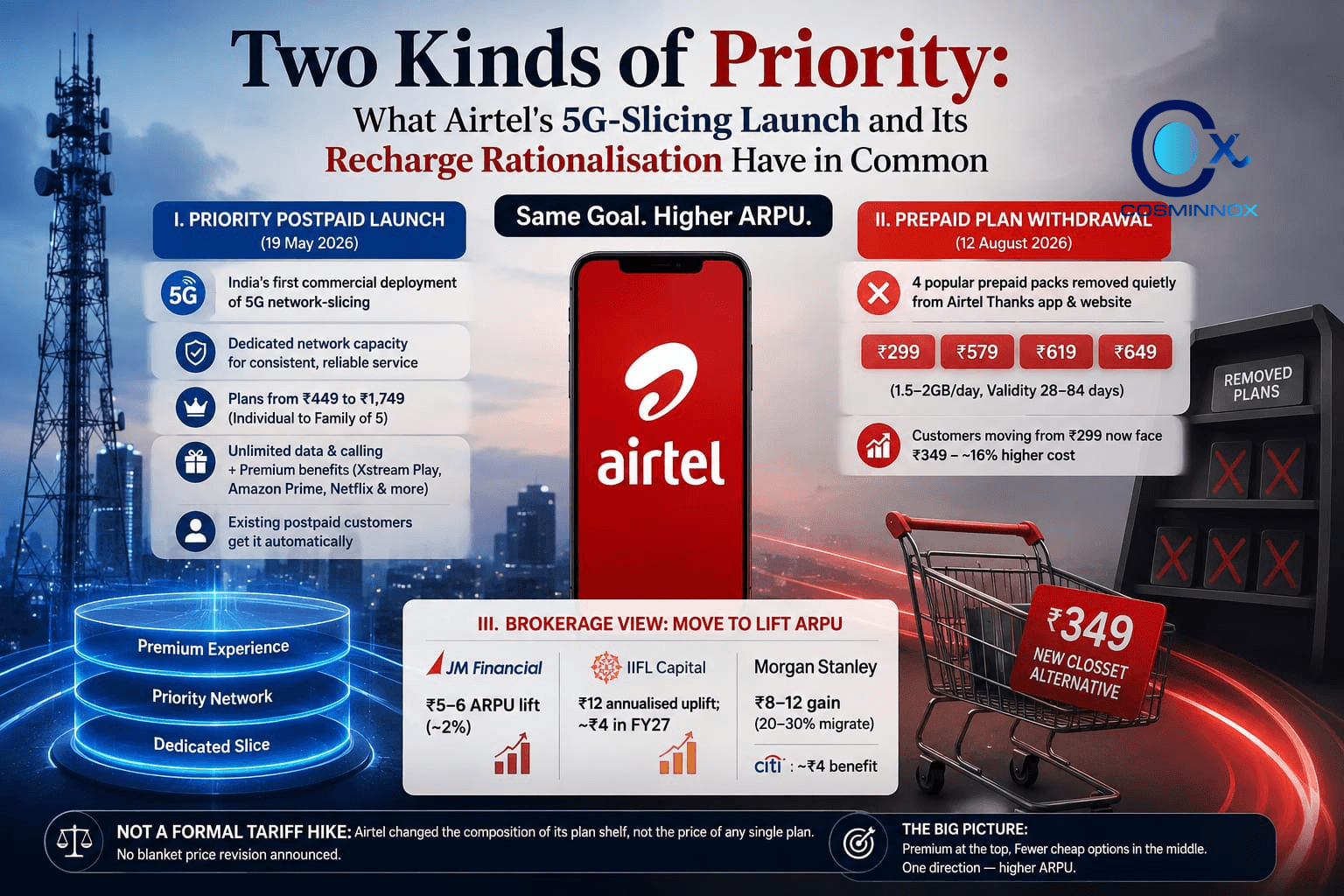
On 19 May 2026, Airtel announced Priority Postpaid, which uses 5G network-slicing technology to reserve dedicated network capacity for postpaid customers, aiming to deliver more consistent service during periods of high traffic demand [Airtel press release, 19 May 2026]. The company describes this as India's first commercial deployment of slicing-based 5G, following earlier launches in the US, Singapore, the UK and Malaysia [Airtel press release, 19 May 2026]. Plans start at Rs 449 plus GST for an individual line and rise to Rs 1,749 for a family plan of five, with entitlements including unlimited data and calling, fraud-detection tools, and bundled subscriptions to services such as Xstream Play, Amazon Prime and Netflix depending on tier [Airtel press release, 19 May 2026]. Existing postpaid customers received the benefit automatically; prepaid users can switch through the Airtel app or a retail store [Airtel press release, 19 May 2026].
II. The prepaid plan withdrawal
On 12 August 2026, Airtel removed four prepaid packs — priced at Rs 299, Rs 579, Rs 619 and Rs 649 — from the Airtel Thanks app and its website, without a formal press announcement [BusinessToday, 12 August 2026]. The plans had offered daily data allowances of 1.5–2GB across validities of 28 to 84 days [AndroidPure, 12 August 2026]. Airtel's entry-level Rs 199 and Rs 219 plans were left unchanged, but customers who previously recharged at Rs 299 now face the Rs 349 plan as the closest equivalent — a roughly 16 percent increase for that segment [Business Standard, 16 August 2026].
III. What the brokerages read into it
Equity analysts have treated the withdrawal as a deliberate, if indirect, monetisation move rather than routine portfolio housekeeping. JM Financial estimated the change could lift ARPU by Rs 5–6, or about 2 percent, assuming roughly one-tenth of subscribers migrate to costlier plans [Business Standard, 16 August 2026]. IIFL Capital projected an annualised ARPU uplift near Rs 12, though it expects only about Rs 4 of that to show up in FY27 results, since it treats the move as an early instalment of a broader tariff hike it already expected around December 2026 [Business Standard, 16 August 2026]. Morgan Stanley modelled a Rs 8–12 gross ARPU gain if 20–30 percent of sub-Rs 349 subscribers shift upward, while Citi estimated a more modest Rs 4 benefit [Newskarnataka, 16 August 2026].
Counter-evidence: not a formal tariff hike
Several analysts were explicit that this episode differs from Airtel's past across-the-board tariff hikes, such as the 13–21 percent increase it implemented in July 2024 [Business Standard, 1 July 2024]. This time, no blanket price revision was announced; Airtel changed the composition of its plan shelf rather than the price of any single plan, and it has not issued a public statement explaining the withdrawals [AndroidPure, 12 August 2026]. Business Today separately cautioned that broader tariff-hike speculation circulating in the market should not be treated as confirmed unless telecom operators officially announce such changes [BusinessToday, 12 August 2026].
What this does and doesn't establish
The record supports a narrower claim than "Airtel raised prices": within a single fiscal year, Airtel added a premium, capacity-guaranteed tier at the top of its portfolio while narrowing affordable options in the middle, and independent brokerages read both moves as consistent with an ARPU-focused strategy, even while declining to call the prepaid change a tariff hike outright. Whether this represents a preview of a larger, formally announced tariff revision — as IIFL suggests — or a one-off rationalisation, is not yet resolved by the available evidence, and depends on decisions Airtel, Reliance Jio and Vodafone Idea have not yet made public.