What the Court actually decided
On July 29, 2026, a Bench of Justices P.S. Narasimha and Alok Aradhe dismissed an appeal filed by Otis Elevator Co. (India) Ltd. against a 2014 order of the National Consumer Disputes Redressal Commission (NCDRC), and simultaneously allowed a connected appeal filed by the deceased's family directing the NCDRC to proceed with execution of the award [LiveLaw, "Supreme Court Holds OTIS Liable For RAW Officer's Death Due To Lift Malfunction," July 30, 2026; Bar & Bench, "Elevator manufacturers, operators and building owners jointly liable for user safety," July 30, 2026].
The underlying facts, as recorded across multiple court reports: on March 20, 2003, a lift at the Research and Analysis Wing (RAW) office complex on Lodhi Road, New Delhi, stopped between the sixth and seventh floors while carrying 13 occupants. During the rescue, the lift moved again, fatally injuring RAW officer Vipin Handa; the other occupants were rescued safely [Bar & Bench, July 30, 2026]. The NCDRC found that Otis — which had both manufactured and, under a comprehensive maintenance contract with the Military Engineering Service (MES), maintained the lift — had known for roughly eight months about a voltage-fluctuation defect and had recommended a stabiliser that was never installed [LiveLaw, July 30, 2026].
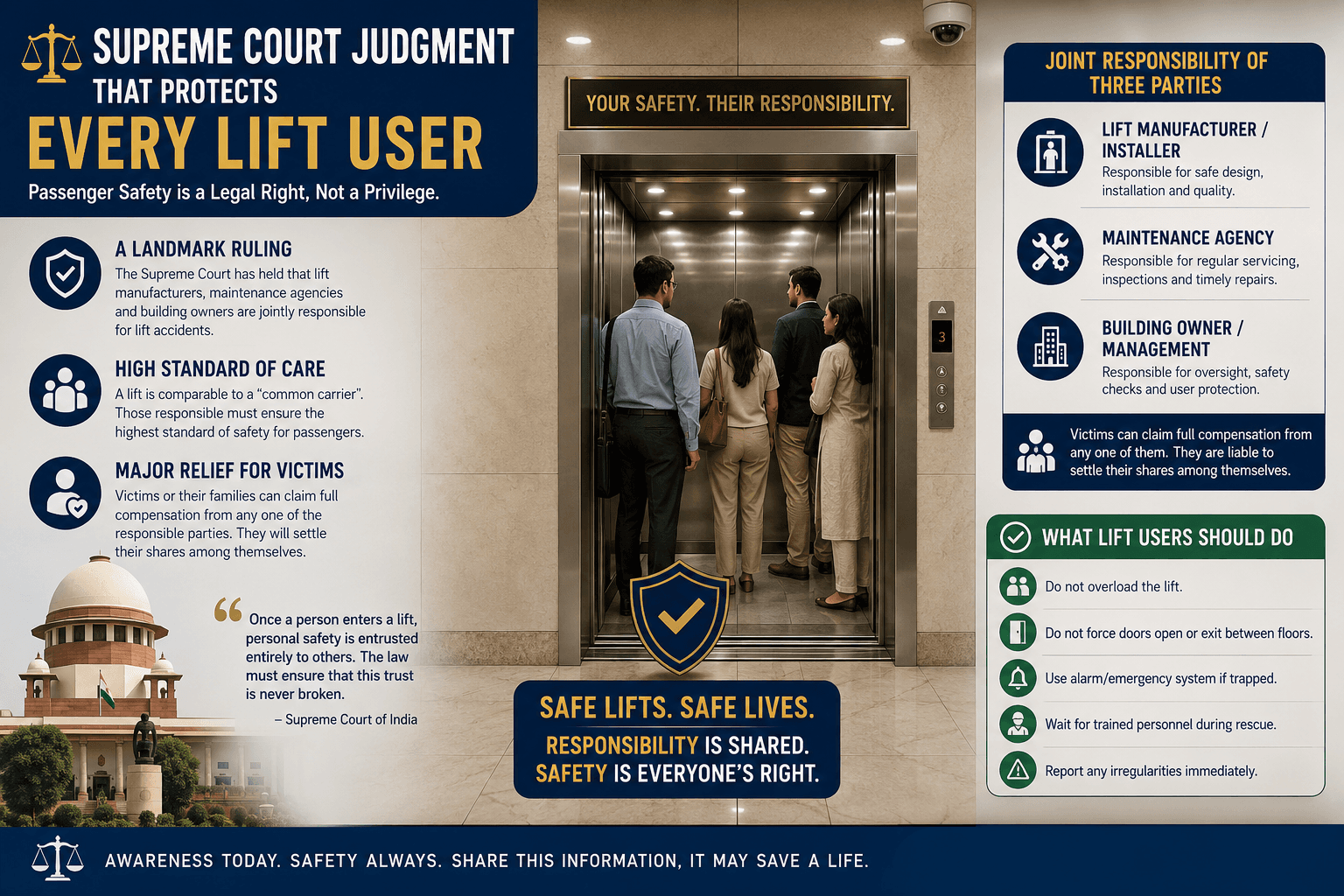
The NCDRC's 2014 order, which the Supreme Court has now upheld in full, apportioned liability as:
Otis (manufacturer and maintenance contractor): 70%
Military Engineering Service (maintenance oversight): 25%
RAW (building occupant/user department): 5%
Compensation of ₹3.01 crore (₹3,01,48,195) was affirmed, with interest at 9% per annum from the date of the accident, rising to 12% if unpaid within 90 days [Law Trend, "Elevators Are Common Carriers Requiring Heightened Duty Of Care," July 30, 2026; News9live, "Supreme Court sets major lift safety rule after RAW officer death," July 30, 2026].
The genuinely new legal element: "common carrier" status
What the Supreme Court added in 2026 — and what the NCDRC's 2014 order did not need to say — is an explicit doctrinal label. The Court held that an elevator must be treated as a common carrier, reasoning that passengers surrender complete control over their safety to the system and are therefore owed the same heightened duty of care historically applied to public transport [India Legal, "Supreme Court: Elevators are common carriers," July 30, 2026]. The Bench further held that a party undertaking comprehensive maintenance of a lift owes a heightened duty of care to users, and that awareness of a defect without follow-through on a proposed remedy amounts to deficiency of service [LiveLaw, July 30, 2026].
The Court also addressed a procedural question with practical weight for future claimants: it held that the burden of identifying which party bears how much liability should not fall on a grieving family seeking compensation — consumer forums may award compensation first and let the liable parties settle apportionment between themselves afterward [Bar & Bench, July 30, 2026].
Counter-evidence: what this ruling does not newly establish
A think-tank reading of this judgment has to separate the headline from the holding.
The 70/25/5 apportionment is not new. It was fixed by the NCDRC in 2014. The Supreme Court's role across twelve years of appeal was to affirm that division, not to create it [Law Trend, July 30, 2026].
Joint and several liability across manufacturer, maintenance agency, and premises owner is not a novel consumer-law concept. The NCDRC applied it in the original 2014 order under the Consumer Protection framework; the Supreme Court's 2026 ruling reinforces rather than originates this principle.
The ruling arises from a consumer-forum dispute, not a fresh tort statute. Its reasoning on "common carrier" status and burden-shifting is now binding precedent for future consumer-forum claims involving lift accidents, but the case does not itself create a new lift-safety statute; existing State Lift Acts, Rules, and municipal safety codes remain the operative regulatory framework that RWAs and building owners must comply with [India.com, "Who takes the blame when a lift falls?," July 30, 2026].
Otis's defence was rejected on its specific facts, not dismissed in principle. The Court's reasoning turned on the fact that Otis itself had identified the defect and proposed a fix that was never implemented — a fact-specific finding of deficiency of service, not a blanket rule that maintenance contractors are always liable regardless of circumstances [LiveLaw, July 30, 2026].
What this means, in bounded terms, for buildings and RWAs
The judgment does not change who is required to maintain a lift. It sharpens the legal consequence of failing to act on a known, documented defect — regardless of which of the three parties (manufacturer, maintenance agency, or building owner/occupant) sits closest to the failure. For Resident Welfare Associations, commercial building managers, hospitals, and hotels, the practical takeaways that follow directly from the Court's reasoning are:
Documented complaints about unusual sounds, jerks, or door malfunction now carry evidentiary weight in establishing "awareness of defect" — the standard the Court applied to Otis.
A maintenance contract with a third party does not, by itself, transfer legal exposure away from the building owner or occupant; the NCDRC and Supreme Court both held RAW (the occupant) partly liable despite Otis holding the maintenance contract.
Consumer forums can now award compensation without requiring the family to first prove the internal split of blame between manufacturer, maintenance agency, and owner — which removes a procedural hurdle claimants previously faced.
What the evidence does and doesn't establish
The Supreme Court's July 2026 ruling establishes, as binding precedent, that elevators are common carriers owing passengers a heightened duty of care, and that consumer forums may award lift-accident compensation without requiring claimants to pre-determine the internal apportionment of fault. It affirms, rather than originates, the specific 70/25/5 liability split and the ₹3.01 crore award, both of which date to the NCDRC's 2014 order. It does not, on its own, create new statutory lift-safety obligations — those continue to sit with existing State Lift Acts and municipal codes — and its "deficiency of service" finding against Otis was anchored in that company's own documented knowledge of the defect, not a categorical rule about maintenance contractors in general.
Correction protocol: if any figure in this piece is updated following further reporting or a published version of the judgment, a dated correction note will be added here rather than a silent edit.